Legiones Astartes – Dawnbreaker Cohort

Even within a Legion whose skills in the arts of orbital strike and shock assault are legendary, the Dawnbreaker cohorts stand apart. Chosen from amongst the most experienced and daring of the Legion’s assault squads, the Dawnbreakers are trained and equipped to act as the tip of the Blood Angels’ spear. Lacking the versatility of standard tactical or assault units, the Dawnbreakers have one purpose in battle: to sunder the enemy’s lines and tear the heart from its formation. Armed with lances and blades wreathed in keen-edged power fields, there are few warriors who can stand in the face of such an onslaught.
| LD | CL | WP | IN | |||||||||||
| M | WS | BS | S | T | W | I | A | LD | CL | WP | IN | SAV | INV | |
| Dawnbreaker Champion (⌀32mm) | 8 | 8 | 7 | 7 | ||||||||||
| Dawnbreaker Champion (⌀32mm) | 12 | 5 | 4 | 4 | 4 | 2 | 4 | 3 | 8 | 8 | 7 | 7 | 2+ | - |
| Dawnbreaker (⌀32mm) | 8 | 8 | 7 | 7 | ||||||||||
| Dawnbreaker (⌀32mm) | 12 | 5 | 4 | 4 | 4 | 2 | 4 | 3 | 8 | 8 | 7 | 7 | 2+ | - |
- Falling-star power spear
- Grenade discharger
- [Allegiance]
- Blood Angels
- Set the Sky Aflame
- Bulky (2)
- Deep Strike
- Dawnbreaker Champion: Infantry (Sergeant, Antigrav)
- Dawnbreaker: Infantry (Antigrav)
- The Dawnbreaker Champion in this Unit may have its Falling-star power spear exchanged for one Perdition weapon for +5 Points.
- Every Model in this Unit may have melta bombs selected for them for +25 Points per Unit.
- Any Model in this Unit may have its falling-star power spear exchanged for one pair of equinox blades for Free.
Falling-star power spear
As much works of art as they are weapons, these ornate spears have been redesigned to enhance the aggressive fighting style of the Dawnbreakers and to serve as icons of the Blood Angels’ prowess and noble intent.
| Melee Weapon | |||||||
Melee Weapon | IM | AM | SM | AP | D | Special Rules | Traits |
| Falling-star power spear | |||||||
| Falling-star power spear | +1 | A | S | 3 | 1 | Impact (SM), Breaching (5+) | Power |
Grenade discharger
These compact grenade launchers are intended to saturate the Dawnbreakers’ landing zones with shrapnel.
| Ranged Weapon | |||||||
Ranged Weapon | R | FP | RS | AP | D | Special Rules | Traits |
| Grenade discharger | |||||||
| Grenade discharger | |||||||
| - Frag | |||||||
| - Frag | 12 | 1 | 4 | 6 | 1 | Blast (3") | Assault |
| - Krak | |||||||
| - Krak | 12 | 1 | 6 | 4 | 1 | - | Assault |
Pair of equinox blades
| Melee Weapon | |||||||
Melee Weapon | IM | AM | SM | AP | D | Special Rules | Traits |
| Pair of equinox blades | |||||||
| Pair of equinox blades | I | +1 | S | 3 | 1 | Breaching (6+) | Power |
Set the Sky Aflame
The Dawnbreakers are trained to make their arrival upon the field of battle a spectacle that will bring terror to the enemy and embolden their allies. Few can forget the sight of these angelic warriors descending from on-high.
A Unit with this Special Rule cannot be intercepted by distant enemy Units when they arrive on the Battlefield.When a Unit with at least one Model with this Special Rule is deployed via Deep Strike and is the target of a Shooting Attack made as part of the Intercept Advanced Reaction, no enemy Models over 12" away from any Model in the Unit that was deployed via Deep Strike may make Shooting Attacks as part of that Intercept Advanced Reaction.
In order to make a Shooting Attack for a Unit that has been selected during the Attack Sub-Phase, as part of a Reaction or for any other Rule or Sub-Phase that requires a Shooting Attack to be made, the following procedure must be followed:
As part of the Rules for conducting a Shooting Attack, the term ‘Attacking Unit’ will be used to refer to the Unit whose Models will be making attacks as part of that Shooting Attack, while the term ‘Attacking Player’ will be used to identify the Player that controls the Attacking Unit. The term ‘Target Unit’ will be used to refer to the Unit that is selected as the Target Unit for the Shooting Attack.
For example, a Legionary selected from the Imperial Fists Faction and selected as part of a Loyalist Army would have the Loyalist and Imperial Fists Traits. On their own these Traits have no effect on the Model’s Characteristics, Points cost or other features, but Rules that target Imperial Fists or Loyalist Models will apply their effects to the Model.
In addition to Models, Weapons can also have Traits. These are usually different to those possessed by Models, but are used for the same purposes. Weapons will commonly have Traits that define the type of Weapon it is or a specific type of usage. For example, a bolt pistol has the following Traits: Assault, Bolt. These identify which ‘family’ of Weapons it belongs to for any Rules that might only affect ‘Bolt’ Weapons and notes that it can be used for attacks where only ‘Assault’ Weapons may be used.
While they appear similar to Characteristics, it is important to note that Traits never have a ‘value’ attached to them. Furthermore, Traits cannot be modified in any way by another Special Rule or effect during a Battle, unless a Rule specifically states it affects a Trait.
Some weapons trade precision for indiscriminate destruction, high explosive impacts that can devastate a wide area. From artillery shells to high energy blasts, such weapons are popular tools of destruction on the battlefields of the Horus Heresy.
Attacks made with the Blast (X) Special Rule use a Blast Marker to determine how many Hits are caused.When making attacks with a Weapon that has the Blast (X) Special Rule, before any Hit Tests are made, a Blast Marker must first be placed to determine how many Hits may be inflicted by the attack. The Player making the attack must place the Blast Marker indicated in brackets as part of the Special Rule so that the hole in the middle is entirely over the Base of any one Model in the Target Unit. Once the Blast Marker has been placed, the Player making the attack must make a Hit Test for the attack, and each Model from the Target Unit that is fully or partially under the Blast Marker will suffer 1 Hit if the Hit Test is successful.
If any Models from Units other than the Target Unit are fully or partially covered by the Blast Marker, then a new Fire Group must be created for those Hits and set to one side. Continue resolving the Shooting Attack on the original Target Unit, and once that Shooting Attack has been completely resolved begin a new Shooting Attack to resolve those additional Fire Groups generated for Units other than the original Target Unit.
If the Hit Test is unsuccessful then no Hits are inflicted and the Player making the attack must make a Scatter Roll for the Blast Marker. Once a Scatter Roll has been made for the Blast Marker and it has been moved, one Hit is inflicted on a Unit for each Model from that Unit that is wholly or partially covered by the Blast Marker.
Hits can be scored on both friendly and enemy Units by attacks using the Blast (X) Special Rule. Hits inflicted by Weapons with the Blast (X) Special Rule are allocated in the same manner as other Hits, regardless of which actual Models were under the Blast Marker and the Blast Marker may not be used to inflict Hits on specific Models.
If a Fire Group includes multiple attacks made with the Blast (X) Special Rule, do not place multiple Blast Markers. A single Blast Marker is placed using the Rules detailed above, and a Hit Test is made for each attack in that Fire Group. For each successful Hit Test, one Hit is inflicted for each Model from the target Unit that is fully or partially under the Blast Marker. If any Hit Tests are unsuccessful then, after any Hits made by successful Hit Tests are counted, a single Scatter Roll is made for the Blast Marker, regardless of the total number of unsuccessful Hit Tests. For each Hit Test that was unsuccessful, one Hit is inflicted on a Unit for each Model from that Unit that is wholly or partially covered by the Blast Marker after the Scatter Roll has been resolved.
Designed to pierce the armour worn by heavy infantry, some weapons have gained a fearsome reputation on the battlefields of the Horus Heresy. While many such weapons are rare or temperamental in use, the sheer power of their attacks more than makes up for this.
With a Weapon that has the Breaching (X) Special Rule there is a chance that a Wound Test may result in the Wound ignoring Armour Saves.When any Wound Test is made for an attack with the Breaching (X) Special Rule, if the result of the Dice roll, before any modifiers are applied, is equal to or greater than the value of X attached to this variant of the Breaching (X) Special Rule, then if a wound is inflicted by that Wound Test, that wound becomes a ‘Breaching Wound’.
A Breaching Wound is always treated as having an AP Characteristic of 2 regardless of the Characteristics of the Weapon used to make the attack.
On the battlefields of the Horus Heresy, precision proves far more valuable than wanton carnage, allowing attacks to be placed on the most valuable targets and not the chaff of the enemy army. Whether through well-honed skill or artfully crafted weapons, warriors capable of such feats are highly sought after in any host.
Attacks made with the Precision (X) Special Rule are allocated by the Attacking Player, not the Defender.When any Hit Test is made for an attack with the Precision (X) Special Rule, if the result of the Dice roll, before any modifiers are applied, is equal to or greater than the value of X attached to this variant of the Precision (X) Special Rule, then if a Hit is inflicted by that roll, that Hit becomes a ‘Precision Hit’.
These Precision Hits must form a separate Fire Group or Strike Group. Wound Tests are made as normal for Precision Hits and cause Precision wounds. In Step 8 of the Shooting Attack process or Step 7 of the Initiative Step sequence, when selecting a Target Model for a Fire Group or Strike Group that is made up of Precision wounds, the Target Model is not selected using the normal Rules. Instead the attacking Player chooses which Model in the Target Unit will be the Target Model, and may select any Model that is a part of that Unit.
Note that Models Engaged in a Challenge cannot use this Special Rule to allocate Hits to any Model other than the enemy Model that is Engaged in the same Challenge and that any attacks which are made as Snap Shots, or for Weapons or attacks that have either the Blast (X), Barrage (X), Template or Reaping Blow (X) Special Rules, may never trigger the Precision (X) Special Rule no matter what the result of the Hit Test is.
Some warriors are trained or equipped to make the most of the force of a charge. When they slam into enemy ranks, it is with the force of a thunderbolt.
On a successful Charge, a Model with the Impact (X) Special Rule temporarily increases a Characteristic by 1.If a Unit that includes any Models with the Impact (X) Special Rule or any Models that have any Weapons with the Impact (X) Special Rule, and that Unit makes a successful Charge, then this Special Rule is triggered. Once triggered, until the end of that Assault Phase, when making Melee Attacks for Models in that Unit, each Model or Weapon that is selected for one of those Models, that has a variant of this Special Rule gains a modifier of +1 to any Characteristics that is the value of X.
Heavy beams and armour-piercing cannon rarely inflict superficial damage, but always blast and break the hull of their target. Such weapons are superior tank killers, their sheer power prized over lesser weapons when the objective is to apply maximum damage without concern for finesse.
A Weapon with the Armourbane Special Rule counts Glancing Hits as Penetrating Hits.When making Armour Penetration Tests for an attack with this Special Rule, a result that is equal to, or greater than, the target Armour Value inflicts a Penetrating Hit. A Weapon with this Special Rule can never inflict a Glancing Hit, and any Rule that would force them to do so instead inflicts a Penetrating Hit.
The Blood Angels Trait is used in the following Legiones Astartes datasheets:


The humble sergeant stands as one of the greatest weapons in the arsenals of any army. Skilled in war and in leadership, each sergeant is the beating heart of their unit and the cornerstone upon which victory is built.
The following Rules apply to all Models with the Sergeant Sub-Type:- The Controlling Player of a Unit that includes one or more Models with the Sergeant Sub-Type may use the Characteristics of one of those Models to resolve any Characteristic Check made for that Unit.
Infantry units include all types of foot soldiers. Infantry are fairly slow moving, but can cross almost any terrain and make the best use of cover to avoid enemy fire.
Infantry is the most basic Type, and is applied to most Models in the game. A Model with the Infantry Type uses the Core Rules without modification, gaining neither benefit nor penalty. Models with the Infantry Type may Embark and Disembark upon Models with the Transport Sub-Type.Some weapons are wreathed in flame emitted from small projectors, or burn with otherworldly fire, stirring a primaeval aversion in even the boldest warriors.
A Weapon with this Special Rule causes additional modifiers to a Target’s Leadership Characteristic.If a Melee Attack made for a Weapon or Model with this Special Rule inflicts one or more wounds on a Target Unit, regardless of whether any Damage is inflicted, until the end of the Phase, that Unit is considered to be ‘aflame’. If the Controlling Player of a Unit that is aflame is required to make a Leadership Check during that Phase for a Combat that includes that Unit, the value of X on this Special Rule is applied as an additional negative modifier to the Leadership Characteristic being used for that Check.
Transport vehicles are designed to balance armour and capacity, attempting to mount the most protection without compromising how many warriors they can carry. Yet, some warriors are plated in such imposing armour or even spawned in such an aberrant nature that they occupy far more space than any regular fighter. Such warriors are mighty in both power and stature, but prove more difficult to ferry into battle.
Models with the Bulky (X) Special Rule take up more space on Transport Models.A Model with the Bulky (X) Special Rule does not use up 1 Point of Transport Capacity when it Embarks on a Model with the Transport Sub-Type. Instead it uses up a number of points of Transport Capacity equal to the value of X attached to the variant of the Bulky (X) possessed by that Model.
Deep strike deployments are usually conducted en-masse and at a distance from the enemy, lest the attacking force be destroyed in detail as it lands.
The Deep Strike Special Rule allows a Unit to enter play anywhere on the Battlefield.A Unit that includes only Models with the Deep Strike Special Rule that enters play from Reserves may make a Deep Strike instead of deploying as described in the Reserves Rules. No more than one Unit may attempt a Deep Strike in a given Player Turn. The Unit attempting a Deep Strike may have another Unit without the Deep Strike Special Rule Embarked upon it if the Deep Striking Unit includes Models with the Transport Sub-Type (note that some Missions may allow more Units to attempt a Deep Strike in the same Player Turn. This will be specifically noted in the Mission Special Rules section of that Mission). Note that in Missions where the Reserves Mission Special Rule is not in use, the Deep Strike Special Rule has no effect. Furthermore, Units may not make use of the Deep Strike Special Rule during the first Battle Turn, even if they enter play from Reserves.
To perform a Deep Strike, the Active Player must declare an Eligible Unit that has entered play from Reserves in the Reserves Sub-Phase as the Deep Striking Unit. The Active Player must then select one Model from that Unit and place it anywhere on the Battlefield. This Model must be placed at least 1" away from any enemy Model, Battlefield Edge or piece of Impassable Terrain. Once this first Model has been placed, the remaining Models in the Unit must be placed within Unit Coherency with at least one other Model in the same Unit and within 6" of the first Model placed. No Models may be placed within 1" of an enemy Model, any Battlefield Edge or a piece of Impassable Terrain. Any Models that cannot be placed using these Rules must be Removed as a Casualty immediately. This deployment must take place during the Reserves Sub-Phase, and a Unit that deploys as a Deep Strike may not move in the Move Sub-Phase of the same Player Turn or have a Charge declared for it in the Charge Sub-Phase of the same Player Turn, but may make Shooting Attacks as normal. A Unit that is Embarked on a Model that is deployed as part of a Deep Strike may Disembark during the Move Sub-Phase of the same Player Turn, but may not make any move other than the move made to Disembark and may not have a Charge declared for it in the Charge Sub-Phase of the same Player Turn.
Enemy Units may declare Intercept Reactions against a Unit deployed as part of a Deep Strike, but not Reposition Reactions.
Whether equipped with antigrav repulsors or empowered by some esoteric, psychic art, this unit is able to skim above the ground. While incapable of true flight, this does allow it to avoid any of the hampering effects of the prevailing terrain, gliding over obstacles that would ensnare or entangle more conventional troops.
The following Rules apply to all Models with the Antigrav Sub-Type:- A Unit that includes only Models with the Antigrav Sub-Type may ignore the effects of any and all Terrain it passes over during movement, including passing over Impassable Terrain without penalty or restriction. However, such Units may not begin or end their movement in Impassable Terrain, and if beginning or ending their movement in Dangerous Terrain must take Dangerous Terrain Tests as normal.
- A Unit that includes only Models with the Antigrav Sub-Type may ignore both friendly and enemy Models and Units when moving. However, when moving over a friendly Unit all Models with the Antigrav Sub-Type must end their move at least 1" away from all Models that are not part of the same Unit, or if moving over an enemy Unit, must end their move at least 1" away from any enemy Model.
Trigger: The Reactive Player may declare an Intercept Reaction whenever the Active Player brings a Unit into play from Reserves or Aerial Reserves. The declaration is made as soon as the last Model from the Unit is placed on the Battlefield and has made any moves it is permitted to make when it enters play.
Cost: The Reactive Player must spend 1 point of their Reaction Allotment to declare an Intercept Reaction - this cost paid as soon as the declaration is made.
Target: The Unit entering play from Reserves or Aerial Reserves is always the Target Unit of this Reaction. After declaring this Reaction, the Reactive Player must select one Unit under their control, this Unit must be able to draw a Line of Sight to at least one Model in the Target Unit. The selected Unit is the Reacting Unit.
Process
Once an Intercept Reaction has been declared, the Reactive Player may make a Shooting Attack for the Reacting Unit, targeting only the Target Unit. All attacks made as part of this Shooting Attack must be made as Snap Shots and Models with the Vehicle Type may only attack with Defensive Weapons.
Designed to be carefully attached to a target and blast precise holes in the thickest armour, these cumbersome devices are ill-suited to open war. However, when a vulnerable target can be isolated in battle, there are no better tools for piercing its protection.
Weapons with this Special Rule can only attack Vehicles and immobile Models.A Weapon or attack with this Special Rule may only be selected during Step 2 of any Combat in the Fight Sub-Phase if the Unit making attacks is only Locked in Combat with enemy Units composed of Models with the Vehicle Type and Models with a Movement Characteristic of ‘0’ or ‘-’. If a Unit is Locked in Combat with any enemy Units that include any Models that do not have the Vehicle Type or a Movement Characteristic of ‘0’ or ‘-’ then no Model may use a Weapon or other attack that has this Special Rule.
A Weapon or other attack with this Special Rule may also be used to make attacks targeting a Model with the Building Type or a Terrain Piece that has a Toughness or Armour Characteristic.
The [Allegiance] Trait is used in the following Legiones Astartes datasheets:


This datasheet has Elites Battlefield Role. Full list of Legiones Astartes units sharing same Battlefield Role follows:
Melta bombs
| Melee Weapon | |||||||
Melee Weapon | IM | AM | SM | AP | D | Special Rules | Traits |
| Melta bombs | |||||||
| Melta bombs | -3 | 1 | 9 | 2 | 4 | Armourbane, Detonation | - |
The Blood Angels Trait is used in the following Legiones Astartes datasheets:
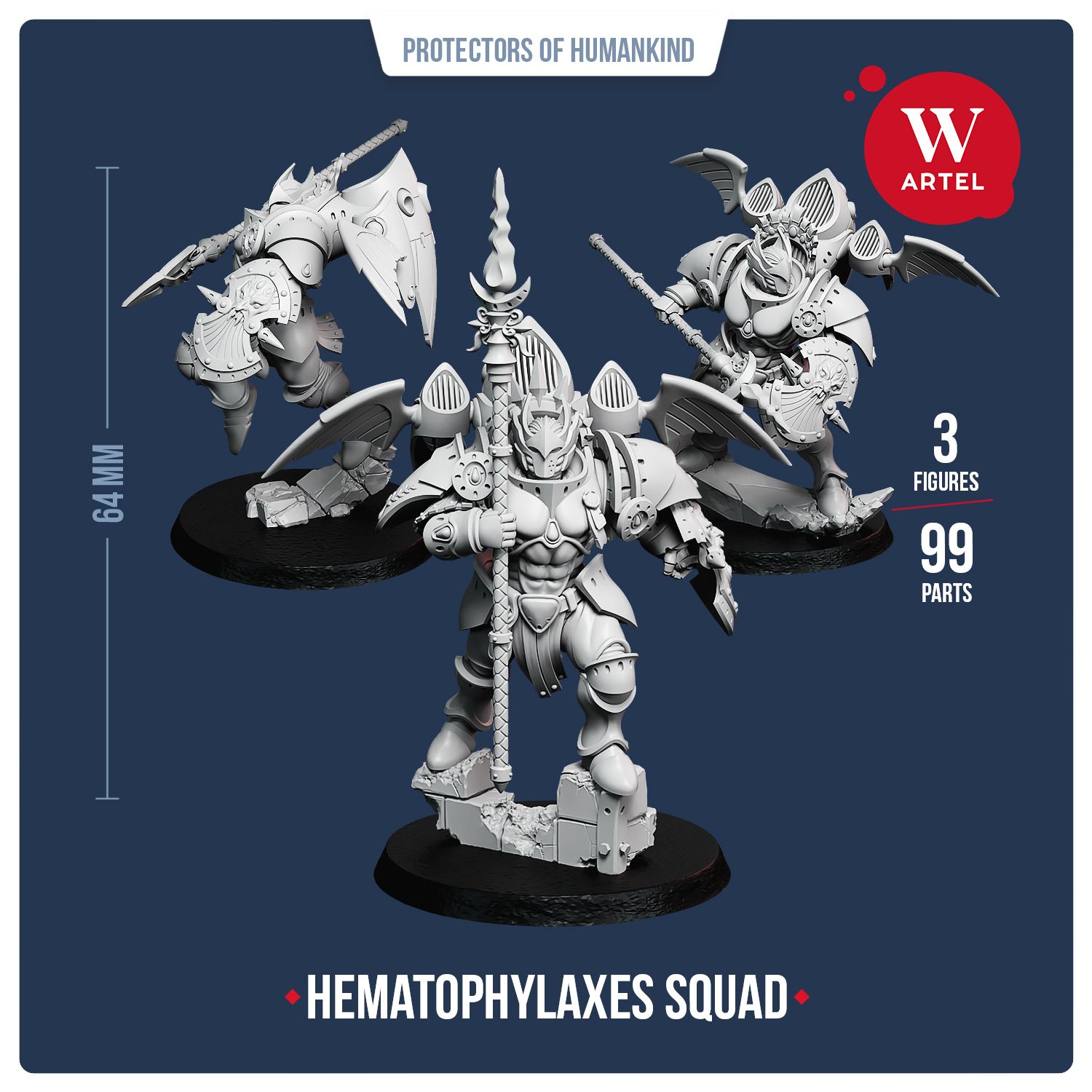
Falling-star power spear
As much works of art as they are weapons, these ornate spears have been redesigned to enhance the aggressive fighting style of the Dawnbreakers and to serve as icons of the Blood Angels’ prowess and noble intent.
| Melee Weapon | |||||||
Melee Weapon | IM | AM | SM | AP | D | Special Rules | Traits |
| Falling-star power spear | |||||||
| Falling-star power spear | +1 | A | S | 3 | 1 | Impact (SM), Breaching (5+) | Power |
Grenade discharger
These compact grenade launchers are intended to saturate the Dawnbreakers’ landing zones with shrapnel.
| Ranged Weapon | |||||||
Ranged Weapon | R | FP | RS | AP | D | Special Rules | Traits |
| Grenade discharger | |||||||
| Grenade discharger | |||||||
| - Frag | |||||||
| - Frag | 12 | 1 | 4 | 6 | 1 | Blast (3") | Assault |
| - Krak | |||||||
| - Krak | 12 | 1 | 6 | 4 | 1 | - | Assault |
The Dawnbreakers are trained to make their arrival upon the field of battle a spectacle that will bring terror to the enemy and embolden their allies. Few can forget the sight of these angelic warriors descending from on-high.
A Unit with this Special Rule cannot be intercepted by distant enemy Units when they arrive on the Battlefield.When a Unit with at least one Model with this Special Rule is deployed via Deep Strike and is the target of a Shooting Attack made as part of the Intercept Advanced Reaction, no enemy Models over 12" away from any Model in the Unit that was deployed via Deep Strike may make Shooting Attacks as part of that Intercept Advanced Reaction.
Though some would later attribute the various ‘Perdition’ weapons to the artifice of Sanguinius himself, these brutal weapons had been in the use of the IXth Legion since long before the Primarch had returned to them. The flame projectors built into these weapons are a legacy of the wars fought during Old Earth’s long darkness, the innovation of some long forgotten warlord brought to its pinnacle by the warriors of the IX"’ Legion.
Any Model with the Command, Champion or Sergeant Sub-Type and the Blood Angels Trait may have its power sword, power axe, power spear or power maul exchanged for one Blade of Perdition, one Axe of Perdition, one Spear of Perdition or one Maul of Perdition for +5 Points per Model.If a Model has a Perdition weapon as part of its Wargear, you can select one of the following for that Model to have:
- Blade of Perdition
- Axe of Perdition
- Maul of Perdition
- Spear of Perdition
| Melee Weapon | |||||||
Melee Weapon | IM | AM | SM | AP | D | Special Rules | Traits |
| Blade of Perdition | |||||||
| Blade of Perdition | I | A | S | 3 | 1 | Breaching (6+), Aflame (1) | Power, Flame |
| Axe of Perdition | |||||||
| Axe of Perdition | -1 | A | +1 | 3 | 1 | Breaching (5+), Aflame (1) | Power, Flame |
| Maul of Perdition | |||||||
| Maul of Perdition | -1 | A | +2 | 3 | 1 | Breaching (6+), Aflame (1) | Power, Flame |
| Spear of Perdition | |||||||
| Spear of Perdition | +1 | A | S | 3 | 1 | Precision (6+), Aflame (1) | Power, Flame |