Questoris Familia
Contents | ||
Books
| Book | Kind | Edition | Version | Last update |
 Liber Questoris Liber Questoris | ||||
| Liber Questoris | Rulebook | 3 | 1.1 | October 2025 |
 Legacies of the Age of Darkness Legacies of the Age of Darkness | ||||
| Legacies of the Age of Darkness | Expansion | 3 | 1.1 | October 2025 |
The Questoris Familia Army List
The Rules found in this book are used in conjunction with the Rules for Armies in the Age of Darkness of the Warhammer: The Horus Heresy - Age of Darkness Rulebook. The Rules in the Age of Darkness Rulebook describe the process of creating an Army, while the additional Rules that follow provide Unit Profiles for Armies of the Questoris Familia.
‘Core’ and ‘Expanded’ Army List Profiles
All Army List Profiles for the Warhammer: The Horus Heresy - Age of Darkness range are divided into two categories: Core Units and Expanded Units. All of the Units in this book are 'Core' Units. These represent the mainstay of the Questoris Familia and are supported by a wide range of miniatures. Expanded Units will have Rules for their use provided in supplementary publications available from the Warhammer Community website, White Dwarf magazine or other places.Both types of Unit may be freely used in any Horus Heresy Battle, and this category does not affect their availability as part of an Army or Detachment or the Rules for their use during a Battle.
As new Units and Models are released, their Army List Profiles will clearly state if those Units are Core or Expanded Units, and future publications may shift the category of a given Unit, with any such changes clearly noted in the Unit's Army List Profile.
The Knights At War: Building A Questoris Familia Army
Every Unit from the Questoris Familia Army List will have an Allegiance, represented by a Trait on its Unit Profile. For Units which are not specific to a particular Allegiance, this will be represented by ‘[Allegiance]’. When you add such a Unit to your Army, this Trait is replaced with either ‘Loyalist’ or ‘Traitor’, based on which Allegiance you have selected for your Army.Some Units within this Army List will have either the Loyalist or Traitor Trait on their Unit Profile. Such Units cannot select which Allegiance they are part of, and can only be selected in an Army with the appropriate Allegiance.
Every Unit from the Questoris Familia Army List will also have a Faction represented by a Trait on its Unit Profile. For Units which are not specific to a Knight Household or other Organisation, this will be represented by ‘[Questoris Familia]’. When you add such a Unit to your Army, you must select one of the following Faction Traits to replace this with (this replaces all instances of the [Questoris Familia] Trait on that Unit Profile while it is part of your Army):
All Units selected as part of an Army which have the [Questoris Familia] Trait must have the same Faction Trait from the above list selected to replace it unless another Rule or Special Rule states otherwise.
Future publications may also provide other options for replacing the [Questoris Familia] Trait on Units. Units which are specific to a certain Knight Household will already have the appropriate Faction Trait, and this may not be replaced.
Additional Reaction Point
If an Army contains a Knight Households Primary Detachment, the Controlling Player gains one additional Reaction Point if that Detachment contains any Units with the Seneschal Household Rank Prime Advantage.Household Paradigms
Each time you select a Faction Trait from the list above, a corresponding Household Paradigm is also automatically selected for the Army, conferring a number of Special Rules and effects onto Models with that Faction Trait.Household Paradigms
When a Faction Trait is selected to replace the [Questoris Familia] Trait for an Army which includes Units selected from the Questoris Familia Army List, a corresponding Household Paradigm is automatically selected, conferring a number of Special Rules and effects onto Models with that Faction Trait. These Household Paradigms are presented below.
Questoris Imperialis: Imperial House
In deference to the value many Knight Households placed upon their own independence, the Imperium was quick to establish a precedence of self-sufficiency where a Household held prominence over a world. Indeed, many Knight Households were loath to sacrifice the traditions their ancestors had bitterly defended before the Imperium had discovered their world. Where the temptation of fealty to a powerful Forge World was of no consequence to a Household, the Imperium instead titled them Questoris Imperialis, requiring oaths of service to the Emperor in return for acknowledgement of their self-rule. Such Households were often among the most powerful and prestigious of their kind, possessing formidable reserves of knight armours and the requisite knowledge to maintain them, and when they went to war en masse, the very earth would quake at their tread.
An Army which contains any Models with the Questoris Imperialis Faction Trait also gains the Imperial House Household Paradigm, and is subject to the following Special Rules:
Baronial Court
A single Yeomanry Mesnie Additional Detachment may be added to an Army with the Imperial House Household Paradigm without requiring a specific corresponding Household Rank Prime Advantage to have been selected for a Unit in that Army. This Additional Detachment is linked to either a Knight Households Primary Detachment or a Lord of War Additional Detachment (chosen by the Player), as long as that Detachment contains at least one Model with the Questoris Imperialis Faction Trait.Additionally, an Army with the Imperial House Household Paradigm is not subject to the 0-1 per Army restriction on the Lord Scion Household Rank Prime Advantage.
When declaring Questoris Vows for an Army with the Imperial House Household Paradigm, the following Questoris Vow may be declared in addition to the Vows listed here.
Vow of Dominion
Proud and haughty, scions who swear the Vow of Dominion pledge to represent the might of their Household upon the battlefield, striking down their foe with such force that the supremacy of the Questoris Fam ilia is made plain for all to see.
The first time in a Battle each Model with this Questoris Vow scores Victory Points due to the Vanguard (X) Special Rule, the number of Victory Points gained by the Controlling Player is increased by 2.The Controlling Player of any Units that include only Models with the Questoris Imperial is Faction Trait can spend Reaction Points to make the following Advanced Reaction:
Rallying Cry
The Households of the Questoris Imperialis are the most practised at going to war en masse, knowing well the ebb and flow of battle, where the bravery of even stalwart scions might falter. Many are the tales of a single Imperial knight sounding its warhorns in a defiant cry, rallying its Banner to crash into the fray once more.
Trigger: Once per Battle, the Reactive Player may declare a Rallying Cry Advanced Reaction in the Victory Sub-Phase of the Active Player’s End Phase, when the Active Player scores 1 or more Victory Points.
Target: For a Rallying Cry Advanced Reaction, the Reacting Unit is any Unit under the Reactive Player’s control which contains only Models with the Knight Sub-Type and the Questoris Imperialis Trait.
Process
Once a Rallying Cry Advanced Reaction has been declared, the Reactive Player may make a single Repair Test for all Models under their control with the Knight Sub-Type.
Questoris Mechanicum: Mechanicum Vassals
Those Households sworn to the service of the Mechanicum are a strange breed, often bearing terrible weapons not seen upon the battlefield since the Dark Age of Technology. Some are even rumoured to have been inducted into the baser mysteries of the Mechanician’s secret arts, their scions studded with esoteric augmetics, or even sealed eternally within the tomb of their knight armour.
An Army which contains any Models with the Questoris Mechanicum Faction Trait also gains the Mechanicum Vassals Household Paradigm, and is subject to the following Special Rules:
Servants of the Machine
A single Automata Talon Additional Detachment may be added to an Army with the Mechanicum Vassals Household Paradigm without requiring a specific corresponding Household Rank Prime Advantage to have been selected for a Unit in that Army. This Additional Detachment is linked to either a Knight Households Primary Detachment or a Lord of War Additional Detachment (chosen by the Player), as long as that Detachment contains at least one Model with the Questoris Mechanicum Faction Trait.Additionally, an Army with the Mechanicum Vassals Household Paradigm is not subject to the 0-1 per Army restriction on the Preceptor Household Rank Prime Advantage.
When declaring Questoris Vows for an Army with the Mechanicum Vassals Household Paradigm, the following Questoris Vow may be declared in addition to the Vows listed here.
Vow of Obeisance
The knights of the Questoris Mechanicum are oft directed to swear the Vow of Obeisance, oathed to assist the menial tactical objectives ofTaghmata hosts rather than indulge their honour.
The first time in a Battle a friendly Unit with at least one Model within 12" of a Model with this Questoris Vow scores an Objective, the value of that Objective is modified by +2 for the duration of the Victory Sub-Phase of that End Phase.The Controlling Player of any Units that include only Models with the Questoris Mechanicum Faction Trait can spend Reaction Points to make the following Advanced Reaction:
Rad Purge
Scions of the Questoris Mechanicum are drilled in tactics that would often be deemed below the prideful scions of the Imperial Houses, harnessing their armours’ reactors as baleful weapons with which to slaughter lesser foes.
Trigger: The Reactive Player may declare the Rad Purge Advanced Reaction at the end of Step 5 of the Fight Sub-Phase of any Combat which includes at least one Unit under the Reactive Player’s control which contains only Models with the Knight Sub-Type and the Questoris Mechanicum Trait.
Target: The Reacting Unit is always a Unit under the Reactive Player’s control which contains only Models with the Knight Sub-Type and the Questoris Mechanicum Trait and which is in a Combat.
Process
- Once this Advanced Reaction is declared, each enemy Unit with one or more Models in Base Contact with at least one Model from the Reacting Unit suffers a number of automatic Hits equal to the number of Models from that Unit which are Engaged with at least one Model from the Reacting Unit. Each such Hit has a Strength of 2, an AP of 5 and a Damage of 1, as well as the Phage (T) and Poisoned (2+) Special Rules.
- Once these Hits have been resolved and any Casualties inflicted by them have been removed, the Combat Round ends. Note that any Casualties inflicted by this Advanced Reaction should be taken into account in the following Resolution Sub-Phase for the purposes of scoring Combat Resolution Points.
Questoris Mendicant: Freeblade Company
Drawn out from the ranks of their former Households, either willingly due to the lure of adventure or unquenchable lust for battle, or unwillingly as outcast, renegade or last survivor, freeblades are knights mendicant, owing no alliance and no fealty. Of these, many were drawn to the Great Crusade, joining the Questoris Crusade forces and fighting on countless worlds in support of the Emperor’s great work. Many would go on to form illustrious Freeblade Companies, banding together with like-minded scions and forging legends to rival that of their erstwhile Households.
An Army which contains any Models with the Questoris Mendicant Faction Trait also gains the Freeblade Company Household Paradigm, and is subject to the following Special Rules:
Loyal Retainers
A single Armiger Talon Additional Detachment may be added to an Army with the Freeblade Company Household Paradigm without requiring a specific corresponding Household Rank Prime Advantage to have been selected for a Unit in that Army. This Additional Detachment is linked to either a Knight Households Primary Detachment or a Lord of War Additional Detachment (chosen by the Player), as long as that Detachment contains at least one Model with the Questoris Mendicant Faction Trait.Mendicant Knights
Units selected as part of a Lord of War Detachment in an Army with the Freeblade Company Household Paradigm which are selected from the Questoris Familia Army List may each have a single Household Rank Prime Advantage selected for them as if they had been selected to fill a Prime Force Organisation Slot.When declaring Questoris Vows for an Army with the Freeblade Company Household Paradigm, the following Questoris Vow may be declared in addition to the Vows listed here. Unlike other Questoris Vows, the Vow of Belligerence may be declared for a single Model with the Knight Sub-Type in an Army which does not make use of the Knight Households Primary Detachment, but otherwise obeys all the standard Rules for declaring Questoris Vows.
Vow of Belligerence
Shorn from their Houses, freeblade knights hunger to acquire a fame and prowess which rivals their one-time peers, the Vow of Belligerence swearing them - often rashly - to be the first warrior to break the foe’s lines.
If a Model with this Questoris Vow is part of the first Combat in a Battle for which the Controlling Player is declared the winner, the Controlling Player gains 2 Victory Points.The Controlling Player of any Units that include only Models with the Questoris Mendicant Faction Trait can spend Reaction Points to make the following Advanced Reaction:
Valorous End
As eager to form a valorous legend with their deaths as they are with their lives, it is not unknown for freeblade scions whose armours are on the brink of ruin to willingly detonate their own reactors in the hope of clawing a worthy foe into the grave with them.
Trigger: The Reactive Player may declare a Valorous End Advanced Reaction in Step 11 of a Shooting Attack or Step 10 of an Initiative Step in the Active Player’s Turn when a Model under the Reactive Player’s control with the Knight Sub-Type and the Questoris Mendicant Trait would be Removed as a Casualty after losing its last Hull Point.
Target: For a Valorous End Advanced Reaction, the Reacting Model is always the Model with the Knight Sub-Type and the Questoris Mendicant Trait under the Reactive Player’s control which has lost its last Hull Point and would be Removed as a Casualty.
Process
- The Reactive Player immediately resolves any version of the Explodes (X) Special Rule which the Reacting Model has, but automatically rolls a 6 on the Dice rolled as part of the Special Rule.
- After the Explodes (X) Special Rule has been resolved, the Reacting Model is immediately Removed as a Casualty.
The Knight Households Primary Detachment
In Step 3 of the Crusade Army Selection Rules process, if the Questoris Familia Army List is selected as the Army List for an Army’s Primary Detachment, the Crusade Primary Detachment in the Crusade Force Organisation Chart is replaced with the Knight Households Primary Detachment. Apart from the Force Organisation Slots it contains, this Detachment is treated as if it was a Crusade Primary Detachment for the purposes of the Army Selection process, and the Army’s Faction is determined by the Faction Trait of any Units selected to fill Force Organisation Slots in the Knight Households Primary Detachment (of which there must be at least one).
Additionally, Units selected to fill Prime Slots in the Knight Households Primary Detachment may only have Household Rank Prime Advantages selected for them, and no other Prime Advantages.
[PRIMARY DETACHMENT]
Knight Households Additional Detachments
In addition to the Detachments presented in the Age of Darkness Rulebook, armies which make use of the Questoris Familia Army List have access to a number of further Additional Detachments.Unlike other Detachments, these Additional Detachments may be added to an Army when certain Household Rank Prime Advantages are selected for Units used to fill a Force Organisation Slot in an Army, and are linked to whichever Detachment these Prime Slot Units were selected for (typically the Knight Households Primary Detachment). Unless otherwise specified, these Additional Detachments must use the Questoris Familia Army List and the Faction selected for the Detachment to which they are linked, but some may specify different Army Lists may be used to fill any Force Organisation Slots they contain.
Armiger Talon
Automata Talon
- Elites Slots in this Detachment may only be used to select Domitar Battle Maniple Units, Support Slots in this Detachment may only be used to select Castellax Battle Maniple Units, Recon Slots in this Detachment may only be used to select Vorax Attack Maniple Units, and Fast Attack Slots in this Detachment may only be used to select Vultarax Stratos Squadron Units, each selected from Liber Mechanicum. Models selected as part of this Detachment replace their Cybernetica Trait with the [Questoris Familia] Faction Trait.
Support Banner
- Units selected to fill Prime Slots in this Detachment may only have Household Rank Prime Advantages selected for them, and no other Prime Advantages.
Yeomanry Mesnie
- Units selected to fill Slots in this Detachment must be selected from the Solar Auxilia Army List found in Liber Auxilia or the Imperials Militia Army List (in any combination). Models selected as part of this Detachment replace their Solar Auxilia or Imperialis Militia Trait with the [Questoris Familia] Faction Trait.
Household Rank Prime Advantages
Each noble, referred to heraldically as a ‘scion,’ within a Knight Household is a warrior with their own chronicle of battle and the traditions and glories of their forebears to uphold. A Household’s bloodline ranges from the scions aspirant, freshly raised up to pilot their armour in battle and wreathed in dreams of would-be glory, through the scions martial, the experienced fighters who make up their Household’s line of battle, to the upper echelons of the Household who hold the traditional ranks of the Household’s command and who have already writ their own legends in battle. In times of open war, when a Knight Household takes to the field en masse, each will have their own roles to play, roles founded as much in ancient tradition as in the individual record and reputation of the knight armour and the warrior piloting it. Unleashed, such a tide of iron and fire is a force few powers in the galaxy can withstand.
Household Rank Prime Advantages are a list of Prime Advantages which may only be selected for Units entirely composed of Models with the Knight Sub-Type, but otherwise obey all the standard Rules and limitations of Prime Advantages. Note that some Household Rank Prime Advantages will specify that they can only be selected for a limited number of Prime Slot Units in an Army.Aucteller (0-1 per Army)
Though on many Knight Worlds affairs of honour were settled through highly ritualised duels, when pressed, massed battle was inevitable. In such warfare the aucteller was oathsworn to strike down the foe’s greatest warriors at the cost of their own life. During the Great Crusade such tactics were suppressed, but as the wars of the Horus Heresy unfolded, the need for such sacrifices was born again.
All Models in a Unit selected to fill a Prime Slot with this Household Rank Prime Advantage gain the Precision (5+) Special Rule on any Melee Weapons they have. Any Model in a Unit selected to fill a Prime Slot with this Household Rank Prime Advantage may not have any Questoris Vow declared for it other than the Vow of Execution.Lord Scion (0-1 per Army)
The term lord scion is used as a collective term that encompasses the upper echelons of a Questoris knight Crusade force, afforded a dizzying array of titles depending on Household culture and sub-variations in peerage and rank, and ordered below the supreme authority of a seneschal on the battlefield. They are each a war-tempered veteran, resistant to the debilitating feedback of a damaged knight’s Throne Mechanicum and holding authority over the rank and file scions of their House. In turn they are granted command of the myriad non-knight forces a Household might muster, collectively denoted ‘yeomanry’ in spite of the countless configurations they can occupy.
All Models in a Unit selected to fill a Prime Slot with this Household Rank Prime Advantage may have two Repair Tests made for them by the Active Player in each of their Statuses Sub-Phases, rather than just one.Preceptor (0-1 per Army)
It is unusual, but not unknown, for a scion to display a particular facility’for technology, sometimes even serving time observing and learning from their Household’s sacristans, earning themselves the honoured title of Preceptor. The Preceptor’s lore can be put to use on the battlefield, allowing them to interface with advanced auto-repair systems which would be beyond those without their learning, and also serve as intermediary for any bonded battle-automata their l lousehold might be fortunate enough to call upon.
All Models in a Unit selected to fill a Prime Slot with this Household Rank Prime Advantage gain the Battlesmith (2) Special Rule and count as having an Intelligence Characteristic of 8 when making Intelligence Checks as part of the Battlesmith (X) Special Rule.Scion Arbalester (0-1 per Army)
An arbalester excelled at dealing death and destruction at a distance, utilising their knight’s firepower to its fullest and most devastating effect. While some of their more impetuous or glory-hungry brethren scorned their tactics as unworthy, these skilled gunners took on a vital role in the Household’s battle line, identifying and destroying enemy heavy’ weapons emplacements to screen their comrades’ advance.
When a Model in a Unit selected to fill a Prime Slot with this Household Rank Prime Advantage moves a distance equal to no more than half of its Movement Characteristic in inches in the Movement Phase, it may still benefit from any variant of the Heavy (X) or Ordnance (X) Special Rule on any Weapons it has.Scion Aspirant
The Knight Households are not simply a military force but a hereditary bloodline of war, a bloodline whose offspring must be tempered in the fires of battle from a young age. Such an apprenticeship is a dangerous one, but vital to the sustenance of a Household’s strength across the generations. Rather than taking part in the glorious charges of massed knight banners, scions aspirant are charged with leading the lesser armours of the Armiger Talons into battle, their own pilots vying to become the next scion aspirant to ascend to knighthood.
All Models in a Unit selected to fill a Prime Slot with this Household Rank Prime Advantage gain the Expendable (1) Special Rule and modify the value of X on any version of the Auto-repair (X) Special Rule they have by -1.Scion Dolorous (0-1 per Army)
A title bestowed upon the most famed beast-killers and slayers among a Household’s knights, the epithet ‘Dolorous’, from the ancient tongue encoded into the great arks which bore the knights to their founding worlds, means ‘grievous’ or ‘mournful’ in its true form. It also implies one perhaps to whom battle and slaughter have become an addiction to the exclusion of all else, and for whom life beyond the confines of their knight armour is a pale and hollow thing, and mortal danger their only wine and meat.
All Models in a Unit selected to fill a Prime Slot with this Household Rank Prime Advantage gain the Fear (2) Special Rule. Any Model in a Unit selected to fill a Prime Slot with this Household Rank Prime Advantage may not have any Questoris Vow declared for it other than the Vow of Slaying.Scion Implacable (0-1 per Army)
An epithet applied to a Household knight who had shown a particular aptitude for siege warfare, an ‘Implacable’ was an invaluable warrior in the maelstrom of cityscape warfare. In such situations a knight, despite its power, could become swarmed by enemy infantry. Not so the Implacable, whose caution on the battlefield seemed not to diminish their fervour for crushing infantry like vermin.
All Models in a Unit selected to fill a Prime Slot with this Household Rank Prime Advantage gain the Firestorm Special Rule. Any Model in a Unit selected to fill a Prime Slot with this Household Rank Prime Advantage may not have any Questoris Vow declared for it other than the Vow of Resolve.Scion Martial
The scions of the knights martial, also known in common parlance as the Household’s ‘Banners’, form the main strength of the knights’ battleline; experienced in warfare and expert in the use of the powerful war machines they command.
The Scions Martial represent the meridian of skill and power on which the Unit Profiles in the Questoris Familia Army List are based, and therefore, the Scion Martial Household Rank Prime Advantage does not modify the profile of any Models in a Unit for which it is selected.Scion Uhlan (0-1 per Army)
The Uhlan tradition was one followed by the most hot- blooded and impetuous knights. In war, they sought to destroy their foes in a fury of close-range fire and swift assault. Caution was anathema to them and valour was found only in the close press of battle. The scions Uhlan were used by the wiser Household commanders as advance scouts and reavers, either to form the front skirmish line of the Household in the open field or as flanking forces to encircle a foe and run down an enemy once it had broken.
All Models in a Unit selected to fill a Prime Slot with this Household Rank Prime Advantage gain the Fast (2) and the Impact (A) Special Rules. Any Model in a Unit selected to fill a Prime Slot with this Household Rank Prime Advantage may not have any Questoris Vow declared for it other than the Vow of Alacrity.Seneschal (0-1 per Army)
The martial traditions and aristocratic rule of the Knight Households demanded a rigid hierarchy and at the apex of this order was the seneschal. For a knight to have attained a rank heavy with such symbolic authority and might, they must have proven themselves both in tactical command and the more insidious battlefield of dynastic struggle, alongside the simple, gruelling prerequisite of having endured long enough to reach such heights.
When a Model in a Unit selected to fill a Prime Slot with this Household Rank Prime Advantage is allocated a Penetrating Hit, the Damage of the Penetrating Hit is modified by -1, to a minimum of 1. Additionally, a Unit with this Household Rank Prime Advantage counts as being a High Command Choice for the purposes of any version of the Slay the Warlord (X) Secondary Objective.The Knight Sub-type
The Knight Sub-Type is a Vehicle Sub-Type that adds a number of additional Rules and caveats to the way in which Vehicle Models operate, and this section presents these additional Rules according to the parts of the game they impact.
Knight Models and Bases
A Model with the Knight Sub-Type must have a base (unless otherwise specified), and when measuring for that Model, all distances are measured to and from the base, not the Model’s Hull.Knight Model Characteristics
A Model with the Knight Sub-Type has Weapon Skill, Strength, Initiative and Attacks Characteristics in addition to those Characteristics on a standard Vehicle Model Profile, as well as no Transport Capacity Characteristic (this does mean a Model with the Knight Sub-Type may not also have the Transport Sub-Type). Additionally, a Model with the Knight Sub-Type will only have two Sub-Characteristics for Armour - Front and Rear (see Knight Facings and Arcs) - and any Attacks or Hits that are forced to target the Side Armour of such a Model instead target the Rear Armour.Knights and Rushing
The presence of an Initiative Characteristic on the Profile of a Model with the Knight Sub-Type allows it to Rush in the Movement Phase.Knights and Terrain
A Model with the Knight Sub-Type is not affected in any way by Difficult Terrain or Dangerous Terrain, but may still neither pass through nor end its move in Impassable Terrain.Knights and Other Models
A Model with the Knight Sub-Type ignores both friendly and enemy Models and Units when moving, and never counts as having moved through an enemy Unit. However, when moving over a friendly Unit all Models with the Knight Sub-Type must end their move at least 1" away from all Models that are not part of the same Unit, or if moving over an enemy Unit, must end their move at least 1" away from any enemy Model.Knights and Line of Sight
Models with the Knight Sub-Type do not block Line of Sight unlike other Vehicle Models.Targeting Knights
A Unit entirely composed of Models with the Knight Sub-Type may be selected as the target of a Shooting Attack even if it is part of a Combat.Knight Firing Arcs
A Model with the Knight Sub-Type uses a different chart for determining its Firing Arcs (see Knight Facings and Arcs).Knight Weapon Mounts
Some Weapons available to Models with the Knight Sub-Type may have the following Weapon Mount:- Dorsal (Arc) Mounted – Dorsal Mounted Weapons will always specify one or more Firing Arcs and may attack targets in any of these listed Firing Arcs. However, they may not target any Unit within 8" of the attacking Model.
Attacking Knights in Combat
The presence of a Weapon Skill Characteristic on the Profile of a Model with the Knight Sub-Type means Hit Tests resolved against it in Combat use this value.Knights and Volley Attacks
Any Defensive Weapons a Model with the Knight Sub-Type has are considered to have the Assault Trait.Knights, Charging and Attacks
A Model with the Knight Sub-Type may have Charges declared for it and make Attacks in the Fight Sub-Phase.Knights and Failed Charges
If a Charge roll for a Unit entirely composed of Models with the Knight Sub-Type is failed in Step 5 of the Charge Procedure, the Controlling Player immediately rolls a single Dice, with a Target Number equal to the highest value of X of any instance of the Auto-repair (X) Special Rule on Models in the Charging Unit. If this roll succeeds, there is no further effect, but if the roll fails, all Models in the Charging Unit gain the Stunned Tactical Status.Knights and Combat Resolution
In Step 4 of the Resolution Sub-Phase, the Controlling Player of a Unit that includes any Models with the Knight Sub-Type may choose the Consolidate or Gun Down Aftermath Options for that Unit in addition to the Hold Aftermath Option, though restrictions on when these may be selected still apply.Knight Facings and Arcs
The diagram below shows how a Model with the Knight Sub-Type is divided into its two Armour Facings: Front and Rear. These Armour Facings are determined by drawing an imaginary line along the centre of the Model’s base, from left to right as shown in the diagram below, equally dividing the front and rear halves of the base. On most Models this will involve simply drawing a straight line between the two points where the Model’s base is widest. Models with the Knight Sub-Type also only have two Firing Arcs - Front and Rear - determined in exactly the same way as their Armour Facings.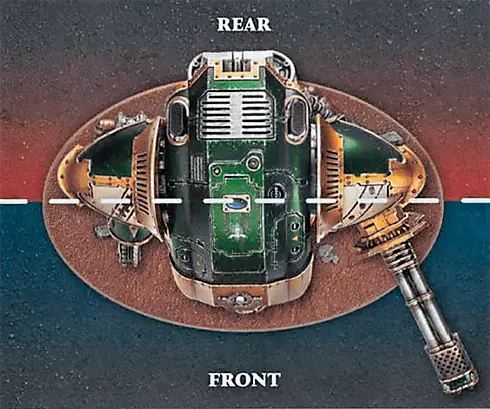
Questoris Vows
Whether sworn in highly ostentatious rituals on the eve of battle, ex-loaded as imperatives onto a knight armour’s systems by a Mechanicum Prelate or whispered as private oaths in the quiet solitude of a knight’s cockpit, the scions of the Knight Households have ever pledged themselves to knightly vows upon the battlefield. A by-product of the chivalric trappings of the Households’ cultures and the individual nature of the knight armours themselves, these Questoris Vows bound knight scions to personal quests upon the battlefield, typically either proffered or approved by a given lord scion to ensure such vows did not interfere with the Household’s objectives as a whole.
At the end of Step 7 of the Core Mission Sequence, the Controlling Player of an Army which makes use of the Knight Households Primary Detachment may declare a number of Questoris Vows for their Army. For each Model in their Army with the Knight Sub-Type which has been deployed upon the Battlefield, the Controlling Player may declare a single Questoris Vow, which should then be noted alongside that Model’s entry on their Army Roster. A Model may only have one Questoris Vow declared for it, and no single Questoris Vow may be declared for more than one Model in an Army. The Questoris Vows which may be declared for a Model with the Knight Sub-Type are listed below, with additional Questoris Vows available in future publications.Vow of Alacrity
A common vow among the more impetuous scions of a Household, those who swear the Vow of Alacrity are pledged to be the first to lay an enemy low.
If, during the Controlling Player’s first Player Turn, an attack made by a Model with this Questoris Vow causes the last Model in an enemy Unit to be Removed as a Casualty, or causes an enemy Unit to Fall Back off the Battlefield, then the amount of Victory Points that would be scored by the Controlling Player for achieving any version of the First Strike (X) Secondary Objective is increased by 2.Vow of Execution
Knights pledged to the Vow of Execution seek out the commanders among a foe’s hosts, striving to shatter their chain of command and break their ranks.
If an attack made by a Model with this Questoris Vow causes the last Model in an enemy Unit selected to fill a High Command Force Organisation Slot to be Removed as a Casualty, the amount of Victory Points that would be scored by the Controlling Player as a result for achieving any version of the Slay the Warlord (X) Secondary Objective is increased by 2.Vow of Resolve
A dark oath, sworn only when the odds of survival for a given host of knights seem grim, the Vow of Resolve is a simple one, pledging a scion to endure no matter what their foe might throw at them.
If a Model with this Questoris Vow remains on the Battlefield at the end of the Battle, then the amount of Victory Points that would be scored by the Controlling Player for achieving any version of the Last Man Standing (X) Secondary Objective is increased by 2.Vow of Slaying
The Vow of Slaying has its origins in the great hunts enacted to track down and fell the megafauna which call many Knight Worlds home, and scions bound to this vow set their sights upon the mightiest combatants - be they flesh or machine - that their foe can muster.
If an attack made by a Model with this Questoris Vow causes the last Model in an enemy Unit selected to fill a Lord of War or Warlord Force Organisation Slot to be Removed as a Casualty, then the amount of Victory Points that would be scored by the Controlling Player as a result for achieving any version of the Giant Killer (X) Secondary Objective is increased by 2.Questoris Familia Advanced Reactions
Joust!
Long is the history of knights doing battle by means of a mutual, headlong charge, and upon the battlefields of the Age of Darkness the most common response to a foe closing to strike at a knight’s compatriots is for a scion to unleash their own punishing charge.
This Reaction allows the Reacting Unit to Charge an enemy Unit that has declared a Charge.Trigger: The Reactive Player may declare the Joust! Advanced Reaction at the end of Step 3 of the Charge process of any Charge declared by the Active Player where the Charging Unit is within 12" of a Unit under the Reactive Player’s control entirely composed of Models with the Knight Sub-Type which is not the target of the Charge.
Cost: The Reactive Player must spend 1 point of their Reaction Allotment to declare the Joust! Advanced Reaction, this cost paid as soon as the declaration is made.
Target: The Target Unit is always the Unit whose Charge triggered the Reaction. The Reacting Unit is always a Unit under the Reactive Player’s control within 12" of at least one Model in the Target Unit entirely composed of Models with the Knight Sub-Type which is not the target of the Charge.
Process
- Once this Reaction is declared, the Reactive Player must make a Charge Roll for the Reacting Unit.
- If the result of the Charge Roll would be enough to move any Model from the Reacting Unit into Base contact with a Model from the Target Unit, then a Charge Move is made and the Units are Locked in Combat. No Model in the Target Unit may claim a bonus for any Special Rule that requires a successful Charge to have been made, while the Models in the Reacting Unit gain any bonuses for any Special Rules that would apply to that Unit as a result of a successful Charge.
- If the result of the Charge Roll would not bring any Model from the Reacting Unit into Base Contact with a Model from the Target Unit, then no Charge Move is made and the Players proceed to Step 4 of the Charge process.
Rotate Ion Shields
Almost unique among the energy field projectors used by the Mechanicum, the directional ion shielding provided by knight armours can be re-oriented in the midst of battle, such that a skilled scion can focus their ion shields to deflect an attack which could fell even a mighty knight, albeit at the cost of leaving their other flanks exposed.
This Reaction allows the Reacting Player to improve the Invulnerable Save of a Knight by +1 against a single Shooting Attack, but modify its Invulnerable Save by -1 against all subsequent Shooting Attacks that Player Turn.Trigger: The Reactive Player may declare a Rotate Ion Shields Advanced Reaction in the Shooting Phase, during Step 3 of the Shooting Attack sequence of any Shooting Attack made by the Active Player that targets a Unit that contains only Models with the Knight Sub-Type.
Cost: The Rotate Ion Shields Reaction has no cost.
Target: The Reacting Unit is always the Unit that was the target of the Shooting Attack that triggered the Reaction.
Process
- All Models in the Reacting Unit immediately improve the Invulnerable Save they benefit from against Shooting Attacks made against their Front Arcs by +1 for the duration of the Shooting Attack which triggered the Reaction.
- The Active Player finishes resolving the original Shooting Attack which triggered the Reaction.
- After the Shooting Attack which triggered the Reaction has been fully resolved, all Models in the Reacting Unit modify all Invulnerable Saves they benefit from against Shooting Attacks made against their Front Arcs by -1 for the rest of the Active Player’s Turn.
Stomp
Immense constructs of steel and ceramite, the sheer weight of a knight armour is sufficient to crush many lesser foes, and many knight scions will simply stomp onrushing infantry underfoot rather than afford them an ‘honourable’ death at the touch of their armour’s weapons.
This Reaction allows the Reactive Player to move a Knight towards an enemy Unit which has moved within 8" and perform a stomp attack.Trigger: The Reactive Player may declare a Stomp Advanced Reaction in Step 2 of the Move Sub-Phase process, if an enemy Unit entirely composed of Models with the Infantry, Cavalry or Automata Types ends a move within 8" and in Line of Sight of a Unit under the Reactive Player’s control which is entirely composed of Models with the Knight Sub-Type.
Cost: The Reactive Player must spend 1 point of their Reaction Allotment to declare a Stomp Advanced Reaction, this cost paid as soon as the declaration is made.
Target: The Target Unit is always the Unit whose Move triggered the Reaction, and must be entirely composed of Models with the Infantry, Cavalry or Automata Types. Once the cost has been paid, the Reactive Player must select one Unit under their control that is within 8" and has Line of Sight to the Target Unit, and which contains only Models with the Knight Sub-Type. That Unit is the Reacting Unit.
Process
- Once a Stomp Reaction has been declared, the Active Player must completely resolve the Target Unit’s movement.
- Once the Target Unit has finished its move, the Reactive Player may move each Model in the Reacting Unit a number of inches up to the Base Value of its Initiative Characteristic, and this move must be made directly towards the Target Unit without ending within 1" of any enemy Model which is not part of the Target Unit.
- Once the Reacting Unit has completed this move, the Reactive Player may place a 3" Blast Marker in Base Contact with a single Model from the Reacting Unit without any Models from outside the Target Unit being fully or partially under the Blast Marker.
- Once this Blast Marker has been placed, the Target Unit suffers a number of automatic Hits equal to the number of Models from the Target Unit partially or fully under the Blast Marker. These Hits are resolved with a Strength equal to the highest Base Hull Points Characteristic of a Model in the Reacting Unit, with an AP of 3 and a Damage of 2.
Special Rules
Aflame (X)
Some weapons are wreathed in flame emitted from small projectors, or burn with otherworldly fire, stirring a primaeval aversion in even the boldest warriors.
A Weapon with this Special Rule causes additional modifiers to a Target’s Leadership Characteristic.If a Melee Attack made for a Weapon or Model with this Special Rule inflicts one or more wounds on a Target Unit, regardless of whether any Damage is inflicted, until the end of the Phase, that Unit is considered to be ‘aflame’. If the Controlling Player of a Unit that is aflame is required to make a Leadership Check during that Phase for a Combat that includes that Unit, the value of X on this Special Rule is applied as an additional negative modifier to the Leadership Characteristic being used for that Check.
Armour-breaker (X)
Some weapons are designed to crack armour and deal massive damage to internal components of armoured fighting vehicles. Few tanks can withstand the firepower of such weapons for long.
Attacks made with the Armour-breaker (X) Special Rule can sometimes inflict an extra point of Damage.When any Armour Penetration Test is made for an attack or Model with the Armour-breaker (X) Special Rule, and it results in a Penetrating Hit - roll a Dice. If the result of that Dice roll is equal to or greater than the value of X attached to this variant of the Armour-breaker (X) Special Rule, then the Damage Characteristic of that Penetrating Hit is increased by 1. Note that the Armour-breaker (X) Special Rule may only be triggered by an Armour Penetration Test and has no effect when making a Wound Test.
Colossus
Acastus knights were among the largest classes of knights in existence, their Thrones Mechanicum pushing human capabilities for machine interface and their massive bulk causing them to operate more akin to the massive constructs of the Titan Legios than their knightly peers.
A Model with the Colossus Special Rule changes elements of the Knight Sub-Type regarding bases, Line of Sight, Firing Arcs and Armour Facings.A Model with both the Knight Sub-Type and the Colossus Special Rule is not required to have a base, and when measuring for that Model, all distances are measured to and from the Model’s Hull. A Model with both the Knight Sub-Type and the Colossus Special Rule does block Line of Sight in the manner of other Vehicles. Additionally, when determining Front and Rear Firing Arcs and Armour Facings for a Model with both the Knight Sub-Type and the Colossus Special Rule, draw an imaginary line along the centre of the Model, from left to right or right to left, equally dividing the front and rear portions of the Model.
Firestorm
Many units within the Legion conduct warfare at pointblank distances, blasting their foes with a deluge of short ranged firepower.
A Model with this Special Rule does not have to make Volley Attacks as Snap Shots.When a Model with this Special Rule makes Volley Attacks, it is not required to fire Snap Shots. In addition, after making Volley Attacks in Step 4 of the Charge Procedure, a Unit containing any Models with this Special Rule is not required to make a Charge Roll in Step 5. If the Controlling Player chooses not to make a Charge Roll in Step 5 of the Charge Procedure then the Charge Procedure ends immediately.
Implacable Advance
The wargear of many Legiones Astartes warriors and war machines incorporates a variety of targeting and stabilisation systems, enabling larger weaponry to be brought to bear even at close ranges.
Models with this Special Rule can make Volley Attacks with other Weapons.The Controlling Player of a Model with this Special Rule treats all Ranged Weapons such a Model has that do not have any variant of the Heavy (X) Special Rule or Ordnance (X) Special Rule as having the Assault Trait.
Independent Fire
Whether by means of advanced targeting cogitators or by merit of numerous crew, each tasked with manning a separate gun, some armoured vehicles are capable of targeting numerous foes simultaneously. The hail of fire such vehicles can project far outweighs the lack of focus in their volleys.
Models with this Special Rule can shoot at multiple targets at full Ballistic Skill.When making multiple Shooting Attacks in the same Shooting Phase, a Model with this Special Rule and the Vehicle Type does not have to make all attacks as Snap Shots.
Melta (X)
The beams of energy generated by melta weaponry dissipate over long ranges. When used at close quarters, however, their effect on armoured vehicles is devastating.
This Special Rule increases the amount of Damage against Vehicles when Shooting Attacks are made within a specific range.If at least one Model in a Unit with the Vehicle Type that is targeted by a Shooting Attack made by a Model using a Weapon with this Special Rule is within a range equal to or less than the value specified by X, that attack has the Armourbane Special Rule and the Damage of Penetrating Hits caused by that attack is doubled.
Overload (X)
Some weapons are almost as dangerous to the wielder as to the foe. Supercharged powerpacks can explode in combat or volatile munitions can jam or even detonate, all of which can prove deadly to those charged with deploying such weapons.
Weapons with this Special Rule may inflict Hits on the Models making Shooting Attacks with them.When the Controlling Player declares that attacks will be made for a Model using a Weapon or profile that has the Overload (X) Special Rule, any Hit Tests made for those attacks that result in a number that is equal to or less than the value of X attached to the variant of the Overload Special Rule that the Weapon had, before any modifiers are applied to the roll, are Misfires.
For Weapons that do not make Hit Tests, such as Weapons with the Template Special Rule, instead roll a number of dice equal to the Firepower Characteristic of the Weapon used to make the attack after the attack has been declared and the number of Models hit is determined. Each Dice that results in a number equal to or less than the value of X attached to the variant of the Overload Special Rule that the Weapon had creates a Misfire. This does not affect the number of Hits on the Target Unit created by this attack.
For each Misfire, the Unit for which the Hit Tests were made suffer a Hit - these Hits must form a new Fire Group or Strike Group, referred to as the ‘Misfire Group’.
Once the current Shooting Attack and any Reactions triggered by it have been fully resolved, the Misfire Group must be resolved. A Misfire Group is resolved in the same way as any other Fire Group or Strike Group, using the Profile of the Weapon used for the Fire Group or Strike Group it was created from. Wounds, Glancing Hits or Penetrating Hits from this Misfire Group are allocated by the Controlling Player, and must be allocated to a Model that made attacks as part of the Fire Group or Strike Group that generated the Misfire Group. If a Hit from a Misfire Group is generated by an attack made by a Model with the Vehicle Type, then it is resolved against the lowest Armour Value from all of the Model’s facings.
Hits, wounds or Casualties inflicted upon a Unit as a result of this Special Rule do not cause Leadership or Cool Checks, and Hits inflicted as part of a Misfire Group do not trigger any Special Rules that take effect as a result of a certain value on a Hit Test.
Rapid Tracking
Some weapons feature augmented motility and enhanced targeting systems, able to track and lock onto fast moving targets with ease.
Weapons with this Special Rule are better able to utilise it for intercepting new arrivals on the Battlefield.Each time a Model makes a Shooting Attack as part of the Intercept Advanced Reaction, its Controlling Player can select a Weapon with this Special Rule for that Shooting Attack, even if it is not a Defensive Weapon.
Wargear
Ion Gauntlet Shield
The ion gauntlet shield generator mounted in the Cerastus’ gauntlet assembly is more concentrated than the ion shield mounted on other knight armours, but lacks its tactical flexibility.
Ion gauntlet shields provide an Invulnerable Save against Melee Attacks.A Model with an ion gauntlet shield has a 5+ Invulnerable Save against Penetrating Hits inflicted with Melee Weapons. Additionally, a Model with an ion gauntlet shield may have Invulnerable Saves made for it against any Glancing Hits it has suffered in Step 10 of an Initiative Step, before any rolls on the Vehicle Damage Chart are made, discarding a single Glancing Hit for each successful save.
Ion Shield
These sophisticated energy screens rely on ion fields to deflect the path of solid projectiles or to diffuse high-energy beams before they strike their target. Highly effective in battle, the main limitation of these devices is the immense energy drain required to keep them functional, and as such only the largest war engines can rely on their protection.
Ion shields provide a different Invulnerable Save against Shooting Attacks made against a Model’s Front and Rear Facings, including against Glancing Hits.A Model with an ion shield has a 5+ Invulnerable Save against Shooting Attacks made against its Front Facing and a 6+ Invulnerable Save against Shooting Attacks made against its Rear Facing. Additionally, a Model with an ion shield may have Invulnerable Saves made for it against any Glancing Hits it has suffered in Step 11 of a Shooting Attack, before any rolls on the Vehicle Damage Chart are made, discarding a single Glancing Hit for each successful save.
Ionic Flare Shield
Ionic flare shields combine the unique technology of the knights’ ion shields with elements from the various flare shield systems of the Mechanicum, resulting in shielding systems with analogous performance and function compared to standard ion shields but with an increased ability’ to counteract the high-energy blasts typical of anti-armour weapons.
Ionic flare shields provide a different Invulnerable Save against Shooting Attacks made against a Model’s Front and Rear Facings, including against Glancing Hits, and nullify the effect of the Armourbane Special Rule on any Shooting Attacks made against the Model.When making Armour Penetration Tests against a Model with an ionic flare shield, no Weapon may make use of the Armourbane Special Rule.
A Model with an ionic flare shield has a 5+ Invulnerable Save against Shooting Attacks made against its Front Facing and a 6+ Invulnerable Save against Shooting Attacks made against its Rear Facing. Additionally, a Model with an ionic flare shield may have Invulnerable Saves made for it against any Glancing Hits it has suffered in Step 11 of a Shooting Attack, before any rolls on the Vehicle Damage Chart are made, discarding a single Glancing Hit for each successful save.
Rad Furnace
Most of the creations of the Mechanicum draw their power from atomantic or fusion reactors, but some few rely instead on so-called rad furnaces. These devices are based on ancient technology that burns far stronger than modern reactors, but floods the area with deadly radiation, rendering them useless for most applications. However, in battle the deleterious effect of radiation on the enemy becomes a benefit rather than a drawback - though it means that only the most extensively augmented magi can accompany such units into battle.
A Model with a rad furnace reduces the enemy’s Toughness while Locked in Combat.Any Model, friendly or enemy, that is part of a Combat that includes one or more Models with a rad furnace must reduce its Toughness Characteristic by 1 while a part of that Combat in the Fight Sub-Phase. This reduction is not cumulative with the effects of the Phage (X) Special Rule. Models with a rad furnace, the Automata Type or the Cybernetica Trait are unaffected and do not reduce their Toughness Characteristic. Additionally, a Unit that is composed of a majority of Models with rad furnaces does not reduce any Characteristics due to the effects of the Phage (X) Special Rule.
Armoury of the Knight Households
The lesser and greater constructs of the Knight Households made use of a range of Weapons and items of Wargear that were often unique or elsewise much more advanced or esoteric variants of widespread patterns of Imperial weaponry. This section presents the Rules for these Weapons and artefacts of the Horus Heresy.
Arc Weapons
These weapons amplify the force of a weapon’s blows or blasts with powerful electrostatic discharges which detonate like thunderclaps when striking their target. These weapons are considered rare and advanced even by the adepts of the Mechanicuni and are rarely seen outside of the ranks of that order, for few others could keep such temperamental weapons operational on the battlefields of the Age of Darkness.
Some of these Weapons have both a Ranged and Melee Profile, see Melee Weapons for those Profiles.| Ranged Weapon | |||||||
Ranged Weapon | R | FP | RS | AP | D | Special Rules | Traits |
| Galvanic caster | |||||||
| Galvanic caster | 24 | 3 | 3 | 6 | 1 | Shred (5+), Rending (5+) | Arc, Assault |
| Arc pistol | |||||||
| Arc pistol | 12 | 2 | 6 | 5 | 1 | Pistol, Suppressive (1), Shock (Suppressed) | Arc, Assault |
| Shock lance (Ranged) | |||||||
| Shock lance | 18 | 6 | 7 | 3 | 1 | Stun (2) | Arc |
Auto Weapons
An ancient form of firearm that propels a solid slug by means of a chemical explosion, both ancient ‘bullets’ of lead or other base metals and more advanced armour-piercing sabot rounds. Such weapons are most often used as anti-armour weapons, delivering volleys of large armour-piercing shells to defeat armour that is proof against the mass reactive fire of the more advanced bolter weaponry. This category of weaponry also plays host to more advanced weapons, like the first generations of assault cannon and magnetic charge accelerator cannon.
| Ranged Weapon | |||||||
Ranged Weapon | R | FP | RS | AP | D | Special Rules | Traits |
| Heavy stubber | |||||||
| Heavy stubber | 36 | 3 | 4 | 6 | 1 | - | Auto |
| Autocannon | |||||||
| Autocannon | 48 | 2 | 7 | 4 | 2 | Breaching (6+), Heavy (FP) | Auto |
| Twin icarus autocannon | |||||||
| Twin icarus autocannon | 48 | 4 | 7 | 4 | 2 | Heavy (FP), Breaching (6+), Skyfire, Rapid Tracking | Auto |
| Phaeton autocannon | |||||||
| Phaeton autocannon | 30 | 3 | 7 | 3 | 2 | Ordnance (R), Breaching (5+) | Auto |
| Rapid-fire battlecannon | |||||||
| Rapid-fire battlecannon | 48 | 1 | 8 | 4 | 2 | Heavy (FP & AP), Blast (3"), Pinning (1) | Auto |
| Avenger gatling cannon | |||||||
| Avenger gatling cannon | 36 | 7 | 6 | 4 | 1 | Ordnance (FP), Breaching (6+), Suppressive (2) | Auto |
Bolt Weapons
A branch of weaponry rare outside the ranks of the Legiones Astartes, bolt weapons are based on a robust Terran design, refined from the weapons used during the Emperor’s battles to conquer Old Earth. These brutally efficient weapons fire a caseless, self- propelled and mass-reactive munition, more akin to a miniature rocket than a simple bullet and easily capable of eviscerating most foes.
| Ranged Weapon | |||||||
Ranged Weapon | R | FP | RS | AP | D | Special Rules | Traits |
| Twin heavy bolter | |||||||
| Twin heavy bolter | 36 | 6 | 5 | 4 | 1 | - | Bolt |
| Twin mauler bolt cannon | |||||||
| Twin mauler bolt cannon | 24 | 6 | 6 | 4 | 1 | Pinning (2), Shred (4+) | Bolt |
| Twin castigator bolt cannon | |||||||
| Twin castigator bolt cannon | 36 | 10 | 6 | 3 | 1 | Ordnance (D), Suppressive (2) | Bolt |
Conversion Beam Weapons
These esoteric energy weapons fire a beam that induces a subatomic implosion in their target, with the beam itself gathering power over distance up to a terminal point of beam instability. Conversion beam weapons are hath difficult to construct and highly complex to use, needing skilled calibration to operate as well as dedicated reactor core systems to power. As a result, they are primarily used for dedicated siege warfare or starship breaching assaults by specialised operators such as Techmarines and Mechanicum Destructors. More rarely, larger conversion beam weapons are mounted on a vehicle chassis with advanced control mechanisms and an abundance of reactor power.
| Ranged Weapon | |||||||
Ranged Weapon | R | FP | RS | AP | D | Special Rules | Traits |
| Moirax conversion beamer | |||||||
| Moirax conversion beamer | |||||||
<15 | 1 | 6 | 4 | 1 | Heavy (RS), Blast (3"), Suppressive (1) | Conversion | |
15-30 | 1 | 7 | 3 | 2 | Heavy (RS), Blast (3"), Suppressive (1) | Conversion | |
>30-45 | 1 | 8 | 2 | 3 | Heavy (RS), Blast (3"), Suppressive (1) | Conversion | |
| Conversion beam desolator array | |||||||
| Conversion beam desolator array | |||||||
<18 | 2 | 8 | 4 | 2 | Ordnance (D), Blast (7") | Conversion | |
18-42 | 2 | 9 | 3 | 3 | Ordnance (D), Blast (7") | Conversion | |
>42-72 | 2 | 10 | 2 | 4 | Ordnance (D), Blast (7") | Conversion | |
Cutting Tools of the Mechanicum
These are powerful industrial tools that make use of a phase field to assist short, continuous releases of high-energy packets. More portable and easily manipulated than common lascutters, phase cutting tools are preferred in industrial processes to cut the composite ceramite and rolled plasteel sheets in which constructs are commonly clad. Upon the mighty knight armours of the Questoris Familia, what are otherwise unwieldy industrial tools become potent weapons of destruction capable of scything through the thickest armour.
These Weapons have both a Ranged and Melee Profile.| Ranged Weapon | |||||||
Ranged Weapon | R | FP | RS | AP | D | Special Rules | Traits |
| Las-impulsor (Ranged) | |||||||
| Las-impulsor | 8 | 1 | 9 | 2 | 4 | Ordnance (D), Armourbane | Las |
| Atrapos phasecutter (Ranged) | |||||||
| Atrapos phasecutter | 12 | 1 | 10 | 2 | 6 | Ordnance (D), Armourbane | Las |
Flame Weapons
Among the most ancient of weapons employed within the ranks of the armies of the Imperium, flame has always been a potent weapon against creatures that lurk in darkness. Many Forge Worlds consider the cleansing power of flame a key part of their arsenal, and indeed, the ability of these weapons to rout the enemy from fortified positions has proven pivotal in any number of battles.
| Ranged Weapon | |||||||
Ranged Weapon | R | FP | RS | AP | D | Special Rules | Traits |
| Heavy flamer | |||||||
| Heavy flamer | Template | 1 | 5 | 4 | 1 | Template, Panic (1) | Flame |
| Acheron infernus cannon | |||||||
| Acheron infernus cannon | Template | 1 | 7 | 4 | 1 | Template (Hellstorm), Heavy (AP), Shred (5+), Panic (2) | Flame |
Graviton Weapons
Little understood even by the Tech-priests of Mars, the term ‘graviton gun’ refers to a group of gravity projector devices whose sophistication is such that the few that now remain are relics of a lost age. Such weapons prove extremely useful when fighting on a starship or in a null gravity environment. The power of the graviton gun’s highest settings is sufficient to rupture organs and crack bones even inside armour, but its primary use is to impede the enemy and damage machinery without the risks of secondary explosions.
| Ranged Weapon | |||||||
Ranged Weapon | R | FP | RS | AP | D | Special Rules | Traits |
| Graviton gun | |||||||
| Graviton gun | 18 | 1 | 6 | 4 | 1 | Blast (3"), Breaching (6+), Shock (Pinned), Pinning (1) | Graviton |
| Graviton pulsar | |||||||
| Graviton pulsar | 24 | 2 | 6 | 3 | 1 | Heavy (D), Blast (3"), Breaching (6+), Shock (Pinned), Pinning (2) | Graviton |
| Graviton singularity cannon | |||||||
| Graviton singularity cannon | 36 | 1 | 9 | 2 | 8 | Blast (5"), Heavy (D), Armourbane, Critical Hit (6+), Overload (1) | Graviton |
Las Weapons
In the Imperium the term ‘las’ is applied to a wide variety of weapons, from crude particle weapons, such as the ubiquitous laspistol, to more complex and deadly weapons such as the neutron laser beam cannon. The defining features that link these disparate weapons are their nature as energy weapons, rather than projectile weapons, and their reliance on rechargeable power packs or portable generators instead of conventional magazines.
| Ranged Weapon | |||||||
Ranged Weapon | R | FP | RS | AP | D | Special Rules | Traits |
| Lascannon | |||||||
| Lascannon | 48 | 1 | 9 | 2 | 1 | Heavy (D), Armourbane | Las |
| Multi-laser | |||||||
| Multi-laser | 36 | 3 | 6 | 6 | 1 | Suppressive (1) | Las |
| Neutron-wave battery | |||||||
| Neutron-wave battery | 120 | 4 | 12 | 2 | 4 | Ordnance (D), Armourbane, Shock (Stunned) | Las |
Lightning Weapons
Lightning guns are aptly-named weapons, taking the form of baroquely designed carbines connected to reactor cores of various sizes. They fire ionising las-beams, down which a powerful phased discharge of electromagnetic force is unleashed. These weapons are equally effective at slaughtering the living and overloading machine targets.
| Ranged Weapon | |||||||
Ranged Weapon | R | FP | RS | AP | D | Special Rules | Traits |
| Lightning lock | |||||||
| Lightning lock | 36 | 1 | 7 | 3 | 2 | Blast (3"), Shred (5+), Breaching (5+), Suppressive (0) | Arc |
| Lightning cannon | |||||||
| Lightning cannon | 36 | 1 | 7 | 3 | 2 | Blast (5"), Shred (5+), Breaching (5+), Suppressive (1) | Arc |
Melta Weapons
Capable of focusing microwave beams to such a fierce heat that even the sturdiest of armour runs like water, melta weapons are among the most fearsome anti-tank weapons available to the warriors of the Emperor. The origins of this technology are unknown, for it was in common use among the armies of Terra, Mars and Jupiter long before the Emperor unified Sol.
| Ranged Weapon | |||||||
Ranged Weapon | R | FP | RS | AP | D | Special Rules | Traits |
| Meltagun | |||||||
| Meltagun | 12 | 1 | 8 | 2 | 3 | Melta (6) | Melta |
| Thermal lance | |||||||
| Thermal lance | 24 | 1 | 9 | 2 | 4 | Heavy (RS), Melta (12) | Melta |
| Thermal cannon | |||||||
| Thermal cannon | 36 | 1 | 10 | 2 | 6 | Heavy (RS), Blast (3"), Melta (12) | Melta |
Missile Weapons
From advanced guided missiles to crude explosive rockets, the households of the Questoris Familia make use of a variety of rocket-propelled munitions. Several are held in common with the other militant hosts of the Imperium, and while the towering knight armours of the households are replete with many more advanced weapon systems, the ease with which these armaments can be repaired and replaced ensures they retain a valuable place in the knights’ arsenal.
| Ranged Weapon | |||||||
Ranged Weapon | R | FP | RS | AP | D | Special Rules | Traits |
| Hyperios missile launcher | |||||||
| Hyperios missile launcher | 48 | 3 | 7 | 3 | 2 | Skyfire, Rapid Tracking | Missile |
| Ironstorm missile pod | |||||||
| Ironstorm missile pod | 72 | 1 | 5 | 4 | 1 | Ordnance (D), Blast (5") | Missile |
| Ironstorm missile battery | |||||||
| Ironstorm missile battery | 72 | 2 | 5 | 4 | 1 | Ordnance (D), Blast (5") | Missile |
| Hunter-killer missile | |||||||
| Hunter-killer missile | 48 | 1 | 9 | 3 | 3 | Armourbane, Limited (1) | Missile |
| Stormspear rocket pod | |||||||
| Stormspear rocket pod | 48 | 3 | 7 | 3 | 1 | - | Missile |
Missile Weapons
Unleashing projectiles of super-heated plasma capable of melting armour and flesh with equal ease, plasma weapons are understood only by the secretive Tech-Priests of Mars. Kept contained by temperamental, magnetically sealed flasks, the plasma that feeds these weapons is as dangerous to the wielder as to the foe, and deadly leaks or even explosions are far from unknown. Yet, such is the destructive power of these weapons that even the risk of such detonations does not outweigh their value.
| Ranged Weapon | |||||||
Ranged Weapon | R | FP | RS | AP | D | Special Rules | Traits |
| Phased plasma-fusil | |||||||
| Phased plasma-fusil | 24 | 3 | 5 | 3 | 1 | Breaching (5+) | Plasma |
Rad Weapons and Irradiation Projectors
‘Irad’ or ‘rad’ projectors are potent anti-personnel weapons and relics of the Dark Age of Technology, used exclusively by the militant forces of the Mechanicum. They commonly comprise a bulky generator unit terminating in a dish-like projector that unleashes a powerful blast of deadly cross-spectrum radiation. Victims caught in the blast of such a weapon suffer an appalling death as they are boiled alive from within - their tissues blasted apart on a cellular level. Thick barriers of solid matter between the beam and the target provide some protection from this effect, though victims who survive the initial blast will often die later of extreme radioactive contamination.
| Ranged Weapon | |||||||
Ranged Weapon | R | FP | RS | AP | D | Special Rules | Traits |
| Irad-cleanser | |||||||
| Irad-cleanser | Template | 1 | 2 | 5 | 1 | Template, Phage (T), Poisoned (2+), Panic (1) | Rad |
| Irad-scourer | |||||||
| Irad-scourer | Template | 1 | 5 | 4 | 2 | Template, Panic (2), Phage (T), Poisoned (2+), Breaching (6+) | Rad |
| Karacnos mortar | |||||||
| Karacnos mortar | 60 | 1 | 6 | 4 | 1 | Blast (3"), Barrage (2), Phage (T), Pinning (3), Poisoned (2+) | Rad |
| Rad grenades | |||||||
| Rad grenades | 8 | 1 | 4 | 3 | 1 | Poisoned (2+), Phage (T) | Rad |
Volkite Weapons
‘Volkite’ is an arcane Martian term for a variety of powerful ray weapons whose origins date back to the Age of Strife. Possessed of considerable killing power surpassing most armaments of their size, volkites were difficult to manufacture, even for the most able of the Mechanicum’s forges, and the demands of the Great Crusade swiftly overwhelmed supply of them. Once relatively common, they had fallen largely from favour by the time of the Horus Heresy, and were superseded by the far more flexible and utilitarian Terran bolter. Those few that remained in service were the purview of only a few specialised units at the outbreak of the conflict.
| Ranged Weapon | |||||||
Ranged Weapon | R | FP | RS | AP | D | Special Rules | Traits |
| Volkite serpenta | |||||||
| Volkite serpenta | 10 | 2 | 5 | 5 | 1 | Pistol, Deflagrate (5) | Assault, Volkite |
| Volkite caliver | |||||||
| Volkite caliver | 30 | 2 | 6 | 5 | 1 | Deflagrate (6) | Volkite |
| Volkite culverin | |||||||
| Volkite culverin | 45 | 3 | 6 | 5 | 1 | Heavy (FP), Deflagrate (6) | Volkite |
| Volkite veuglaire | |||||||
| Volkite veuglaire | 30 | 5 | 7 | 5 | 1 | Heavy (FP), Deflagrate (7) | Volkite |
| Volkite chieorovile | |||||||
| Volkite chieorovile | 45 | 5 | 7 | 4 | 2 | Ordnance (FP), Deflagrate (7), Shred (4+) | Volkite |
Arc Weapons
Used to augment the combat power of a Legio Cybernetica battle-automata, Questoris knights and the warriors of the Secutarii, these weapons amplify the force of a weapon’s blows with a powerful magneto-hydraulic action that releases electrostatic discharges which detonate like thunderclaps when striking their target. Advanced variants of such weapons are even able to project short ranged blasts of electromagnetic plasma.
Some of these Weapons have both a Ranged and Melee Profile, see Ranged Weapons for more details.| Melee Weapon | |||||||
Melee Weapon | IM | AM | SM | AP | D | Special Rules | Traits |
| Arc lance | |||||||
| Arc lance | +1 | A | +1 | 3 | 1 | Precision (6+), Shock (Suppressed) | Arc |
| Arc maul | |||||||
| Arc maul | -1 | A | +3 | 3 | 2 | Shock (Suppressed) | Arc |
| Shock lance (Melee) | |||||||
| Shock lance | I | A | +1 | 2 | 4 | Impact (IM & D), Shock (Stunned) | Arc |
Chain Weapons
These savage weapons have their origins within the blood-red depths of the Terran wars of Unity. They feature heavy grips and a series of razor-edged blades mounted along the edge of the weapon and set into cacophonous motion by the powerful motors at its heart. Able to shred flesh and armour with equal ease in the hands of a skilled wielder (and all but unusable otherwise), there were those, even before the Heresy, who wondered at the development of such a weapon, seemingly designed as much for the displays of fountaining gore it created as its effectiveness in battle.
| Melee Weapon | |||||||
Melee Weapon | IM | AM | SM | AP | D | Special Rules | Traits |
| Reaper chainblade | |||||||
| Reaper chainblade | I | A | +1 | 2 | 2 | Reaping Blow (2), Shred (5+) | Chain |
| Reaper chainsword | |||||||
| Reaper chainsword | -1 | A | +2 | 2 | 3 | Reaping Blow (2), Shred (4+) | Chain |
| Reaper chainfist | |||||||
| Reaper chainfist | -3 | A | +3 | 2 | 6 | Armourbane | Chain |
Cutting Tools of the Mechanicum
These are powerful industrial tools that make use of a phase field to assist short, continuous releases of high energy packets. More portable and easily manipulated than common lascutters, phase cutting tools are preferred in industrial processes to cut the composite ceramite and rolled plasteel sheets in which constructs are commonly clad. Upon the mighty knight armours of the Questoris Familia, what are otherwise unwieldy industrial tools become potent weapons of destruction capable of scything through the thickest armour.
These Weapons have both a Ranged and Melee Profile.| Melee Weapon | |||||||
Melee Weapon | IM | AM | SM | AP | D | Special Rules | Traits |
| Las-impulsor (Melee) | |||||||
| Las-impulsor (Melee) | -3 | -1 | 10 | 2 | 5 | Armourbane | Las |
| Atrapos phasecutter (Melee) | |||||||
| Atrapos phasecutter | -2 | -1 | 12 | 2 | 6 | Armourbane | Las |
Power Weapons
These melee weapons are sheathed in disruption fields that allow them to cleave armour as though it were paper and annihilate flesh or bone with ease. They are both difficult to master, for a single mis-stroke can lead to catastrophe in a close packed melee, and expensive to manufacture and maintain.
| Melee Weapon | |||||||
Melee Weapon | IM | AM | SM | AP | D | Special Rules | Traits |
| Thunderstrike gauntlet | |||||||
| Thunderstrike gauntlet | -2 | -1 | +3 | 2 | 4 | Critical Hit (6+), Impact (S), Shock (Suppressed) | Power |
| Tempest warblade | |||||||
| Tempest warblade | I | A | S | 2 | 2 | Reaping Blow (6), Aflame (2) | Power |
| Power sword | |||||||
| Power sword | I | A | S | 3 | 1 | Breaching (6+) | Power |
Siege Destroyers
This is a general term given to a specialised form of massive close combat weapon intended for Questoris knights and Mechanicum battle-automata. Wreckers are designed to enable these heavy assault units to smash through fortifications and easily crush armoured barricades and defences in siege warfare. The most common form of this weapon is a hydraulic ram or massive disruption-field augmented hammer, although specialised forms of heavy claw or drill systems are also used.
| Melee Weapon | |||||||
Melee Weapon | IM | AM | SM | AP | D | Special Rules | Traits |
| Gyges siege claw | |||||||
| Gyges siege claw | I | A | +5 | 3 | 3 | Armour-breaker (5+), Breaching (5+) | Power |
| Paired Gyges siege claws | |||||||
| Paired Gyges siege claws | I | A | +6 | 3 | 4 | Armour-breaker (5+), Breaching (5+) | Power |
| Hekaton siege claw | |||||||
| Hekaton siege claw | -1 | A | x2 | 3 | 3 | Armour-breaker (4+), Breaching (4+), Shock (Pinned) | Power |
A Unit Profile does not exist in isolation, and each Unit Profile is considered part of an Army List - a collection of Unit Profiles that defines a single Faction and determines which Units may be included in a given Detachment (see Army and Army List).
The [Allegiance] Trait is used in the following Questoris Familia datasheets:
The [Questoris Familia] Trait is used in the following Questoris Familia datasheets:
The martial traditions and aristocratic rule of the Knight Households demanded a rigid hierarchy and at the apex of this order was the seneschal. For a knight to have attained a rank heavy with such symbolic authority and might, they must have proven themselves both in tactical command and the more insidious battlefield of dynastic struggle, alongside the simple, gruelling prerequisite of having endured long enough to reach such heights.
When a Model in a Unit selected to fill a Prime Slot with this Household Rank Prime Advantage is allocated a Penetrating Hit, the Damage of the Penetrating Hit is modified by -1, to a minimum of 1. Additionally, a Unit with this Household Rank Prime Advantage counts as being a High Command Choice for the purposes of any version of the Slay the Warlord (X) Secondary Objective.The Questoris Imperialis Trait is used in the following Questoris Familia datasheets:
The term lord scion is used as a collective term that encompasses the upper echelons of a Questoris knight Crusade force, afforded a dizzying array of titles depending on Household culture and sub-variations in peerage and rank, and ordered below the supreme authority of a seneschal on the battlefield. They are each a war-tempered veteran, resistant to the debilitating feedback of a damaged knight’s Throne Mechanicum and holding authority over the rank and file scions of their House. In turn they are granted command of the myriad non-knight forces a Household might muster, collectively denoted ‘yeomanry’ in spite of the countless configurations they can occupy.
All Models in a Unit selected to fill a Prime Slot with this Household Rank Prime Advantage may have two Repair Tests made for them by the Active Player in each of their Statuses Sub-Phases, rather than just one.- Units selected to fill Slots in this Detachment must be selected from the Solar Auxilia Army List found in Liber Auxilia or the Imperials Militia Army List (in any combination). Models selected as part of this Detachment replace their Solar Auxilia or Imperialis Militia Trait with the [Questoris Familia] Faction Trait.
Warriors trained to break the foe’s lines are often at the forefront of their host, but are ill-suited to holding ground in the face of an enemy counter-attack.
A Unit that includes Models with this Special Rule can score Victory Points for destroying enemy Units.The Controlling Player of a Unit that includes a majority of Models with the Vanguard (X) Special Rule scores Victory Points equal to the value of X when:
- An enemy Unit that is within 3" of an Objective Marker, or was within 3" of an Objective Marker at the start of the Player Turn has its last model Removed as a Casualty by an attack made by that Unit.
- An enemy Unit that is within 3" of an Objective Marker, or was within 3" of an Objective Marker at the start of the Player Turn gains the Routed Tactical Status while in a Combat with that Unit.
This rulebook presents a number of Advanced Reactions that may be made by a Player of any Faction or Allegiance. Future publications may present additional Advanced Reactions that may only be used by Players of a specific Faction or Allegiance, or that cover more niche situations.
The following Advanced Reactions are presented in this section:
The Questoris Mechanicum Trait is used in the following Questoris Familia datasheets:
| ELITES – The most deadly of warriors available to an Army. |
| SUPPORT – Support troops that aid other warriors in the completion of their duties. |
| RECON – Light infantry and cavalry intended to harass, pursue and track the foe. |
| FAST ATTACK – Fast Units capable of striking the enemy and withdrawing at speed. |
The Cybernetica Trait is used in the following Forces of the Taghmata datasheets:

- Elites Slots in this Detachment may only be used to select Domitar Battle Maniple Units, Support Slots in this Detachment may only be used to select Castellax Battle Maniple Units, Recon Slots in this Detachment may only be used to select Vorax Attack Maniple Units, and Fast Attack Slots in this Detachment may only be used to select Vultarax Stratos Squadron Units, each selected from Liber Mechanicum. Models selected as part of this Detachment replace their Cybernetica Trait with the [Questoris Familia] Faction Trait.
It is unusual, but not unknown, for a scion to display a particular facility’for technology, sometimes even serving time observing and learning from their Household’s sacristans, earning themselves the honoured title of Preceptor. The Preceptor’s lore can be put to use on the battlefield, allowing them to interface with advanced auto-repair systems which would be beyond those without their learning, and also serve as intermediary for any bonded battle-automata their l lousehold might be fortunate enough to call upon.
All Models in a Unit selected to fill a Prime Slot with this Household Rank Prime Advantage gain the Battlesmith (2) Special Rule and count as having an Intelligence Characteristic of 8 when making Intelligence Checks as part of the Battlesmith (X) Special Rule.Vile toxins, exotic radiation and all-consuming chemical agents all sap the abilities of warriors in the field even as they kill them. Most terrible are the effects of phosphex, choking the life and strength from those it touches, or the fleshcorroding properties of the dreaded life-eater virus.
Unsaved Wounds with the Phage (X) Special Rule reduce a Characteristic by 1.If an attack made for a Weapon or Model with this Special Rule inflicts one or more Unsaved Wounds on a Target Unit, then once the Shooting Attack or Initiative Step in which the Unsaved Wound was inflicted has been completely resolved, all remaining Models in the Unit that was the target of the attack must reduce the Characteristic that is the value of X for that variant of the Phage (X) Special Rule by 1 for the remainder of the Battle. Models in a Unit may have any number of different Characteristics reduced by 1 by the Phage (X) Special Rule, but no individual Characteristic may be reduced by more than 1 by the Phage (X) Special Rule no matter how many Unsaved Wounds with any variant of that Special Rule are allocated to Models in that Unit.
Poison is a subtle weapon, relying not on brute strength to bring harm to the foe, but on its own insidious bite. Though some consider it a dishonourable tool, there are many that are willing to make use of it in the name of victory.
A Weapon with the Poisoned (X) Special Rule has a chance to cause a wound regardless of the target’s Toughness.When making Wound Tests for Hits that have the Poisoned (X) Special Rule, if the result of any Dice rolled is equal to or greater than the value of X attached to the specific variant of this Special Rule then a wound is caused automatically, regardless of the Toughness Characteristic used to determine the Target Number. A Hit that has this Special Rule may still inflict a wound by passing a Wound Test as normal, instead of using this Special Rule, but never inflicts more than 1 wound if it would both pass the Wound Test and trigger the Poisoned (X) Special Rule. Wounds caused using the Poison (X) Special Rule retain the AP and Damage of the Weapon and Saving Throws and Damage Mitigation Tests may be made to discard them as normal. The Poisoned (X) Special Rule has no effect on Models that have the Vehicle Type, and limited effect on Models with the Automata or Walker Types.
The Questoris Mendicant Trait is used in the following Questoris Familia datasheets:
Shorn from their Houses, freeblade knights hunger to acquire a fame and prowess which rivals their one-time peers, the Vow of Belligerence swearing them - often rashly - to be the first warrior to break the foe’s lines.
If a Model with this Questoris Vow is part of the first Combat in a Battle for which the Controlling Player is declared the winner, the Controlling Player gains 2 Victory Points.The Knight Households are not simply a military force but a hereditary bloodline of war, a bloodline whose offspring must be tempered in the fires of battle from a young age. Such an apprenticeship is a dangerous one, but vital to the sustenance of a Household’s strength across the generations. Rather than taking part in the glorious charges of massed knight banners, scions aspirant are charged with leading the lesser armours of the Armiger Talons into battle, their own pilots vying to become the next scion aspirant to ascend to knighthood.
All Models in a Unit selected to fill a Prime Slot with this Household Rank Prime Advantage gain the Expendable (1) Special Rule and modify the value of X on any version of the Auto-repair (X) Special Rule they have by -1.An Army does not have to include a Lord of War Detachment and may not include more than one such Detachment. Units selected to fill Force Organisation Slots in a Lord of War Detachment may be selected from any Army List or Faction, but all Units in the Detachment must be selected from the same Army List or Faction. The total Points Value of all Units selected as part of a Lord of War Detachment and any Units selected in other Detachments that have the Warlord Battlefield Role must be no more than 25% (rounded up to the nearest whole number) of the Points Limit set for a Battle.
In order to make a Shooting Attack for a Unit that has been selected during the Attack Sub-Phase, as part of a Reaction or for any other Rule or Sub-Phase that requires a Shooting Attack to be made, the following procedure must be followed:
As part of the Rules for conducting a Shooting Attack, the term ‘Attacking Unit’ will be used to refer to the Unit whose Models will be making attacks as part of that Shooting Attack, while the term ‘Attacking Player’ will be used to identify the Player that controls the Attacking Unit. The term ‘Target Unit’ will be used to refer to the Unit that is selected as the Target Unit for the Shooting Attack.
A number of Rules, including Tactical Statuses and Victory Conditions are triggered by the removal of Models as Casualties, and as such all Players should be made aware of any Models that are Removed as Casualties. Furthermore, any Player may request to see which Models have been Removed as Casualties by any Player at any point during the Battle.
Volatile fuel, overpowered reactors or dangerous munitions can cause some war engines to explode when destroyed. Such explosions can prove devastating to friend and foe alike.
A Model with this Special Rule can explode and cause Hits to nearby Models and Units.Before a Model with the Explodes (X) Special Rule is Removed as a Casualty, the Controlling Player must roll a Dice. If the result of that roll equals or exceeds the value of X attached to this variant of the Explodes (X) Special Rule, the Model explodes. Every Unit with one or more Models within 6" of an exploding Model suffers a number of Hits equal to the Base Wounds Characteristic or Base Hull Points Characteristic of the exploding Model. Each such Hit has a Strength of 8, an AP of ‘-’ and a Damage of 1. Once all Hits caused by this Special Rule have been resolved, the Model with the Explodes (X) Special Rule is Removed as a Casualty as normal.
Every Army must include a single Primary Detachment - and may never include more than one. Each High Command Force Organisation Slot filled in the Primary Detachment allows the Controlling Player to select one Apex or Auxiliary Detachment to be added to the Army. Likewise, each Command Force Organisation Slot filled in the Primary Detachment allows the Controlling Player to select one Auxiliary Detachment to be added to the Army. If multiple Command Force Organisation Slots are filled, then multiple Auxiliary Detachments may be added to the Army - these may be multiple instances of the same Auxiliary Detachment or different Auxiliary Detachments as the Player desires. Apex and Auxiliary Detachments added to the Army in this manner are linked to the Primary Detachment and must use the same Army List to select any Units that are selected to fill Force Organisation Slots in those Detachments. Players may choose not to add additional Detachments when eligible to do so.
| LORD OF WAR – The largest and most powerful Units available to any Army. No Army may spend more than 25% of its Points Limit on Units with either the Lord of War or Warlord Battlefield Role. |
An Army does not have to include an Allied Detachment, but may include any number of Allied Detachments the Controlling Player chooses - as long as the total Points Value of all Units selected in all Allied Detachments combined is no more than 50% (rounded up to the nearest whole number) of the Points Limit set for a Battle. All Units selected to fill Force Organisation Slots in an Allied Detachment must be selected from a different Faction than that used for the Primary Detachment. If more than one Allied Detachment is included in an Army, then all Allied Detachments in the Army must be of a different Faction than the Primary Detachment, but may be the same as other Allied Detachments.
Each Command Force Organisation Slot filled in an Allied Detachment allows the Controlling Player to select one Auxiliary Detachment to be added to the Army. If multiple Command Force Organisation Slots are filled, then multiple Auxiliary Detachments may be added to the Army - these may be multiple instances of the same Auxiliary Detachment or different Auxiliary Detachments as the Player desires. Auxiliary Detachments added to the Army when selecting Command Choices for an Allied Detachment remain separate Detachments, but are linked to that Allied Detachment that allowed their selection and must use the same Army List to select any Units that are selected to fill Force Organisation Slots. Players may choose not to add additional Detachments when eligible to do so.
An Army does not have to include a Warlord Detachment and may not include more than one such Detachment. Units selected to fill Slots in a Warlord Detachment must be selected from the same Army List and Faction as that used for the Primary Detachment. A Warlord Detachment may only be selected for an Army if the Points Limit set for that Army is 3,000 Points or more. The total Points Value of all Units selected with the Warlord Battlefield Role and any Units selected in other Detachments that have the Lord of War Battlefield Role must be no more than 25% (rounded up to the nearest whole number) of the Points Limit set for a Battle. A Warlord Detachment must always include at least one Model with the Paragon Type.
The scions of the knights martial, also known in common parlance as the Household’s ‘Banners’, form the main strength of the knights’ battleline; experienced in warfare and expert in the use of the powerful war machines they command.
The Scions Martial represent the meridian of skill and power on which the Unit Profiles in the Questoris Familia Army List are based, and therefore, the Scion Martial Household Rank Prime Advantage does not modify the profile of any Models in a Unit for which it is selected.On the battlefields of the Horus Heresy, precision proves far more valuable than wanton carnage, allowing attacks to be placed on the most valuable targets and not the chaff of the enemy army. Whether through well-honed skill or artfully crafted weapons, warriors capable of such feats are highly sought after in any host.
Attacks made with the Precision (X) Special Rule are allocated by the Attacking Player, not the Defender.When any Hit Test is made for an attack with the Precision (X) Special Rule, if the result of the Dice roll, before any modifiers are applied, is equal to or greater than the value of X attached to this variant of the Precision (X) Special Rule, then if a Hit is inflicted by that roll, that Hit becomes a ‘Precision Hit’.
These Precision Hits must form a separate Fire Group or Strike Group. Wound Tests are made as normal for Precision Hits and cause Precision wounds. In Step 8 of the Shooting Attack process or Step 7 of the Initiative Step sequence, when selecting a Target Model for a Fire Group or Strike Group that is made up of Precision wounds, the Target Model is not selected using the normal Rules. Instead the attacking Player chooses which Model in the Target Unit will be the Target Model, and may select any Model that is a part of that Unit.
Note that Models Engaged in a Challenge cannot use this Special Rule to allocate Hits to any Model other than the enemy Model that is Engaged in the same Challenge and that any attacks which are made as Snap Shots, or for Weapons or attacks that have either the Blast (X), Barrage (X), Template or Reaping Blow (X) Special Rules, may never trigger the Precision (X) Special Rule no matter what the result of the Hit Test is.
Knights pledged to the Vow of Execution seek out the commanders among a foe’s hosts, striving to shatter their chain of command and break their ranks.
If an attack made by a Model with this Questoris Vow causes the last Model in an enemy Unit selected to fill a High Command Force Organisation Slot to be Removed as a Casualty, the amount of Victory Points that would be scored by the Controlling Player as a result for achieving any version of the Slay the Warlord (X) Secondary Objective is increased by 2.An army without war engines is easy prey for the foe, and without specially trained warriors to repair those machines they will soon fail in the face of the Horus Heresy’s fury. Battlesmiths are charged with seeing to the care of the metal behemoths that lead every assault, keeping them operational and ensuring their guns never fall silent.
A Model with the Battlesmith (X) Special Rule can repair Vehicles, Automata and other mechanical Units.In the Controlling Player’s Movement Phase as the Active Player, when a Model with the Battlesmith (X) Special Rule has been selected, but either before or after it has been moved, the Controlling Player of that Model may activate this Special Rule. Once activated, the Controlling Player of the Model with the Battlesmith (X) Special Rule, hereafter referred to as the ‘Acting Model’, must select one friendly Model within 6" of the Acting Model. The Model selected must have the Vehicle, Automata or Walker Type and is hereafter referred to as the ‘Target Model’. Once a Target Model has been selected, the Player controlling the Acting Model must make an Intelligence Check for the Acting Model.
If the Check, is failed there is no further effect, but if the Check is passed then the Player controlling the Acting Model may select one of the following options:
- Repair – The Target Model gains a number of Wounds or Hull Points equal to the value of X in the Battlesmith (X) Special Rule variant possessed by the Acting Model. This cannot increase the Target Model’s Wounds or Hull Points above its Base Value.
- Restore – A number of Statuses equal to the value of X in the Battlesmith (X) Special Rule variant possessed by the Acting Model may be removed from the Target Model.
When a Characteristic Check is made for an individual Model, then the Target Number for the Check is always equal to the value of the Characteristic of the same name possessed by the Model. For example, the Target Number of a Willpower Check made for a Model with Willpower 7 would be 7.
When a Characteristic Check is made for a Unit rather than an individual Model, the Target Number for the Check is equal to the value of the Characteristic of the same name possessed by the Model with the lowest Characteristic of the same name in the Unit. For example, the Target Number of a Leadership Check made for a Unit that includes Models with Leadership Characteristics of 6, 8 and 10 would be 6 - the lowest of the available Characteristic values. Note that if the Unit includes a Model with the Sergeant or Command Sub-Types then that Model’s Characteristic may always be used instead of any other Model’s.
In most cases if a Check is passed then there is no further effect, while failure will often result in the Model for which the Check is made being affected by the Rule which called for the Check. Unlike Tests, Checks must be rolled one at a time and should not be rolled in batches in order to avoid confusion over which Dice refer to which Check.
Some weapons are so heavy that, while they can be fired on the move, are more powerful when properly braced and made ready before shooting. Warriors on the battlefield must use their judgement to decide when speed is required and when the full firepower of their arsenal must be unleashed.
Weapons with the Heavy (X) Special Rule gain +1 to a Characteristic when Stationary.When making a Shooting Attack with a Weapon that has the Heavy (X) Special Rule, a modifier of +1 is added to a Characteristic if the Model with that Weapon is part of a Unit that remained Stationary in the Controlling Player’s previous Movement Phase. If the Characteristic listed is AP, then instead it improves the AP by one Step (see the Rules for modifying Saves and AP). The value of X in the specific variant of the Heavy (X) Special Rule determines which Characteristic gains the +1 modifier.
Huge artillery cannon and vast laser weapons are commonly employed as the primary armament of the greatest war machines of the Imperium. These weapons are devastating when properly braced and prepared for firing - more than capable of destroying smaller war engines in a single blast.
Weapons with the Ordnance (X) Special Rule double the value of a Characteristic when Stationary.When making a Shooting Attack with a Weapon that has the Ordnance (X) Special Rule, a modifier of x2 is applied to a Characteristic if the Model with that Weapon is part of a Unit that remained stationary in the Controlling Player’s previous Movement Phase (if that Characteristic is AP, then the AP is instead changed to AP 2). The value of X in the specific variant of the Ordnance (X) Special Rule determines which Characteristic gains the x2 modifier.
Whether forsaken as oathbreakers or simply deemed beneath their superiors’ notice, there are some warriors for whom death offers neither glory nor honour.
A Player scores less Victory Points when they destroy a Unit that includes only Models with this Special Rule.The number of Victory Points scored by the opponent when a Unit that includes only Models with this Special Rule is entirely Removed as Casualties, for example, as part of the Vanguard (X) Special Rule, First Strike (X) or Slay the Warlord (X) Mission Special Rules, is reduced by the value of X, to a minimum of 1. If a Unit includes Models with different variants of this Special Rule, then the lowest value of X that was present on any Model in the Unit at the start of the Player Turn in which the last Model in the Unit is Removed as a Casualty is used to determine the effect of this Special Rule on that Unit.
Note that, if, at the start of any Player Turn a Unit includes any Models that do not have this Special Rule, then this Special Rule has no effect on that Unit for the duration of that Player Turn regardless of how many other Models in the Unit may have any variant of this Special Rule.
Some vehicles are either fitted with sophisticated auto-repair systems, or are simple enough in construction that their crew can effect repairs in the field. Such vehicles are able to shrug off minor damage that would otherwise reduce the fighting ability of their war machine.
A Model with this Special Rule has a bonus to Repair Tests to remove Statuses.If the Active Player makes a Repair Test in the Statuses Sub-Phase of the End Phase for a Model with the Vehicle Type with this Special Rule, they ignore the usual Target Number of 6. Instead, the value of X attached to the variant of this Special Rule is used as the Target Number for that Repair Test. For example, a Model with the Auto-repair (4+) Special Rule would pass any Repair Tests made for it on the result of a 4 or higher.
Some warriors exude such a terrifying aura that even those hardened by war and death are apprehensive in their presence. Whether this is due to a reputation for cruelty or brutal slaughter or the result of some technological device or psychic glamour makes little difference in the effect it has on the battlefield. Wise commanders will seek to keep their distance and engage such fearsome enemies at range rather than risk their wrath.
Models near an enemy Model with the Fear (X) Special Rule must reduce their Advanced Characteristics.When any Model from a Unit is within 12" of an enemy Model with the Fear (X) Special Rule, all Models in that Unit must reduce their Leadership, Willpower, Cool and Intelligence Characteristics by the value of X. This negative modifier is removed as soon as no Models in a given Unit are within 12" of any Model with the Fear (X) Special Rule. If a Unit would be affected by multiple instances of the Fear (X) Special Rule, the value of X is not stacked and instead the single highest value is used as a negative modifier.
The Vow of Slaying has its origins in the great hunts enacted to track down and fell the megafauna which call many Knight Worlds home, and scions bound to this vow set their sights upon the mightiest combatants - be they flesh or machine - that their foe can muster.
If an attack made by a Model with this Questoris Vow causes the last Model in an enemy Unit selected to fill a Lord of War or Warlord Force Organisation Slot to be Removed as a Casualty, then the amount of Victory Points that would be scored by the Controlling Player as a result for achieving any version of the Giant Killer (X) Secondary Objective is increased by 2.A dark oath, sworn only when the odds of survival for a given host of knights seem grim, the Vow of Resolve is a simple one, pledging a scion to endure no matter what their foe might throw at them.
If a Model with this Questoris Vow remains on the Battlefield at the end of the Battle, then the amount of Victory Points that would be scored by the Controlling Player for achieving any version of the Last Man Standing (X) Secondary Objective is increased by 2.Fleet of foot, genetically enhanced or technologically boosted, some warriors are simply faster than their peers. Such warriors can swiftly reach the most advantageous positions on the battlefield and carry the fight to the foe before they can react.
A Unit that only includes Models with the Fast (X) Special Rule gains a bonus to Rush and Charge Moves.When the Player controlling a Unit that is composed entirely of Models with the Fast (X) Special Rule elects to have that Unit Rush, add the value of X attached to the specific variant of Fast (X) to the distance the Unit can move. Likewise, when a Unit composed entirely of Models with the Fast (X) Special Rule is required to make a Charge Move, add the value of X attached to the specific variant of the Fast (X) Special Rule as a positive modifier to the Charge Roll. In any situation where a Unit includes Models with two or more variants of the Fast (X) Special Rule, the lowest possible modifier is used.
Some warriors are trained or equipped to make the most of the force of a charge. When they slam into enemy ranks, it is with the force of a thunderbolt.
On a successful Charge, a Model with the Impact (X) Special Rule temporarily increases a Characteristic by 1.If a Unit that includes any Models with the Impact (X) Special Rule or any Models that have any Weapons with the Impact (X) Special Rule, and that Unit makes a successful Charge, then this Special Rule is triggered. Once triggered, until the end of that Assault Phase, when making Melee Attacks for Models in that Unit, each Model or Weapon that is selected for one of those Models, that has a variant of this Special Rule gains a modifier of +1 to any Characteristics that is the value of X.
A common vow among the more impetuous scions of a Household, those who swear the Vow of Alacrity are pledged to be the first to lay an enemy low.
If, during the Controlling Player’s first Player Turn, an attack made by a Model with this Questoris Vow causes the last Model in an enemy Unit to be Removed as a Casualty, or causes an enemy Unit to Fall Back off the Battlefield, then the amount of Victory Points that would be scored by the Controlling Player for achieving any version of the First Strike (X) Secondary Objective is increased by 2.| HIGH COMMAND – The highest ranked officers of an Army. |
From armoured transports, to fleet orbital shuttles and even more esoteric modes of travel, mounting infantry atop faster moving transports is an ancient tactic. The best transports offer a safe haven for fragile infantry as well as a means to traverse even the most difficult terrain at speed.
All Models with the Transport Sub-Type are bound by a set of Rules regarding how they operate:- All Models with the Transport Sub-Type have a Transport Capacity Characteristic, which determines the maximum number of Models that can Embark upon it - one Model per point of Transport Capacity, unless another Rule states otherwise.
- Only Models with the Infantry or Paragon Type may Embark or Disembark upon a Model with the Transport Sub-Type.
- A Unit may only Embark on a Model with the Transport Sub-Type if all Models in the Embarking Unit have the same Faction as the Model with the Transport Sub-Type.
- A Model with the Transport Sub-Type may only have a single Unit Embarked upon it at any one time (Models with the Specialist Sub-Type, Command Sub-Type or Paragon Type that have joined a Unit are considered part of that Unit and may Embark alongside it).
- A Unit may not be partially Embarked on a Model with the Transport Sub-Type - either all Models or no Models in a Unit may be Embarked on a given Model.
- If a Model with the Transport Sub-Type has a Unit Embarked upon it, the Embarked Unit is not considered part of the same Unit. The two remain separate Units for all purposes.
When the Active Player selects a Unit under their control to move in the Move Sub-Phase, they may declare that the Unit will Rush. A Unit that Rushes may not make Shooting Attacks in the Shooting Phase of the same Player Turn or have a Charge declared for it in the Assault Phase of the same Player Turn. All Models in a Unit that Rushes add the value of that Model’s Initiative Characteristic to the value of its Movement Characteristic when determining how many inches a Model that Rushes may move.
Note that a Player may only choose to have a Unit Rush when Moving that Unit during the Move Sub-Phase or Reserves Sub-Phase of a Player Turn where they are the Active Player. Units may not Rush as part of any Reaction that allows them to make a Move, or have a Rush declared for them in any Phase or Sub-Phase other than the Move Sub-Phase or Reserves Sub-Phase.
Tangled or otherwise restrictive Terrain is considered Difficult Terrain. Note that an Area of Difficult Terrain does not grant a Cover Save unless it is within a zone of Area Terrain.
Dangerous Terrain follows all the Rules for Difficult Terrain and, in addition, any Model that enters, leaves or moves through an Area of Dangerous Terrain must make a Dangerous Terrain Test. This Test must be made immediately when a Model moves into an Area of Dangerous Terrain or begins a move while within an Area of Dangerous Terrain.
Unless noted otherwise in their Special Rules, Models cannot enter, cross, move into or move through Impassable Terrain - they must go around. The exceptions to this Rule include Models with the Antigrav or Flyer Sub-Types which may move over, but not end their move in, Impassable Terrain.
To determine Line of Sight, use a tape measure or other device to determine if an unbroken straight line can be drawn between the first Model and its target. If a piece of Terrain, Model with the Vehicle Type or other obstruction breaks the line between those two Models then there is no Line of Sight, if the line is unobstructed then both Models have Line of Sight to each other.

When determining if a Model has Line of Sight to a Unit, it only needs to have Line of Sight to one Model that is part of that Unit. This does not grant that Model Line of Sight to any other Models in the Unit that are otherwise hidden and does not affect how or to which Models wounds or Hits can be assigned.

The Stunned Status is primarily inflicted as part of the effects of the Stun (X) Special Rule, but may also be applied by specific Special Rules.
The following Rules apply to any Unit that includes one or more Models that have the Stunned Status:
- The Controlling Player of a Unit that includes any Models that are Stunned may not declare any Reactions for that Unit.
| WARLORD – The eighteen Primarchs and a few other powerful warlords. No Army may spend more than 25% of its Points Limit on Units with either the Warlord or Lord of War Battlefield Role. |
If a Model cannot have an Armour Test or Cover Test made for it, or the Controlling Player chooses not to make an Armour Test or a Cover Test, but has access to an Invulnerable Save then that Saving Throw may be made instead of an Armour Test or a Cover Test. An Invulnerable Test is resolved in exactly the same manner as an Armour Test. Note that Invulnerable Tests are not affected by the AP value of a wound, however a Model may not have a Invulnerable Test made for it if:
- A Special Rule or other effect attached to the wound specifies that it ignores Invulnerable Tests or that no Invulnerable Test may be made.
- An Invulnerable Test may be taken to discard a Penetrating Hit if one is available to the Model.
No more than one Saving Throw of any kind may be made for a given wound or Penetrating Hit. If more than one type of Saving Throw is available then the Controlling Player must select one Saving Throw to make, and may not make any other Saving Throws for that wound or Penetrating Hit - if multiple wounds of the same value or Penetrating Hits are to be resolved then the same type of Saving Throw does not have to be used to resolve them, but this may prove easier and quicker in practice.
Infantry units include all types of foot soldiers. Infantry are fairly slow moving, but can cross almost any terrain and make the best use of cover to avoid enemy fire.
Infantry is the most basic Type, and is applied to most Models in the game. A Model with the Infantry Type uses the Core Rules without modification, gaining neither benefit nor penalty. Models with the Infantry Type may Embark and Disembark upon Models with the Transport Sub-Type.Cavalry use their fast speed to strike deep into enemy territory and escape before their opponent is able to react. This type includes units mounted on bikes, jetbikes, land speeders and even traditional cavalry mounted on riding beasts.
The following Rules apply to all Models with the Cavalry Type:- When making a Fall Back Move for a Model with the Cavalry Type, that Model moves a distance equal to the Initiative Characteristic of the Model plus the total of two Dice rolled and added together.
- Models with the Cavalry Type may not make use of any Cover Save granted by Terrain Features or Areas of Terrain.
The steel warriors of the Mechanicum are unlike any other force in the galaxy, unflinching automatons of logic engrams and gears. Though far more rugged than even the Emperor’s Legiones Astartes, they are bound to the unchanging dictates of their programming and lack the tactical flexibility of flesh and blood warriors.
The following Rules apply to all Models with the Automata Type:- Models with the Automata Type cannot gain any Tactical Statuses and are considered to automatically pass any Check made to avoid gaining a Tactical Status. However, if a Unit that contains any Models with the Automata Type also includes any Models that do not have the Automata Type, that Check must be made using the Characteristics of one of the Models that does not have the Automata Type and is not automatically passed.
- When targeting a Unit that includes any Models with the Automata Type, the effects of the Poisoned (X) Special Rule only trigger on a Wound Test with a result of a ‘6’ before modifiers are applied, regardless of the value of X for that variant of the Special Rule.
- A Unit that includes one or more Models with the Automata Type may not make Reactions.
If a Rule calls for a modifier to be applied to a Characteristic that has already been modified, then that modifier is applied to the Current Value, not the Base Value. Modifiers that add or subtract a fixed value to the Characteristic do so to the Current Value and modifiers that multiply or divide the Characteristic multiply or divide the Current Value. Where multiple modifiers are applied to a Characteristic at the same time, any modifiers that multiply the Characteristic and/or modifiers that divide the Characteristic are applied first, then any modifiers that add to or subtract from the Characteristic are applied last.
Where any Rules call for multiple modifiers of different kinds to be applied to a value, they are always applied in the following order: multiplication then division, then addition and finally subtraction.
Some modifiers may simply ‘set’ the Current Value of a Characteristic to a specific value instead of modifying the Current Value or Base Value. Such modifiers override all other modifiers and are always applied last, replacing the modified Current Value with the set value.
For example, a Model’s Strength Characteristic has a Base Value of 4 on its Unit Profile.
- If this Characteristic has a modifier of ‘+1’ applied to it, its Current Value would become 5.
- If it had modifiers of both ‘+3’ and ‘-1’ applied to it then its Current Value would be 6.
- If it had a modifier of ‘x2’ applied to it then its Current Value would be 8.
- If it had a modifier of ‘x2’ and ‘+1’ applied to it then its Current Value would be 9.
- If a modifier set its value to ‘2’, then its Current Value would be 2.
- If it had a modifier of ‘x2’ and ‘+1’ applied to it and another modifier also set its value to ‘2’, then its Current Value would be 2.
A Wound Test must be made for each Hit inflicted on a Unit, but Wound Tests for Hits with different Strengths, AP values or Special Rules must be rolled separately so that all Players know which Hit is being resolved by a given Wound Test. The order in which differing Wound Tests are made is decided by the Player making the attacks (see the Rules for Shooting Attacks and the Fight Sub-Phase).
To make a Wound Test, roll a number of Dice equal to the number of Hits with the same Strength, AP, Damage and Special Rules that have been inflicted on the Model being rolled for. These Dice are rolled as a Test, using the Wound Table shown here to compare the Hit’s Strength and the Model’s Toughness to determine a Target Number for the Test.

As with other Tests, any Dice whose result equals or exceeds the Target Number has succeeded and inflicts a wound on the Target Unit. Wounds with different Strength, AP or Damage values should be resolved separately in order to streamline the Wound Test process.
Some weapons cleave flesh with ease, inflicting terrible wounds that no mortal toughness can resist. Though of less use against armour and steel, such munitions are capable of tearing bloody holes in the ranks of advancing infantry and stalling any attack in its tracks.
With a Weapon that has the Rending (X) Special Rule, there is a chance that a Hit Test may result in an automatic wound.When any Hit Test is made for an attack with the Rending (X) Special Rule, if the result of the Dice roll, before any modifiers are applied, is equal to or greater than the value of X attached to this variant of the Rending (X) Special Rule, then if a Hit is inflicted by that Hit Test, that Hit becomes a ‘Rending Hit’.
When required to make a Wound Test for a Rending Hit, no Dice are rolled and the Wound Test succeeds automatically regardless of the Weapon’s Strength or the Target’s Toughness. The Wound Test is treated as if the result had been ‘6’ for the purposes of any Rules that would be triggered on certain results of a Wound Test. Wounds caused by a Rending Hit use the AP and Damage Characteristics of the Weapon used to make the attack and retain any Special Rules that Weapon had.
If the Target Unit for an attack made with a Weapon that has this Special Rule includes any Models with the Vehicle Type, then this Special Rule has no effect.
Whether by dint of superior skill or exemplary wargear, some warriors are better able to place strikes on enemy weak points. Such attacks can fell even the most powerful foes with a single well-placed shot.
Attacks made with the Critical Hit (X) Special Rule have a chance to automatically cause a wound and inflict 1 extra point of Damage.When any Hit Test is made for an attack with the Critical Hit (X) Special Rule, if the result of the Dice roll, before any modifiers are applied, is equal to or greater than the value of X attached to this variant of the Critical Hit (X) Special Rule, then if a Hit is inflicted by that Hit Test, that Hit becomes a ‘Critical Hit’.
A Critical Hit automatically inflicts a wound without any Dice being rolled, counting as the roll of a ‘6’ for any variable Special Rules that might be triggered by a Wound Test, and increases the Damage Characteristic of the Hit by +1.
When making a Ranged Hit Test for any Model, roll a number of Dice equal to the Firepower Characteristic of any one Weapon that the Model has (or when instructed roll all of the Dice for attacks made using the same Ballistic Skill and for identical Weapons - a grouping known as a Fire Group - see the Rules for the Shooting Phase for more details). These Dice are rolled as a Test, using the Ranged Hit Test Table and the attacking Model’s Ballistic Skill to determine the Target number for the Test.
The following table is used to determine the Target Number for Ranged Hit Tests:
|
|
Where a number is shown, that is the Target Number of the Ranged Hit Test. For other entries, use the following Rules to resolve the Hit Test:
F (Fail) – If the table shows an ‘F’ then no Dice are rolled and the Test automatically fails to Hit, applying any effects a miss would normally apply to the attacking Model. For Weapons with the Rending (X) Special Rule, a result of F does not trigger the Rending (X) Special Rule.
A (Automatic) – if the table shows an ‘A’ then no Dice are rolled and the Test automatically succeeds as if the Dice’s natural result had been a ‘6’, applying all effects that such a result would normally apply. In addition, such an attack also applies all of the effects of a Critical Hit (see the Critical Hit (X) Special Rule).
CX+ (Critical Hit) – If the table shows a ‘CX+’, then the Target Number of the Ranged Hit Test is 2+, but if the roll results in a value equal to or greater than the value of ‘X’ then the Hit gains the effects of the Critical Hit (X) Special Rule.
As with other Tests, any Dice whose result equals or exceeds the Target Number has succeeded and inflicts a Hit on the Target Unit.
Heavy beams and armour-piercing cannon rarely inflict superficial damage, but always blast and break the hull of their target. Such weapons are superior tank killers, their sheer power prized over lesser weapons when the objective is to apply maximum damage without concern for finesse.
A Weapon with the Armourbane Special Rule counts Glancing Hits as Penetrating Hits.When making Armour Penetration Tests for an attack with this Special Rule, a result that is equal to, or greater than, the target Armour Value inflicts a Penetrating Hit. A Weapon with this Special Rule can never inflict a Glancing Hit, and any Rule that would force them to do so instead inflicts a Penetrating Hit.
Template weapons shoot clouds of fire, gas or other lethal substances, rather than shells or bullets.
Weapons and attacks with the Template Special Rule use the Flame Template to determine how many Models they Hit.When making attacks for a Weapon or other effect that has the Template Special Rule, or otherwise uses a Template, no Hit Tests are made for the attack. Instead, when directed to make Hit Tests for such an attack, a single Template is placed to determine how many Hits are generated. A Template must be placed so that its narrow end is touching the Base of the Model, the edge of a Model’s Hull (if it has the Vehicle Type) or other point being used to make the attack, and so that no part of the Template covers or touches a friendly Model’s Base, Hull or otherwise would inflict Hits on a friendly Model. Within these restrictions, the Player making the attack may place the Template in an orientation of their choosing as long as at least one Model from the original Target Unit remains under the Template. If the Template cannot be placed under these restrictions, such as if it cannot be placed without covering or touching friendly Models, then no attack may be made.
Once the Template has been placed, a number of Hits using the profile of the Weapon or effect are inflicted on the Target Unit equal to the number of Models touched or covered by the Template. If the Weapon or attack has a Firepower Characteristic greater than 1 then only a single Template is placed, but the number of Hits inflicted per Model touched or covered by the Template is equal to the Firepower Characteristic of the attack or Weapon. If more than one enemy Unit has Models that are touched or covered by the Template in its final position, then Hits are inflicted on all such Units as noted above, Hits on Units other than the original target form a new Fire Group that must be placed to one side and used to resolve a separate Shooting Attack on the additional Target Unit once all attacks and Fire Groups from the original Shooting Attack have been fully resolved. When resolving Armour Penetration Tests for Hits inflicted by a Weapon with this Special Rule, the position of the Model that was used to make the attack is used to determine which Armour Facing is used.
Note that the Rules require a Template to be placed in Base Contact with the Model being used to make the attack, but this Model is not counted as having been Hit by the attack and does not stop the attack from being made. However, this only applies to the individual Model being used to make the attack, not to other Models in the same Unit.
Weapons with this Special Rule will have their Range Characteristic as ‘Template’. This does not count as a value of ‘0’ or ‘-’. If a Rule requires a number for the Range Characteristic then all Weapons and attacks with this Special Rule are considered to have a Range Characteristic of ‘8’.
In some rare cases a Weapon may use a different Template than the standard Flame Template, in these cases the Template Rule may be expressed with a bracketed section stating which Template must be used when attacking with that Weapon. Otherwise, the Rules for its use are unchanged from those noted under the Template Special Rule, with the exception of the Range Characteristic it is considered to have.
An example of this is the use of the Hellstorm Template for certain very large Weapons. In this case the Rule would be expressed as ‘Template (Hellstorm)’ and the attack would be resolved using the Template Special Rule, but placing the larger Hellstorm Template. Weapons with the Template (Hellstorm) Special Rule are considered to have a Range Characteristic of ‘16’ when a Rule requires such weapons to have a numbered Range Characteristic.
Trigger: The Reactive Player may declare an Intercept Reaction whenever the Active Player brings a Unit into play from Reserves or Aerial Reserves. The declaration is made as soon as the last Model from the Unit is placed on the Battlefield and has made any moves it is permitted to make when it enters play.
Cost: The Reactive Player must spend 1 point of their Reaction Allotment to declare an Intercept Reaction - this cost paid as soon as the declaration is made.
Target: The Unit entering play from Reserves or Aerial Reserves is always the Target Unit of this Reaction. After declaring this Reaction, the Reactive Player must select one Unit under their control, this Unit must be able to draw a Line of Sight to at least one Model in the Target Unit. The selected Unit is the Reacting Unit.
Process
Once an Intercept Reaction has been declared, the Reactive Player may make a Shooting Attack for the Reacting Unit, targeting only the Target Unit. All attacks made as part of this Shooting Attack must be made as Snap Shots and Models with the Vehicle Type may only attack with Defensive Weapons.

The Pinned Status is primarily inflicted as part of the effects of the Pinning (X) Special Rule, but may also be applied by specific Special Rules.
The following Rules apply to any Unit that includes one or more Models that have the Pinned Status:
- The Controlling Player of a Unit that includes any Models that are Pinned may not choose to have that Unit move, Rush or Charge in any Phase and any effect that would force them to move or Charge has no effect.
- A Unit that includes any Models with the Pinned Status that is Locked in Combat makes any Pile-in Moves as normal, but may not choose to Pursue or Disengage during the Resolution Sub-Phase.

The Suppressed Status is primarily inflicted as part of the effects of the Suppressive (X) Special Rule, but may also be applied by specific Special Rules.
The following Rules apply to any Unit that includes one or more Models that have the Suppressed Status:
- The Controlling Player of a Unit that includes any Models that are Suppressed must make all attacks in any Shooting Attacks declared for that Unit as Snap Shots.
|
If a Model that already has a specific Status would have that Status applied to them again by a result from the Vehicle Damage Table, then they instead lose a single Hull Point (no Saving Throw of any kind or Damage Mitigation Roll may be taken against this).
For example, a Legionary selected from the Imperial Fists Faction and selected as part of a Loyalist Army would have the Loyalist and Imperial Fists Traits. On their own these Traits have no effect on the Model’s Characteristics, Points cost or other features, but Rules that target Imperial Fists or Loyalist Models will apply their effects to the Model.
In addition to Models, Weapons can also have Traits. These are usually different to those possessed by Models, but are used for the same purposes. Weapons will commonly have Traits that define the type of Weapon it is or a specific type of usage. For example, a bolt pistol has the following Traits: Assault, Bolt. These identify which ‘family’ of Weapons it belongs to for any Rules that might only affect ‘Bolt’ Weapons and notes that it can be used for attacks where only ‘Assault’ Weapons may be used.
While they appear similar to Characteristics, it is important to note that Traits never have a ‘value’ attached to them. Furthermore, Traits cannot be modified in any way by another Special Rule or effect during a Battle, unless a Rule specifically states it affects a Trait.
Designed to rip and tear flesh, some weapons are fearsome and intimidating tools of warfare. Whether by the gnashing teeth of a chainblade or the jagged edges of flechette ammunition, these weapons scythe great holes in the lines of even the toughest of infantry and the largest of warriors.
Attacks made with the Shred (X) Special Rule can sometimes inflict an extra point of Damage.When any Wound Test is made for an attack with the Shred (X) Special Rule, if the result of the Dice roll, before any modifiers are applied, is equal to or greater than the value of X attached to this variant of the Shred (X) Special Rule, then if a wound is inflicted by that Wound Test, the Damage Characteristic of that wound is increased by 1. Note that the Shred (X) Special Rule may only be triggered by a Wound Test and has no effect when making an Armour Penetration Test.
Compact and deadly, pistols are ideal weapons in close quarters. They lack the sheer range of larger weapons, but can be brought to bear with impressive speed and are no less deadly than their larger counterparts.
A Model may attack with two Weapons that have the Pistol Special Rule.During Step 3 of any Shooting Attack, a Player may choose to have a Model under their control make attacks with two Weapons rather than one if both Weapons have the Pistol Special Rule.
A hail of enemy gunfire serves to keep any warrior’s head down, and some weapons are designed specifically to suppress the foe. Only the most steadfast of troops will continue the advance when all they can hear is the whistle and crack of gunshots and the screams of the fallen.
Weapons and other attacks that have the Suppressive (X) Special Rule have a chance of inflicting the Suppressed Status on the Target Unit.If a Shooting Attack made for a Weapon or Model with this Special Rule inflicts one or more Hits on a Target Unit, that Target Unit must make a Cool Check in the Morale Sub-Phase of the same Player Turn. If this Check is failed all Models in the Unit gain the Suppressed Status, and if the Check is passed then there is no further effect. The value of X attached to this Rule is applied as a negative modifier to the Cool Characteristic of Models in the Target Unit when making Checks caused by an Attack with this Special Rule, if the attack includes multiple Weapons with different versions of this Special Rule the modifiers do not stack - use only the greatest modifier.
Blasts of exotic radiation, malignant scrap-code or other targeted attacks can render the systems of complex war engines vulnerable without penetrating their armour. While such weapons are less likely to leave their target as a broken ruin, the deleterious effects of their attacks can render even the most powerful war machines impotent.
Weapons with the Shock (X) Special Rule have a chance of inflicting Statuses on Vehicles even if it does not penetrate their armour.When making a Hit Test for a Weapon with this Special Rule against a Target Unit that includes any Models with the Vehicle Type or Walker Type, the result of the Hit Test before any modifiers are applied must be checked. If any Hit Test for a Weapon with the Shock (X) Special Rule results in a ‘5’ or ‘6’ before any modifiers are applied, then all Models with the Vehicle Type or Walker Type in the Target Unit gain a Status at the end of Step 11 of the Shooting Attack process or Step 10 of the Initiative Step process. The Status gained is indicated by the value of X attached to that variant of the Shock (X) Special Rule. If the Model already has the stated Status or the attack would apply the Status multiple times there is no additional effect and this Special Rule never causes a Model to lose Wounds or Hull Points. Hits inflicted by a Weapon with this Special Rule must still have Wound Tests or Armour Penetration Tests made for them, and are not discarded if they trigger this Special Rule.
Some weapons are designed not only to kill and maim, but also to shock and disorient the foe. Such weapons may rely on blinding flares, bursts of enervating energy or even subtle poisons to slow and disable the enemy, but their effects are the same. Debilitated and vulnerable, warriors struck by such weapons become easy prey.
Weapons and other attacks that have the Stun (X) Special Rule have a chance of inflicting the Stunned Status on the Target Unit.If a Shooting Attack made for a Weapon or Model with this Special Rule inflicts one or more Hits on a Target Unit, that Target Unit must make a Cool Check in the Morale Sub-Phase of the same Player Turn. If this Check is failed then all Models in the Unit gain the Stunned Status and if the Check is passed then there is no further effect. The value of X attached to this Rule is applied as a negative modifier to the Cool Characteristic of Models in the Target Unit when making Checks caused by an Attack with this Special Rule, if the attack includes multiple Weapons with different versions of this Special Rule the modifiers do not stack - use only the greatest modifier.
Designed to pierce the armour worn by heavy infantry, some weapons have gained a fearsome reputation on the battlefields of the Horus Heresy. While many such weapons are rare or temperamental in use, the sheer power of their attacks more than makes up for this.
With a Weapon that has the Breaching (X) Special Rule there is a chance that a Wound Test may result in the Wound ignoring Armour Saves.When any Wound Test is made for an attack with the Breaching (X) Special Rule, if the result of the Dice roll, before any modifiers are applied, is equal to or greater than the value of X attached to this variant of the Breaching (X) Special Rule, then if a wound is inflicted by that Wound Test, that wound becomes a ‘Breaching Wound’.
A Breaching Wound is always treated as having an AP Characteristic of 2 regardless of the Characteristics of the Weapon used to make the attack.
Most combat aircraft fly at such speeds that regular weaponry is hard pressed to track or hit them. Only cannon and beams specifically designed to strike such swift targets have any hope of landing hits upon them by any means other than sheer luck.
Attacks made with the Skyfire Special Rule ignore penalties when attacking Flyers.A Hit Test made for a Weapon with the Skyfire Special Rule ignores any rule that would require attacks made targeting an enemy Unit that contains any Models with the Flyer Sub-Type to be made as Snap Shots. Instead such an attack makes a normal Hit Test using the Ballistic Skill of the attacking Model - this includes attacks made as part of any Reaction. A Unit that includes any Models with any Tactical Status may not benefit from the effects of this Special Rule.
Some weapons feature augmented motility and enhanced targeting systems, able to track and lock onto fast moving targets with ease.
Weapons with this Special Rule are better able to utilise it for intercepting new arrivals on the Battlefield.Each time a Model makes a Shooting Attack as part of the Intercept Advanced Reaction, its Controlling Player can select a Weapon with this Special Rule for that Shooting Attack, even if it is not a Defensive Weapon.
Some weapons trade precision for indiscriminate destruction, high explosive impacts that can devastate a wide area. From artillery shells to high energy blasts, such weapons are popular tools of destruction on the battlefields of the Horus Heresy.
Attacks made with the Blast (X) Special Rule use a Blast Marker to determine how many Hits are caused.When making attacks with a Weapon that has the Blast (X) Special Rule, before any Hit Tests are made, a Blast Marker must first be placed to determine how many Hits may be inflicted by the attack. The Player making the attack must place the Blast Marker indicated in brackets as part of the Special Rule so that the hole in the middle is entirely over the Base of any one Model in the Target Unit. Once the Blast Marker has been placed, the Player making the attack must make a Hit Test for the attack, and each Model from the Target Unit that is fully or partially under the Blast Marker will suffer 1 Hit if the Hit Test is successful.
If any Models from Units other than the Target Unit are fully or partially covered by the Blast Marker, then a new Fire Group must be created for those Hits and set to one side. Continue resolving the Shooting Attack on the original Target Unit, and once that Shooting Attack has been completely resolved begin a new Shooting Attack to resolve those additional Fire Groups generated for Units other than the original Target Unit.
If the Hit Test is unsuccessful then no Hits are inflicted and the Player making the attack must make a Scatter Roll for the Blast Marker. Once a Scatter Roll has been made for the Blast Marker and it has been moved, one Hit is inflicted on a Unit for each Model from that Unit that is wholly or partially covered by the Blast Marker.
Hits can be scored on both friendly and enemy Units by attacks using the Blast (X) Special Rule. Hits inflicted by Weapons with the Blast (X) Special Rule are allocated in the same manner as other Hits, regardless of which actual Models were under the Blast Marker and the Blast Marker may not be used to inflict Hits on specific Models.
If a Fire Group includes multiple attacks made with the Blast (X) Special Rule, do not place multiple Blast Markers. A single Blast Marker is placed using the Rules detailed above, and a Hit Test is made for each attack in that Fire Group. For each successful Hit Test, one Hit is inflicted for each Model from the target Unit that is fully or partially under the Blast Marker. If any Hit Tests are unsuccessful then, after any Hits made by successful Hit Tests are counted, a single Scatter Roll is made for the Blast Marker, regardless of the total number of unsuccessful Hit Tests. For each Hit Test that was unsuccessful, one Hit is inflicted on a Unit for each Model from that Unit that is wholly or partially covered by the Blast Marker after the Scatter Roll has been resolved.
The crack of the sniper’s rifle or the burst of heavy artillery, both signal a sudden and indiscriminate death and send infantry scurrying for cover. Such weapons are meant as much to pin the foe in place as to kill them, breaking up advancing ranks of troops and shattering defensive formations.
Weapons and other attacks that have the Pinning (X) Special Rule have a chance of inflicting the Pinned Status on the Target Unit.If a Shooting Attack made for a Weapon or Model with this Special Rule inflicts one or more wounds on a Target Unit, regardless of whether any Damage is inflicted, that Target Unit must make a Cool Check in the Morale Sub-Phase of the same Player Turn. If this Check is failed then all Models in the Unit gain the Pinned Status, if the Check is passed then there is no further effect. The value of X attached to this Special Rule is applied as a negative modifier to the Cool Characteristic of Models in the Target Unit when making Checks caused by an attack with this Special Rule, if the attack includes multiple Weapons with different versions of this Special Rule the modifiers do not stack - use only the greatest modifier.
Some weapons are so terrifyingly potent that their use instils abject fear in even the most strong-willed warriors. In the face of such wanton power the target can only flee or prepare for death, for few would live to tell of the true horrors of the Age of Darkness once they were unleashed on the battlefield.
Weapons and other attacks that have the Panic (X) Special Rule have a chance of inflicting the Routed Status on the Target Unit.If a Shooting Attack made for a Weapon or Model with this Special Rule inflicts one or more wounds on a Target Unit, regardless of whether any Damage is inflicted, that Target Unit must make a Leadership Check in the Morale Sub-Phase of the same Player Turn. If this Check is failed then all Models in the Unit gain the Routed Status, if the Check is passed then there is no further effect. The value of X attached to this Special Rule is applied as a negative modifier to the Leadership Characteristic of Models in the Target Unit when making Checks caused by an attack with this Special Rule. If the attack includes multiple Weapons with different versions of this Special Rule the modifiers do not stack - use only the greatest modifier.
Some weapons are almost as dangerous to the wielder as to the foe. Supercharged powerpacks can explode in combat or volatile munitions can jam or even detonate, all of which can prove deadly to those charged with deploying such weapons.
Weapons with this Special Rule may inflict Hits on the Models making Shooting Attacks with them.When the Controlling Player declares that attacks will be made for a Model using a Weapon or profile that has the Overload (X) Special Rule, any Hit Tests made for those attacks that result in a number that is equal to or less than the value of X attached to the variant of the Overload Special Rule that the Weapon had, before any modifiers are applied to the roll, are Misfires.
For Weapons that do not make Hit Tests, such as Weapons with the Template Special Rule, instead roll a number of dice equal to the Firepower Characteristic of the Weapon used to make the attack after the attack has been declared and the number of Models hit is determined. Each Dice that results in a number equal to or less than the value of X attached to the variant of the Overload Special Rule that the Weapon had creates a Misfire. This does not affect the number of Hits on the Target Unit created by this attack.
For each Misfire, the Unit for which the Hit Tests were made suffer a Hit - these Hits must form a new Fire Group or Strike Group, referred to as the ‘Misfire Group’.
Once the current Shooting Attack and any Reactions triggered by it have been fully resolved, the Misfire Group must be resolved. A Misfire Group is resolved in the same way as any other Fire Group or Strike Group, using the Profile of the Weapon used for the Fire Group or Strike Group it was created from. Wounds, Glancing Hits or Penetrating Hits from this Misfire Group are allocated by the Controlling Player, and must be allocated to a Model that made attacks as part of the Fire Group or Strike Group that generated the Misfire Group. If a Hit from a Misfire Group is generated by an attack made by a Model with the Vehicle Type, then it is resolved against the lowest Armour Value from all of the Model’s facings.
Hits, wounds or Casualties inflicted upon a Unit as a result of this Special Rule do not cause Leadership or Cool Checks, and Hits inflicted as part of a Misfire Group do not trigger any Special Rules that take effect as a result of a certain value on a Hit Test.
The beams of energy generated by melta weaponry dissipate over long ranges. When used at close quarters, however, their effect on armoured vehicles is devastating.
This Special Rule increases the amount of Damage against Vehicles when Shooting Attacks are made within a specific range.If at least one Model in a Unit with the Vehicle Type that is targeted by a Shooting Attack made by a Model using a Weapon with this Special Rule is within a range equal to or less than the value specified by X, that attack has the Armourbane Special Rule and the Damage of Penetrating Hits caused by that attack is doubled.
Some weapons feature augmented motility and enhanced targeting systems, able to track and lock onto fast moving targets with ease.
Weapons with this Special Rule are better able to utilise it for intercepting new arrivals on the Battlefield.Each time a Model makes a Shooting Attack as part of the Intercept Advanced Reaction, its Controlling Player can select a Weapon with this Special Rule for that Shooting Attack, even if it is not a Defensive Weapon.
Some weapons carry only a severely limited stock of munitions. Often intended as weapons of last resort, used at the correct point they can turn the tide of battle.
A Weapon with the Limited (X) Special Rule can only be used to attack a limited number of times per Battle.A Weapon with the Limited (X) Special Rule may only be used to make attacks as part of a Shooting Attack or Combat a number of times equal to the value of X attached to the specific variant of the Special Rule. Each time it is used to make attacks, the Firepower Characteristic or Attacks Modifier Characteristic of the Weapon is not modified by this Special Rule, only the number of times it may be selected in a given Battle.
Long range artillery fire is the terror of any infantry advance, striking its targets no matter what cover they seek or where they attempt to take shelter.
A Weapon with this Special Rule may be used to attack Target Units out of Line of Sight.If a Unit for which a Shooting Attack is made includes any Models with one or more Weapons with this Special Rule, then in Step 2 of the Shooting Attack process they may ignore the restriction on requiring Line of Sight to a Target Unit. If a Player uses this Special Rule to declare a Shooting Attack on a Unit that the attacking Unit cannot draw a Line of Sight to, then in Step 3 of the Shooting Attack process that Player may only declare attacks with Weapons that have this Special Rule.
If a Weapon with this Special Rule and the Blast (X) Special Rule is used to attack a Unit without Line of Sight to that Unit, then no Hit Test is made and an Indirect Scatter Roll must be made for the Blast Marker placed as part of the attack. If such a Weapon makes more than a single attack then a separate Indirect Scatter Roll is made for each attack. When making an Indirect Scatter Roll for such an attack, the number of Dice rolled alongside the Scatter Dice is determined by the value of X for the Weapon with the Barrage (X) Special Rule, the value of these Dice is then totalled to find the distance the attack Scatters.
Exotic beam weapons of arcing energy or sequential explosions triggered by the death of the first victim, some weapons cause not a single casualty, but a slew of them. Such weapons are wielded with grim efficiency against close packed formations of troops on the battlefields of the Horus Heresy. The most well-known examples are the volkite weapons of Mars, but many others are known.
Unsaved Wounds inflicted by attacks with the Deflagrate (X) Special Rule can cause additional Hits.At the end of Step 9 of the Shooting Attack process for any Fire Group or Strike Group that includes Weapons with the Deflagrate (X) Special Rule, create a new Fire Group or Strike Group that must then be selected in Step 10 and resolved. This new Fire Group or Strike Group includes a number of Hits equal to the number of Unsaved Wounds caused by the Fire Group or Strike Group that triggered its creation. These Hits all have a Strength equal to the value of X attached to the variant of the Deflagrate (X) Special Rule possessed by Weapons in the preceding Fire Group or Strike Group, an AP of ‘-’, a Damage of 1 and no Special Rules.
Whether by skill or the merits of a weapon’s design, some warriors are capable of sweeping strikes that scythe through the ranks of the foe.
If a Model with this Special Rule is outnumbered, it gains extra attacks.If a Model is outnumbered in Combat and either has this Special Rule or is made to attack with a Weapon that has this Special Rule, then that Model gains a bonus to its Attacks Characteristic equal to the value of X attached to the variant of this Special Rule it has access to. To be considered outnumbered, the total number of Friendly Models Locked in the same Combat must be less than the total number of Enemy Models Locked in the same Combat. This Special Rule has no effect during the Challenge Sub-Phase, and no Model that is Engaged in a Challenge may gain additional Attacks due to this Special Rule.
Some weapons are wreathed in flame emitted from small projectors, or burn with otherworldly fire, stirring a primaeval aversion in even the boldest warriors.
A Weapon with this Special Rule causes additional modifiers to a Target’s Leadership Characteristic.If a Melee Attack made for a Weapon or Model with this Special Rule inflicts one or more wounds on a Target Unit, regardless of whether any Damage is inflicted, until the end of the Phase, that Unit is considered to be ‘aflame’. If the Controlling Player of a Unit that is aflame is required to make a Leadership Check during that Phase for a Combat that includes that Unit, the value of X on this Special Rule is applied as an additional negative modifier to the Leadership Characteristic being used for that Check.
Some weapons are designed to crack armour and deal massive damage to internal components of armoured fighting vehicles. Few tanks can withstand the firepower of such weapons for long.
Attacks made with the Armour-breaker (X) Special Rule can sometimes inflict an extra point of Damage.When any Armour Penetration Test is made for an attack or Model with the Armour-breaker (X) Special Rule, and it results in a Penetrating Hit - roll a Dice. If the result of that Dice roll is equal to or greater than the value of X attached to this variant of the Armour-breaker (X) Special Rule, then the Damage Characteristic of that Penetrating Hit is increased by 1. Note that the Armour-breaker (X) Special Rule may only be triggered by an Armour Penetration Test and has no effect when making a Wound Test.
Contents | ||