Questoris Familia – Acastus Knight Porphyrion
One of the most heavily armed and armoured of all knight chassis in service, few Households were able to muster Acastus armours, even at the height of the Great Crusade. The Knight Porphyrion variant in particular served often as the supreme enforcer of the rule and dominion of a Household over its scions, though for some its bulk and the selection of a purely ranged armament - no matter its magnitude - was a drawback which could not be overlooked. Others stressed that the size and power of the Porphyrion, rivalling that of a scout-class titan, pushed the limits of what a single human mind could interface with.
| Armour | ||||||||||
| M | WS | BS | S | Front | Rear | I | A | HP | ||
| Knight Porphyrion (⌀170 x 109mm) | ||||||||||
| Knight Porphyrion (⌀170 x 109mm) | 10 | 3 | 4 | 10 | 14 | 11 | 2 | 3 | 18 | |
- Hull (Front) Mounted neutron-wave battery
- Dorsal (Front) Mounted ironstorm missile battery
- Two Hull (Front) Mounted autocannon
- Ion shield
- [Allegiance]
- [Questoris Familia]
- This Model may have both its Hull (Front) Mounted autocannon exchanged for two Hull (Front) Mounted lascannon for +10 Points.
- This Model may have its Dorsal (Front) Mounted ironstorm missile battery exchanged for one Dorsal (Front) Mounted hyperios missile launcher for +10 Points.
In order to make a Shooting Attack for a Unit that has been selected during the Attack Sub-Phase, as part of a Reaction or for any other Rule or Sub-Phase that requires a Shooting Attack to be made, the following procedure must be followed:
As part of the Rules for conducting a Shooting Attack, the term ‘Attacking Unit’ will be used to refer to the Unit whose Models will be making attacks as part of that Shooting Attack, while the term ‘Attacking Player’ will be used to identify the Player that controls the Attacking Unit. The term ‘Target Unit’ will be used to refer to the Unit that is selected as the Target Unit for the Shooting Attack.
Volatile fuel, overpowered reactors or dangerous munitions can cause some war engines to explode when destroyed. Such explosions can prove devastating to friend and foe alike.
A Model with this Special Rule can explode and cause Hits to nearby Models and Units.Before a Model with the Explodes (X) Special Rule is Removed as a Casualty, the Controlling Player must roll a Dice. If the result of that roll equals or exceeds the value of X attached to this variant of the Explodes (X) Special Rule, the Model explodes. Every Unit with one or more Models within 6" of an exploding Model suffers a number of Hits equal to the Base Wounds Characteristic or Base Hull Points Characteristic of the exploding Model. Each such Hit has a Strength of 8, an AP of ‘-’ and a Damage of 1. Once all Hits caused by this Special Rule have been resolved, the Model with the Explodes (X) Special Rule is Removed as a Casualty as normal.
Some weapons are so heavy that, while they can be fired on the move, are more powerful when properly braced and made ready before shooting. Warriors on the battlefield must use their judgement to decide when speed is required and when the full firepower of their arsenal must be unleashed.
Weapons with the Heavy (X) Special Rule gain +1 to a Characteristic when Stationary.When making a Shooting Attack with a Weapon that has the Heavy (X) Special Rule, a modifier of +1 is added to a Characteristic if the Model with that Weapon is part of a Unit that remained Stationary in the Controlling Player’s previous Movement Phase. If the Characteristic listed is AP, then instead it improves the AP by one Step (see the Rules for modifying Saves and AP). The value of X in the specific variant of the Heavy (X) Special Rule determines which Characteristic gains the +1 modifier.
Huge artillery cannon and vast laser weapons are commonly employed as the primary armament of the greatest war machines of the Imperium. These weapons are devastating when properly braced and prepared for firing - more than capable of destroying smaller war engines in a single blast.
Weapons with the Ordnance (X) Special Rule double the value of a Characteristic when Stationary.When making a Shooting Attack with a Weapon that has the Ordnance (X) Special Rule, a modifier of x2 is applied to a Characteristic if the Model with that Weapon is part of a Unit that remained stationary in the Controlling Player’s previous Movement Phase (if that Characteristic is AP, then the AP is instead changed to AP 2). The value of X in the specific variant of the Ordnance (X) Special Rule determines which Characteristic gains the x2 modifier.
Some vehicles are either fitted with sophisticated auto-repair systems, or are simple enough in construction that their crew can effect repairs in the field. Such vehicles are able to shrug off minor damage that would otherwise reduce the fighting ability of their war machine.
A Model with this Special Rule has a bonus to Repair Tests to remove Statuses.If the Active Player makes a Repair Test in the Statuses Sub-Phase of the End Phase for a Model with the Vehicle Type with this Special Rule, they ignore the usual Target Number of 6. Instead, the value of X attached to the variant of this Special Rule is used as the Target Number for that Repair Test. For example, a Model with the Auto-repair (4+) Special Rule would pass any Repair Tests made for it on the result of a 4 or higher.
Heavy beams and armour-piercing cannon rarely inflict superficial damage, but always blast and break the hull of their target. Such weapons are superior tank killers, their sheer power prized over lesser weapons when the objective is to apply maximum damage without concern for finesse.
A Weapon with the Armourbane Special Rule counts Glancing Hits as Penetrating Hits.When making Armour Penetration Tests for an attack with this Special Rule, a result that is equal to, or greater than, the target Armour Value inflicts a Penetrating Hit. A Weapon with this Special Rule can never inflict a Glancing Hit, and any Rule that would force them to do so instead inflicts a Penetrating Hit.
For example, a Legionary selected from the Imperial Fists Faction and selected as part of a Loyalist Army would have the Loyalist and Imperial Fists Traits. On their own these Traits have no effect on the Model’s Characteristics, Points cost or other features, but Rules that target Imperial Fists or Loyalist Models will apply their effects to the Model.
In addition to Models, Weapons can also have Traits. These are usually different to those possessed by Models, but are used for the same purposes. Weapons will commonly have Traits that define the type of Weapon it is or a specific type of usage. For example, a bolt pistol has the following Traits: Assault, Bolt. These identify which ‘family’ of Weapons it belongs to for any Rules that might only affect ‘Bolt’ Weapons and notes that it can be used for attacks where only ‘Assault’ Weapons may be used.
While they appear similar to Characteristics, it is important to note that Traits never have a ‘value’ attached to them. Furthermore, Traits cannot be modified in any way by another Special Rule or effect during a Battle, unless a Rule specifically states it affects a Trait.
Blasts of exotic radiation, malignant scrap-code or other targeted attacks can render the systems of complex war engines vulnerable without penetrating their armour. While such weapons are less likely to leave their target as a broken ruin, the deleterious effects of their attacks can render even the most powerful war machines impotent.
Weapons with the Shock (X) Special Rule have a chance of inflicting Statuses on Vehicles even if it does not penetrate their armour.When making a Hit Test for a Weapon with this Special Rule against a Target Unit that includes any Models with the Vehicle Type or Walker Type, the result of the Hit Test before any modifiers are applied must be checked. If any Hit Test for a Weapon with the Shock (X) Special Rule results in a ‘5’ or ‘6’ before any modifiers are applied, then all Models with the Vehicle Type or Walker Type in the Target Unit gain a Status at the end of Step 11 of the Shooting Attack process or Step 10 of the Initiative Step process. The Status gained is indicated by the value of X attached to that variant of the Shock (X) Special Rule. If the Model already has the stated Status or the attack would apply the Status multiple times there is no additional effect and this Special Rule never causes a Model to lose Wounds or Hull Points. Hits inflicted by a Weapon with this Special Rule must still have Wound Tests or Armour Penetration Tests made for them, and are not discarded if they trigger this Special Rule.
Designed to pierce the armour worn by heavy infantry, some weapons have gained a fearsome reputation on the battlefields of the Horus Heresy. While many such weapons are rare or temperamental in use, the sheer power of their attacks more than makes up for this.
With a Weapon that has the Breaching (X) Special Rule there is a chance that a Wound Test may result in the Wound ignoring Armour Saves.When any Wound Test is made for an attack with the Breaching (X) Special Rule, if the result of the Dice roll, before any modifiers are applied, is equal to or greater than the value of X attached to this variant of the Breaching (X) Special Rule, then if a wound is inflicted by that Wound Test, that wound becomes a ‘Breaching Wound’.
A Breaching Wound is always treated as having an AP Characteristic of 2 regardless of the Characteristics of the Weapon used to make the attack.
Most combat aircraft fly at such speeds that regular weaponry is hard pressed to track or hit them. Only cannon and beams specifically designed to strike such swift targets have any hope of landing hits upon them by any means other than sheer luck.
Attacks made with the Skyfire Special Rule ignore penalties when attacking Flyers.A Hit Test made for a Weapon with the Skyfire Special Rule ignores any rule that would require attacks made targeting an enemy Unit that contains any Models with the Flyer Sub-Type to be made as Snap Shots. Instead such an attack makes a normal Hit Test using the Ballistic Skill of the attacking Model - this includes attacks made as part of any Reaction. A Unit that includes any Models with any Tactical Status may not benefit from the effects of this Special Rule.
Some weapons trade precision for indiscriminate destruction, high explosive impacts that can devastate a wide area. From artillery shells to high energy blasts, such weapons are popular tools of destruction on the battlefields of the Horus Heresy.
Attacks made with the Blast (X) Special Rule use a Blast Marker to determine how many Hits are caused.When making attacks with a Weapon that has the Blast (X) Special Rule, before any Hit Tests are made, a Blast Marker must first be placed to determine how many Hits may be inflicted by the attack. The Player making the attack must place the Blast Marker indicated in brackets as part of the Special Rule so that the hole in the middle is entirely over the Base of any one Model in the Target Unit. Once the Blast Marker has been placed, the Player making the attack must make a Hit Test for the attack, and each Model from the Target Unit that is fully or partially under the Blast Marker will suffer 1 Hit if the Hit Test is successful.
If any Models from Units other than the Target Unit are fully or partially covered by the Blast Marker, then a new Fire Group must be created for those Hits and set to one side. Continue resolving the Shooting Attack on the original Target Unit, and once that Shooting Attack has been completely resolved begin a new Shooting Attack to resolve those additional Fire Groups generated for Units other than the original Target Unit.
If the Hit Test is unsuccessful then no Hits are inflicted and the Player making the attack must make a Scatter Roll for the Blast Marker. Once a Scatter Roll has been made for the Blast Marker and it has been moved, one Hit is inflicted on a Unit for each Model from that Unit that is wholly or partially covered by the Blast Marker.
Hits can be scored on both friendly and enemy Units by attacks using the Blast (X) Special Rule. Hits inflicted by Weapons with the Blast (X) Special Rule are allocated in the same manner as other Hits, regardless of which actual Models were under the Blast Marker and the Blast Marker may not be used to inflict Hits on specific Models.
If a Fire Group includes multiple attacks made with the Blast (X) Special Rule, do not place multiple Blast Markers. A single Blast Marker is placed using the Rules detailed above, and a Hit Test is made for each attack in that Fire Group. For each successful Hit Test, one Hit is inflicted for each Model from the target Unit that is fully or partially under the Blast Marker. If any Hit Tests are unsuccessful then, after any Hits made by successful Hit Tests are counted, a single Scatter Roll is made for the Blast Marker, regardless of the total number of unsuccessful Hit Tests. For each Hit Test that was unsuccessful, one Hit is inflicted on a Unit for each Model from that Unit that is wholly or partially covered by the Blast Marker after the Scatter Roll has been resolved.
Some weapons feature augmented motility and enhanced targeting systems, able to track and lock onto fast moving targets with ease.
Weapons with this Special Rule are better able to utilise it for intercepting new arrivals on the Battlefield.Each time a Model makes a Shooting Attack as part of the Intercept Advanced Reaction, its Controlling Player can select a Weapon with this Special Rule for that Shooting Attack, even if it is not a Defensive Weapon.
The [Allegiance] Trait is used in the following Questoris Familia datasheets:
The [Questoris Familia] Trait is used in the following Questoris Familia datasheets:
This datasheet has Lords of War Battlefield Role. Full list of Questoris Familia units sharing same Battlefield Role follows:
For example, a Land Raider Carrier has a Hull (Front) Mounted twin heavy bolter - this Weapon may only attack targets in the Front Firing Arc.
These sophisticated energy screens rely on ion fields to deflect the path of solid projectiles or to diffuse high-energy beams before they strike their target. Highly effective in battle, the main limitation of these devices is the immense energy drain required to keep them functional, and as such only the largest war engines can rely on their protection.
Ion shields provide a different Invulnerable Save against Shooting Attacks made against a Model’s Front and Rear Facings, including against Glancing Hits.A Model with an ion shield has a 5+ Invulnerable Save against Shooting Attacks made against its Front Facing and a 6+ Invulnerable Save against Shooting Attacks made against its Rear Facing. Additionally, a Model with an ion shield may have Invulnerable Saves made for it against any Glancing Hits it has suffered in Step 11 of a Shooting Attack, before any rolls on the Vehicle Damage Chart are made, discarding a single Glancing Hit for each successful save.
Neutron-wave battery
| Ranged Weapon | |||||||
Ranged Weapon | R | FP | RS | AP | D | Special Rules | Traits |
| Neutron-wave battery | |||||||
| Neutron-wave battery | 120 | 4 | 12 | 2 | 4 | Ordnance (D), Armourbane, Shock (Stunned) | Las |
Ironstorm missile battery
| Ranged Weapon | |||||||
Ranged Weapon | R | FP | RS | AP | D | Special Rules | Traits |
| Ironstorm missile battery | |||||||
| Ironstorm missile battery | 72 | 2 | 5 | 4 | 1 | Ordnance (D), Blast (5") | Missile |
Autocannon
| Ranged Weapon | |||||||
Ranged Weapon | R | FP | RS | AP | D | Special Rules | Traits |
| Autocannon | |||||||
| Autocannon | 48 | 2 | 7 | 4 | 2 | Breaching (6+), Heavy (FP) | Auto |
Intended to break the lines of the foe or to hold the most dangerous of positions, heavy troops trade speed and manoeuvrability for indomitable toughness and stubborn tenacity.
The following Rules apply to all Models with the Heavy Sub-Type:- A Unit that includes only Models with the Heavy Sub-Type gains a bonus of +1 to its Cool Characteristic for Checks to avoid gaining Tactical Statuses.
- A Unit that includes any Models with the Heavy Sub-Type may not Rush.
- A Unit that includes any Models with the Heavy Sub-Type only uses its Movement Characteristic to determine how far it moves as part of a Set-up Move, not Movement and Initiative totalled.
Acastus knights were among the largest classes of knights in existence, their Thrones Mechanicum pushing human capabilities for machine interface and their massive bulk causing them to operate more akin to the massive constructs of the Titan Legios than their knightly peers.
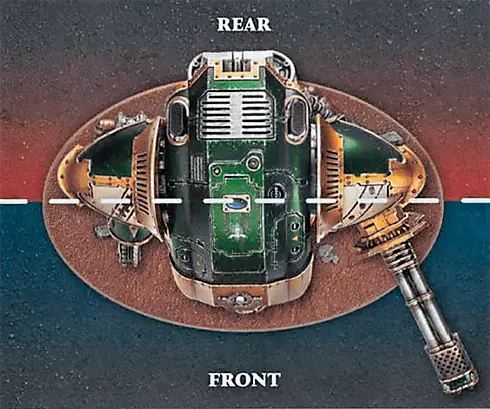
A Model with the Colossus Special Rule changes elements of the Knight Sub-Type regarding bases, Line of Sight, Firing Arcs and Armour Facings.A Model with both the Knight Sub-Type and the Colossus Special Rule is not required to have a base, and when measuring for that Model, all distances are measured to and from the Model’s Hull. A Model with both the Knight Sub-Type and the Colossus Special Rule does block Line of Sight in the manner of other Vehicles. Additionally, when determining Front and Rear Firing Arcs and Armour Facings for a Model with both the Knight Sub-Type and the Colossus Special Rule, draw an imaginary line along the centre of the Model, from left to right or right to left, equally dividing the front and rear portions of the Model.
Whether by means of advanced targeting cogitators or by merit of numerous crew, each tasked with manning a separate gun, some armoured vehicles are capable of targeting numerous foes simultaneously. The hail of fire such vehicles can project far outweighs the lack of focus in their volleys.
Models with this Special Rule can shoot at multiple targets at full Ballistic Skill.When making multiple Shooting Attacks in the same Shooting Phase, a Model with this Special Rule and the Vehicle Type does not have to make all attacks as Snap Shots.
Lascannon
| Ranged Weapon | |||||||
Ranged Weapon | R | FP | RS | AP | D | Special Rules | Traits |
| Lascannon | |||||||
| Lascannon | 48 | 1 | 9 | 2 | 1 | Heavy (D), Armourbane | Las |
Hyperios missile launcher
| Ranged Weapon | |||||||
Ranged Weapon | R | FP | RS | AP | D | Special Rules | Traits |
| Hyperios missile launcher | |||||||
| Hyperios missile launcher | 48 | 3 | 7 | 3 | 2 | Skyfire, Rapid Tracking | Missile |