Questoris Familia – Cerastus Knight Lancer
 ]

This datasheet does not meet the selection criteria (see Filter combo-box or Settings tab).
Cerastus Knight Lancer
UNIT COMPOSITION: 1 KNIGHT LANCER
480 PointsPts

The Lancer is the most famed of the Cerastus type knight armours, a highly sophisticated chassis whose speed and agility far exceed the clumsier Questoris class. The Cerastus type knights appear to have been designed solely for war, not as protectors but as bloody-handed conquerors and tools of destruction, a legacy of the violence that marked the beginning of the Age of Strife. The Lancer is held in high esteem by the more impetuous of a House’s scions, its potent ion gauntlet shield and shock lance perfectly suited to battling the foe face to face, where only a perfectly timed thrust of the lance stands between a scion and death.

Armour
M WS BS S Front Rear I A HP
Knight Lancer (⌀170 x 109mm)
Knight Lancer (⌀170 x 109mm) 14 4 4 9 13 11 4 4 12
WARGEAR
  • Hull (Front) Mounted shock lance
  • Ion gauntlet shield
  • Ion shield
TRAITS
  • [Allegiance]
  • [Questoris Familia]
SPECIAL RULES
  • Auto-repair (5+)
  • Explodes (6+)
  • Vanguard (2)
TYPE
Movement (M) – The Movement Characteristic is primarily used to determine how far a Model can move during the Movement Phase, with higher values denoting an ability to move further (see Moving Units). If a Model’s Movement Characteristic is reduced to 0, then the Controlling Player may not move, Rush or otherwise change the Model’s position on the Battlefield regardless of any other Rules that may affect it until its Movement is changed to a value greater than 0.
Weapon Skill (WS) – The Weapon Skill Characteristic is primarily used to determine a Model’s ability to attack during a Combat in the Assault Phase, with a higher value making it both easier for the Model to make attacks and more difficult for opponents to do so (see Melee Hit Tests). If a Model’s Weapon Skill is reduced to 0 then that Model cannot make attacks in a Combat (if the Hit Test could have triggered a variable Special Rule, then that Rule is considered to automatically fail to activate as part of the Test). Enemy Models whose attacks target a Model with Weapon Skill 0, or a Unit whose majority Weapon Skill is 0, treat the Target Model as though it had a Weapon Skill of T to determine the Target Number for any Hit Tests required.
Ballistic Skill (BS) – The Ballistic Skill Characteristic is primarily used to determine a Model’s ability to make attacks during a Shooting Attack, with a higher value making it easier to succeed at attacks (see Ranged Hit Tests). If a Model’s Ballistic Skill is reduced to 0 then that Model cannot make Shooting Attacks, even if no Hit Test is required or it would have otherwise automatically succeeded due to the use of a Special Rule.
Strength (S) – The Strength Characteristic is primarily used to determine the effectiveness of Wound Tests inflicted by Melee Weapons, with a higher value making it easier to inflict wounds. If a Model’s Strength Characteristic is reduced to 0 then any Wound Tests made that would use that Characteristic or for any Melee Weapon automatically fails and no Dice are rolled for it (if the Wound Test could have triggered a variable Special Rule, then that Rule is considered to automatically fail to activate as part of the Test).
Initiative (I) – The Initiative Characteristic is primarily used to determine the order in which Models make attacks during Combat, with Models with a higher Initiative Value making attacks before those with lower values. For more details, see the Set-up Move Distance for the Assault Phase. When a Model’s Initiative Characteristic is reduced to 0, then that Model will generally be forced to attack after other Models, but suffers no other penalty.
Attacks (A) – The Attacks Characteristic is primarily used to determine the number of attacks a Model may make in a Combat, with the value of the Characteristic indicating the number of attacks that can be made (see Melee Hit Tests). When a Model’s Attacks Characteristic is reduced to 0 then that Model may not make any attacks as part of a Combat.
Range (R) – This Characteristic determines the maximum distance, in inches ("), at which attacks may be made with a Weapon. A Weapon with Range 0 or ‘-’ may not make attacks as part of a Shooting Attack.
Firepower (FP) – This Characteristic is used to determine how many Dice are rolled when making attacks with this Weapon. A Weapon with a Firepower Characteristic of 0 may not be used to make attacks of any kind.
Ranged Strength (RS) – This Characteristic is used only during Wound Tests or Armour Penetration Tests for attacks made using ranged Weapons. If a Weapon has a Strength Characteristic of ‘0’ or then any Wound Tests made for it automatically fail and no Dice are rolled (if the Wound Test could have triggered a variable Special Rule, then that Rule is considered to automatically fail to activate as part of the Test).
Armour Penetration (AP) – This Characteristic is used to determine if a Model Hit by attacks made with a Weapon may make an Armour Test. Like Saving Throws, lower values are more valuable for this Characteristic. When modifying the Armour Penetration Characteristic the same Rules are used as those for modifying Saving Throws.
Damage (D) – This Characteristic determines how the Wounds or Hull Points Characteristic of a Target Model that fails a Saving Throw after sustaining a wound from a Weapon is modified. A Weapon with a Damage Characteristic of 0 cannot inflict Damage on a Model, regardless of the Weapon’s other Characteristics or Special Rules.
Rules and Special Rules
The term Rule refers to any instructions that allow Players to resolve game actions as part of a Battle, covering all of the interactions between Models and Units (such as moving, Shooting and making Assaults). All of the material in the Principles of Combat, Rules of Battle and Battles in the Age of Darkness sections of this book are considered to be Rules. Special Rules modify how a Rule works, but do not present new basic game instructions, and in this book are mostly found in the Armoury of the Age of Darkness section. In all cases, Special Rules take precedence over Rules where the two present differing instructions.
Traits
Traits are a special kind of Characteristic, one which all Models have but which confers no inherent Rules or benefit on its own. Instead, Traits are used by other Special Rules and effects to target specific Models and apply benefits or penalties. The most common Traits are those for Allegiance and Faction, which are possessed by almost all Models. Allegiance requires that each Model have either the Loyalist or Traitor Trait, and most Models will gain one or more Traits based on the Army List from which they were selected.

For example, a Legionary selected from the Imperial Fists Faction and selected as part of a Loyalist Army would have the Loyalist and Imperial Fists Traits. On their own these Traits have no effect on the Model’s Characteristics, Points cost or other features, but Rules that target Imperial Fists or Loyalist Models will apply their effects to the Model.

In addition to Models, Weapons can also have Traits. These are usually different to those possessed by Models, but are used for the same purposes. Weapons will commonly have Traits that define the type of Weapon it is or a specific type of usage. For example, a bolt pistol has the following Traits: Assault, Bolt. These identify which ‘family’ of Weapons it belongs to for any Rules that might only affect ‘Bolt’ Weapons and notes that it can be used for attacks where only ‘Assault’ Weapons may be used.

While they appear similar to Characteristics, it is important to note that Traits never have a ‘value’ attached to them. Furthermore, Traits cannot be modified in any way by another Special Rule or effect during a Battle, unless a Rule specifically states it affects a Trait.
Explodes (X)

Volatile fuel, overpowered reactors or dangerous munitions can cause some war engines to explode when destroyed. Such explosions can prove devastating to friend and foe alike.

A Model with this Special Rule can explode and cause Hits to nearby Models and Units.

Before a Model with the Explodes (X) Special Rule is Removed as a Casualty, the Controlling Player must roll a Dice. If the result of that roll equals or exceeds the value of X attached to this variant of the Explodes (X) Special Rule, the Model explodes. Every Unit with one or more Models within 6" of an exploding Model suffers a number of Hits equal to the Base Wounds Characteristic or Base Hull Points Characteristic of the exploding Model. Each such Hit has a Strength of 8, an AP of ‘-’ and a Damage of 1. Once all Hits caused by this Special Rule have been resolved, the Model with the Explodes (X) Special Rule is Removed as a Casualty as normal.
Penetrating Hits – For each Penetrating Hit result, the target Unit suffers 1 Penetrating Hit. If available, any Saving Throws or Damage Mitigation Rolls may be made to discard the Penetrating Hit in the appropriate Step of the attack process (see the Rules for Shooting Attacks or Melee Attacks). If not discarded due to a Saving Throw or Damage Mitigation Roll the Model will lose a number of Hull Points equal to the Damage Characteristic of the Penetrating Hit, which is decided by the Characteristics of the Weapon used to inflict the Penetrating Hit in the same manner as wounds.

Disable Ads


Boosty subscribers may disable ads:
1. Enter e-mail you have used to login on Boosty.
2. Press Get new pin code button (if you don’t have it already)
3. Enter pin code.

Note that login database updated once a day. So, if you are a new booster - try tomorrow. And thank you!
Initiative Modifier (IM) – This Characteristic is applied as a modifier to a Model’s Initiative Characteristic to determine that Model’s Combat Initiative. A Weapon with an Initiative Modifier of 0 forces the Model attacking with it to set their Combat Initiative to a value of 0. Furthermore, a Weapon with an Initiative Modifier of ‘1’ imposes no modifier to the Initiative Characteristic of a Model.
Attacks Modifier (AM) – This Characteristic is applied as a modifier to a Model’s Attacks Characteristic to determine how many Dice are rolled when making attacks with this Weapon. A Weapon with an Attacks Modifier Characteristic of 0 may not be used to make attacks during the Fight Sub-Phase. Furthermore, a Weapon with an Attacks Modifier of ‘A’ imposes no modifier to the Attacks Characteristic of a Model.
Strength Modifier (SM) – This Characteristic is applied as a modifier to a Model’s Strength Characteristic to determine the Strength used to make Wound Tests in Combat. A Weapon with a Strength Modifier Characteristic of 0 automatically fails any Wound Tests during the Fight Sub-Phase and no Dice are rolled (if the Wound Test could have triggered a variable Special Rule, then that Rule is considered to automatically fail to activate as part of the Test). Furthermore, a Weapon with a Strength Modifier of ‘S’ imposes no modifier to the Strength Characteristic of a Model.
COMBAT – A Combat is a reference to two or more Units conducting an ongoing struggle, where at least one Model from each Unit is in Base-to-Base Contact. Outside of the Assault Phase, a Combat is considered one entity and no other Unit may move through it or end a move within 1" of any Model in the Combat. No Unit in a Combat may be the target of any Shooting Attack.
Combat Initiative Score – A Model’s Combat Initiative score is the combined value of that Model’s current Initiative Characteristic and the Initiative Modifier Characteristic of the Weapon used to make attacks for that Model. It determines in which Initiative Step attacks may be made for that Model.
Initiative Step – A Combat Round is made up of Initiative Steps, each of which has a value assigned to it to show the order in which they are resolved. In each Initiative Step, Models whose Combat Initiative score is equal to the value of the Initiative Step may make attacks. Initiative Steps are always resolved in descending order, from highest to lowest. As such, Initiative Step 10 is resolved before Initiative Step 9. Models removed from Combat before the Initiative Step in which they can attack lose the opportunity to make attacks.
Shock (X)

Blasts of exotic radiation, malignant scrap-code or other targeted attacks can render the systems of complex war engines vulnerable without penetrating their armour. While such weapons are less likely to leave their target as a broken ruin, the deleterious effects of their attacks can render even the most powerful war machines impotent.

Weapons with the Shock (X) Special Rule have a chance of inflicting Statuses on Vehicles even if it does not penetrate their armour.

When making a Hit Test for a Weapon with this Special Rule against a Target Unit that includes any Models with the Vehicle Type or Walker Type, the result of the Hit Test before any modifiers are applied must be checked. If any Hit Test for a Weapon with the Shock (X) Special Rule results in a ‘5’ or ‘6’ before any modifiers are applied, then all Models with the Vehicle Type or Walker Type in the Target Unit gain a Status at the end of Step 11 of the Shooting Attack process or Step 10 of the Initiative Step process. The Status gained is indicated by the value of X attached to that variant of the Shock (X) Special Rule. If the Model already has the stated Status or the attack would apply the Status multiple times there is no additional effect and this Special Rule never causes a Model to lose Wounds or Hull Points. Hits inflicted by a Weapon with this Special Rule must still have Wound Tests or Armour Penetration Tests made for them, and are not discarded if they trigger this Special Rule.

This datasheet has Lords of War Battlefield Role. Full list of Questoris Familia units sharing same Battlefield Role follows:

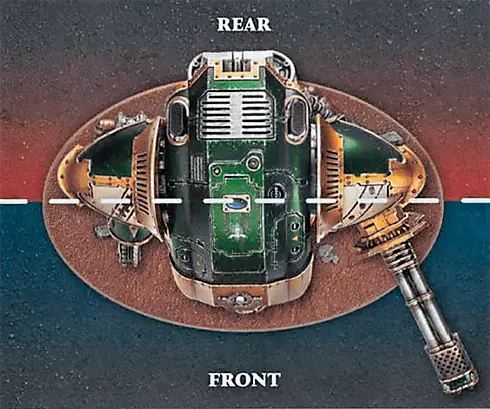
Knight Facings and Arcs
The diagram below shows how a Model with the Knight Sub-Type is divided into its two Armour Facings: Front and Rear. These Armour Facings are determined by drawing an imaginary line along the centre of the Model’s base, from left to right as shown in the diagram below, equally dividing the front and rear halves of the base. On most Models this will involve simply drawing a straight line between the two points where the Model’s base is widest. Models with the Knight Sub-Type also only have two Firing Arcs - Front and Rear - determined in exactly the same way as their Armour Facings.

Hull Points (HP) – The Hull Points Characteristic is primarily used to determine a Model with the Vehicle Type’s capacity for receiving damage during a Battle, with a higher value allowing a Model to sustain more damage before it is removed from play. When a Model’s Hull Points Characteristic is reduced to 0 that Model is removed from play as a Casualty, see the Rules for Destroyed Vehicles here.
Hull (Arc) Mounted – Hull (Arc) Mounted Weapons will always specify a single Firing Arc and may only attack targets in that Firing Arc. The different Hull arcs are: Front, Rear, Left and Right. Some Units may specify Side as an arc - this means both Left and Right arcs.

For example, a Land Raider Carrier has a Hull (Front) Mounted twin heavy bolter - this Weapon may only attack targets in the Front Firing Arc.
Glancing Hits – A Glancing Hit inflicts no Damage, however for each Glancing Hit, the attacking Player must roll once on the Vehicle Damage Table in Step 11 of the Shooting Attack process or Step 10 of the Initiative Step process (Players may find it useful to place a marker to remind them of this).
Ion Shield

These sophisticated energy screens rely on ion fields to deflect the path of solid projectiles or to diffuse high-energy beams before they strike their target. Highly effective in battle, the main limitation of these devices is the immense energy drain required to keep them functional, and as such only the largest war engines can rely on their protection.

Ion shields provide a different Invulnerable Save against Shooting Attacks made against a Model’s Front and Rear Facings, including against Glancing Hits.

A Model with an ion shield has a 5+ Invulnerable Save against Shooting Attacks made against its Front Facing and a 6+ Invulnerable Save against Shooting Attacks made against its Rear Facing. Additionally, a Model with an ion shield may have Invulnerable Saves made for it against any Glancing Hits it has suffered in Step 11 of a Shooting Attack, before any rolls on the Vehicle Damage Chart are made, discarding a single Glancing Hit for each successful save.
Auto-repair (X)

Some vehicles are either fitted with sophisticated auto-repair systems, or are simple enough in construction that their crew can effect repairs in the field. Such vehicles are able to shrug off minor damage that would otherwise reduce the fighting ability of their war machine.

A Model with this Special Rule has a bonus to Repair Tests to remove Statuses.

If the Active Player makes a Repair Test in the Statuses Sub-Phase of the End Phase for a Model with the Vehicle Type with this Special Rule, they ignore the usual Target Number of 6. Instead, the value of X attached to the variant of this Special Rule is used as the Target Number for that Repair Test. For example, a Model with the Auto-repair (4+) Special Rule would pass any Repair Tests made for it on the result of a 4 or higher.
Fall Back – All Models in the Unit gain the Routed Status if they did not already have it. Units with the Routed Status must then make an immediate Fall Back Move.
LOCKED IN COMBAT – If the Assault Sequence ends and at least one Target Unit has neither been forced to Fall Back or been entirely Removed as Casualties, then the Units involved remain in place with at least one Model from each Unit in Base-to-Base Contact with an enemy Model. These Units are ‘Locked in Combat’ and may not be selected or moved in the Movement Phase or selected to make Shooting Attacks in the Shooting Phase. They may be selected during the Fight and Challenge Sub-Phases of the Assault Phase by the Active Player, but may not make a Charge or otherwise be selected in the Charge Sub-Phase.
Vanguard (X)

Warriors trained to break the foe’s lines are often at the forefront of their host, but are ill-suited to holding ground in the face of an enemy counter-attack.

A Unit that includes Models with this Special Rule scores fewer Victory Points for controlling Objectives, but can score Victory Points for destroying enemy Units that hold Objectives.

A Unit that includes a majority of Models with the Vanguard (X) Special Rule may only ever score 1 Victory Point for Controlling an Objective, regardless of that Objective’s value. However, the Player that controls a Unit that includes a majority of Models with the Vanguard (X) Special Rule gains Victory Points equal to the value of X in the Vanguard (X) Special Rule, in addition to any Victory Points scored for controlling an Objective, whenever either of the following two statuses are fulfilled:
  • If an attack made for a Unit that includes a majority of Models with the Vanguard (X) Special Rule causes the last Model in an enemy Unit that is Controlling or Contesting an Objective to be Removed as a Casualty.
  • If a Unit that includes a majority of Models with the Vanguard (X) Special Rule has at least one attack made for it in a Combat that results in one or more enemy Units that had at least one Model within 3" of an Objective at the start of that Assault Phase either Falling Back from Combat or being Massacred.

Note that the Vanguard (X) Special Rule may only be used to score Victory Points once per Objective per Player Turn - no matter how many enemy Units were Controlling or Locked in Combat near that Objective.
Impact (X)

Some warriors are trained or equipped to make the most of the force of a charge. When they slam into enemy ranks, it is with the force of a thunderbolt.

On a successful Charge, a Model with the Impact (X) Special Rule temporarily increases a Characteristic by 1.

If a Unit that includes any Models with the Impact (X) Special Rule or any Models that have any Weapons with the Impact (X) Special Rule, and that Unit makes a successful Charge, then this Special Rule is triggered. Once triggered, until the end of that Assault Phase, when making Melee Attacks for Models in that Unit, each Model or Weapon that is selected for one of those Models, that has a variant of this Special Rule gains a modifier of +1 to any Characteristics that is the value of X.
Stun (X)

Some weapons are designed not only to kill and main, but also to shock and disorient the foe. Such weapons may rely on blinding flares, bursts of enervating energy or even subtle poisons to slow and disable the enemy, but their effects are the same. Debilitated and vulnerable, warriors struck by such weapons become easy prey.

Weapons and other attacks that have the Stun (X) Special Rule have a chance of inflicting the Stunned Status on the Target Unit.

If a Shooting Attack made for a Weapon or Model with this Special Rule inflicts one or more Hits on a Target Unit, that Target Unit must make a Cool Check in the Morale Sub-Phase of the same Player Turn. If this Check is failed then all Models in the Unit gain the Stunned Status and if the Check is passed then there is no further effect. The value of X attached to this Rule is applied as a negative modifier to the Cool Characteristic of Models in the Target Unit when making Checks caused by an Attack with this Special Rule, if the attack includes multiple Weapons with different versions of this Special Rule the modifiers do not stack - use only the greatest modifier.

Shock lance

Ranged Weapon
Ranged Weapon
R
FP
RS
AP
D
Special Rules
Traits
Shock lance (Ranged)
Shock lance
18
6
7
3
1
Stun (2)
Arc

Melee Weapon
Melee Weapon
IM
AM
SM
AP
D
Special Rules
Traits
Shock lance (Melee)
Shock lance
I
A
+1
2
4
Impact (IM & D), Shock (Stunned)
Arc
Ion Gauntlet Shield

The ion gauntlet shield generator mounted in the Cerastus’ gauntlet assembly is more concentrated than the ion shield mounted on other knight armours, hut lacks its tactical flexibility.

Ion gauntlet shields provide an Invulnerable Save against Melee Attacks.

A Model with an ion gauntlet shield has a 5+ Invulnerable Save against Penetrating Hits inflicted with Melee Weapons. Additionally, a Model with an ion gauntlet shield may have Invulnerable Saves made for it against any Glancing Hits it has suffered in Step 10 of an Initiative Step, before any rolls on the Vehicle Damage Chart are made, discarding a single Glancing Hit for each successful save.
© Vyacheslav Maltsev 2013-2026