General’s Handbook 2026-27
War spreads across the Great Parch of Aqshy like an unstoppable inferno. Skaven swarm out from the twisted hellscape of the Gnaw, eager to corrupt and despoil. The lands that border the Heartblood Sea are subjected to near-constant raids from blood-crazed killers, whilst the smoke from corpse-fires and ruined war engines rises over the Snow Peaks.


Books
| Book | Kind | Edition | Last update | |
 General’s Handbook 2026-27 General’s Handbook 2026-27 | ||||
| General’s Handbook 2026-27 | Expansion | 4 | June 2026 | |
General’s Handbook 2026-27
1. Pick Your Armies
Each player picks an army using the rules in Army Composition 2026-27 (Advanced Rules).Advanced RulesIn addition to the Core Rules and the Season Rules 2026-27, this battlepack uses the following Advanced Rules: | ||
2. Determine the Battleplan
One player rolls a dice to determine which battleplan table to use. On a 1-3, use battleplan table 1. On a 4-6, use battleplan table 2. The other player then rolls a dice to determine the battleplan. Alternatively, feel free to pick the battleplan you wish to play.
| ||||||||||||||||||||||||||||||||
Attacker and Defender
The players roll off. The winner chooses which player is the attacker and which is the defender.Objectives and Terrain
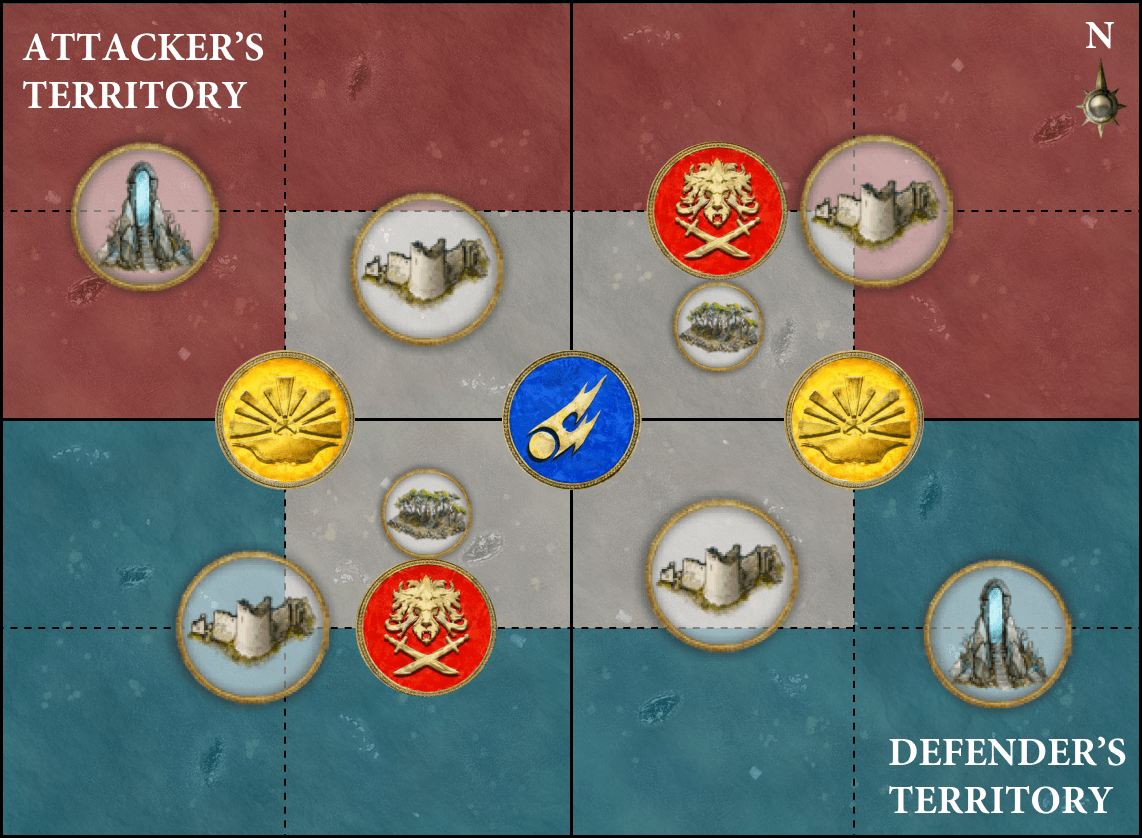
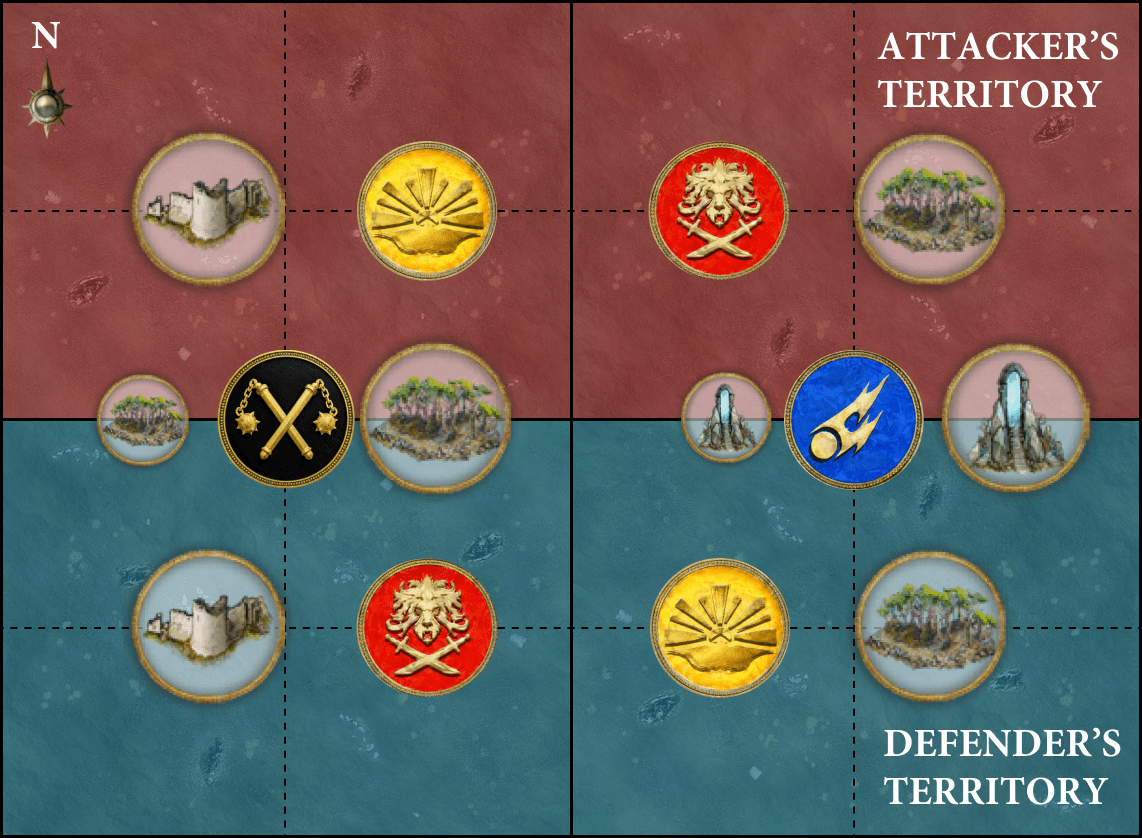
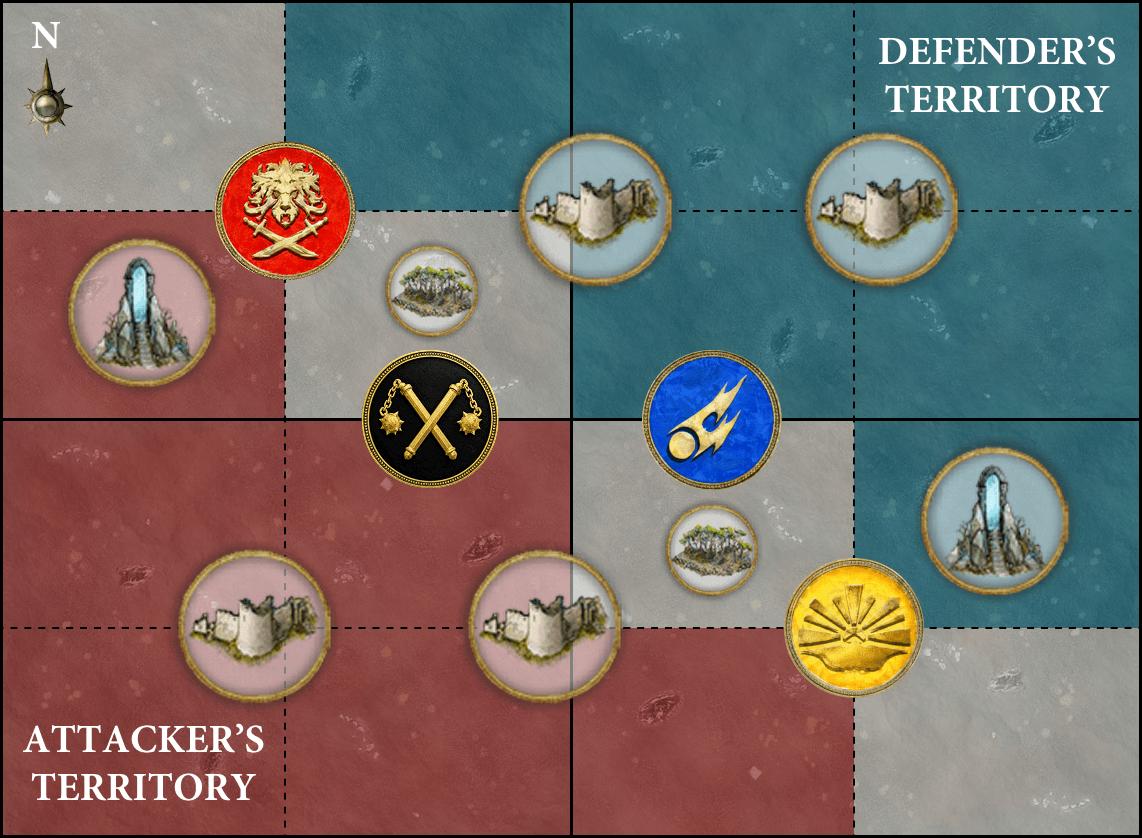
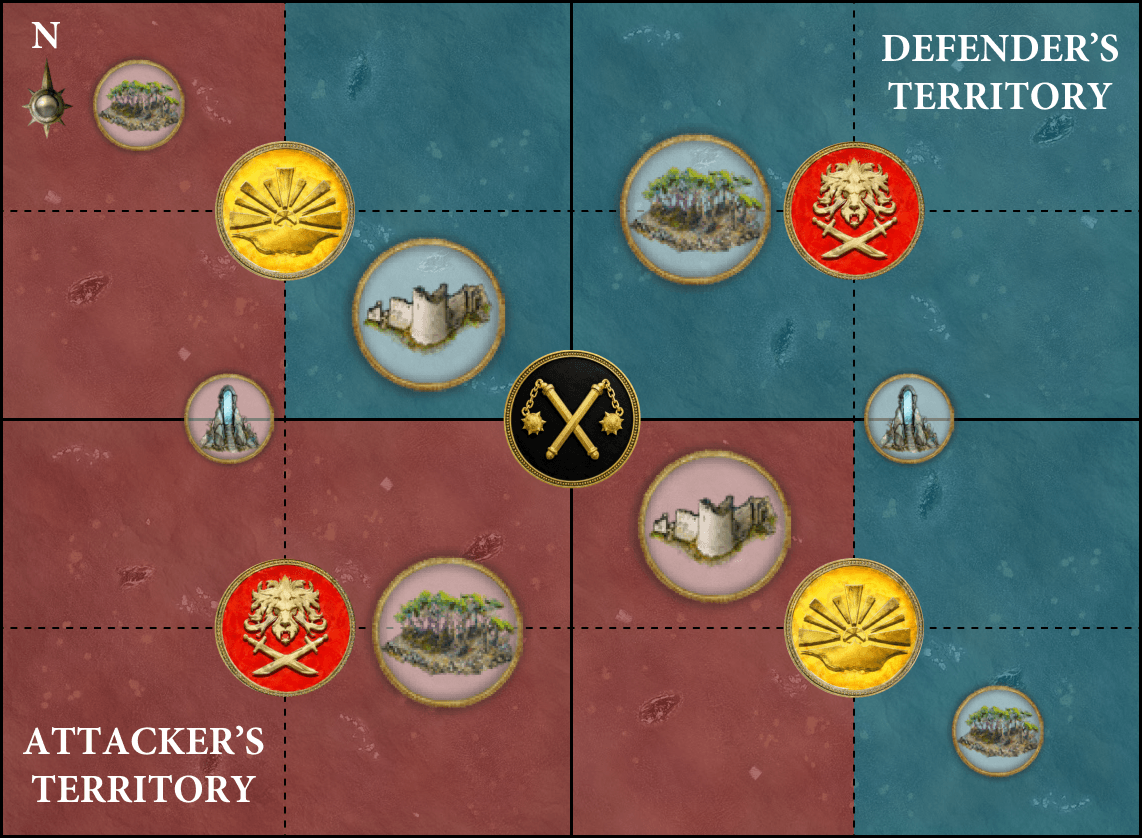
This battlepack contains 6 special objectives called Aqshian objectives: 2 Sun Seekers objectives, 2 Golden Lions objectives, 1 Heldenhain objective and 1 Scions of the Comet objective. The objective itself is the 40mm diameter circle located in the centre, while the surrounding area extending 3" from the objective is the control zone. To contest an Aqshian objective, a unit must be within the control zone of that objective.Some battleplans will use more than 1 of the same type of Aqshian objective. For example, they could include 2 Sun Seekers objectives and/or 2 Golden Lions objectives. In these battleplans, the rules refer to 2 of the same type of objective as a pair or paired. When a rule requires a player to control a pair of objectives, the player has to control both objectives in that pair. When a player has to pick ‘a pair of objectives’, they can only pick a single pair of Aqshian objectives of the same type.
The defender sets up Aqshian objectives in the locations indicated on the battlefield map. The objectives must be those indicated on the battlefield map; for example, if the map shows a Heldenhain objective, the Heldenhain objective must be set up in that location.
Then, the defender sets up terrain features. We recommend 4 small and 4 medium terrain features. Each terrain feature must be set up more than 3” from the battlefield edge, more than 3" from all objectives and more than 6" from all other terrain features. Alternatively, the battlefield can be set up as shown on the corresponding battlefield terrain layout map while maintaining the distance restrictions between the battlefield edge, objectives and other terrain features as detailed above.
Territory
After objectives and terrain features have been set up, the attacker picks which territory is their territory. The other territory is the defender’s territory. The players then resolve the deployment phase. The attacker begins deployment (Core Rules, 10.0).Battle Length
Battles that use this battlepack last for 5 battle rounds.Glorious Victory
Each battleplan will describe how to score victory points. At the end of the battle, if one player has at least 5 victory points more than their opponent, they win a major victory. If one player has fewer than 5 victory points more than their opponent, they win a minor victory. If the players are tied on victory points, the player who completed the most battle tactics wins a minor victory. If the players are tied on victory points and completed the same number of battle tactics, the battle is a draw.Battle Tactics
If you are using this battlepack, you must pick battle tactics cards from this battlepack to add to your army roster during army composition.At the start of the battle, you must reveal your choice of battle tactics cards to your opponent. If the battle tactics cards instruct you to pick something, you must tell your opponent what you have picked and vice versa.
Aqshian Crusades
Sometimes you might want to link together multiple battles in order to play a tournament or start a campaign. With the General’s Handbook 2026-27 battlepack, you can do this by launching an Aqshian Crusade.An Aqshian Crusade is a set of battleplans that, when played in order, give your Matched Play experience a narrative spin. Whether you intend to play a single-day or weekend tournament or embark on a long-term campaign, there is a crusade for you! In an Aqshian Crusade, the same types of terrain are used for all games that would typically be played on the same day, and, in the case of two-day crusades, the battles that would usually be fought at the end of the first day have simpler twists (because even renowned tacticians need some downtime!).
Crusade Types
To launch an Aqshian Crusade, pick 1 of the following crusade types:
|
Mapping the Warpath
Next, pick 1 of the pre-made Aqshian Crusades from the table below. Alternatively, if you’re feeling adventurous, you can mix and match battleplans to forge your own narrative.Each pre-made crusade tells a different story, as summarised in the 'Synopsis' column. The 'Battleplans' column tells you which battleplans from the General’s Handbook 2026-27 battlepack each crusade uses and the order in which to play them. A battleplan’s number can be found at the top of its card.
|
Joint Crusades
Occasionally, crusading armies with a common cause might form temporary alliances or fractious coalitions. Joint Crusades are events for teams with an equal number of players whose armies are fighting alongside one another on an Aqshian Crusade.Before starting a Joint Crusade, the event organiser picks a number of Aqshian Crusades of the same type equal to the number of players in a team divided by 2, rounding up. For instance, if there were 5 players in each team, they would pick 3 crusades. The same crusade can be picked more than once. The event organiser then numbers the crusades they picked (see 'Preparing for Battle'). Battles will be fought using the battleplans in those Aqshian Crusades.
Rounds
A Joint Crusade comprises a number of rounds. We recommend 3 rounds for a 1-day event and 5 rounds for a 2-day event.In each round, the teams are drawn against each other (either randomly or by using a format such as the Swiss system) and each player in a team is paired with a player in the team they are drawn against. The 'Pairing Armies' section contains an example method for pairing players.
Preparing for Battle
In the first round, the first two players from each team to be paired play the first battleplan in Aqshian Crusade 1, the next two play the first battleplan in Aqshian Crusade 2, and so on.In the second round, the first two players from each team to be paired play the second battleplan in Aqshian Crusade 1, the next two play the second battleplan in Aqshian Crusade 2, and so on.
Repeat this sequence for each round. If there are more rounds than battleplans in an Aqshian Crusade, cycle through the battleplans in that crusade again from the beginning.
Pairing Armies
During a Joint Crusade, you will find that some players’ armies are better suited to certain battleplans than others. Your team must work together to ensure the right armies are fighting the right battles. To decide which armies will be fighting on which battleplan, follow these steps at the start of each round. We recommend writing the names of each army on your team on separate cards to create a hand of cards to use in this process.- Each team secretly picks 1 of the armies in their hand to be the guarding army for that battleplan. The guarding armies are then revealed simultaneously.
- Each team presents 2 of their non-guarding armies to be prospective invading armies against the opposing team’s guarding army.
- Each team picks 1 of the opposing team’s invading armies to be paired with their guarding army, revealing their choices simultaneously. The army that was not picked is returned to their team’s hand.
- Repeat steps 1-3 until each team is left with either 1 or 2 unpaired armies in their hand.
- If each team has 2 unpaired armies left, follow step 1, then each team’s guarding army is automatically paired with the opposing team’s remaining army.
- If each team has 1 unpaired army left, those armies are automatically paired.
Glorious Alliance
At the end of each round, add up the victory points earned by all players on your team. The team with the highest total wins the round!Matched Play Publications 2026-27
- Warhammer Age of Sigmar Core Book
- General’s Handbook 2026-27
- Warhammer Age of Sigmar Faction Packs
- Battle Profiles & Rules Updates
- Battletome publications, excluding Warhammer Legends rules
Season Rules 2026-27
FAQ
| Q: | How do manifestations and faction terrain interact with the new seasonal abilities? |
| A: | Manifestations and faction terrain cannot use ‘Eruption of Fury’ or benefit from ‘Fight Through the Pain’, as they are not units. Enemy manifestations and faction terrain can only be targeted by ‘Eruption of Fury’ if they have a Move characteristic – the friendly unit will not be in combat with them in the End of Turn phase if they do not. |
 Once Per Battle (Army), Deployment Phase Once Per Battle (Army), Deployment Phase |
| Once Per Turn (Army), Start of Battle Round |
Effect: Gain a number of rage dice equal to your fury level. At the end of the battle round, any unspent rage dice are lost.
 Once Per Turn (Army), End of Any Turn Once Per Turn (Army), End of Any Turn |
Effect: Pick 1 of the melee weapons that the unit using this ability is armed with. Then, spend up to 3 rage dice.
Resolve a number of combat attacks against the target using the melee weapon you picked equal to the number of rage dice you spent.
Those attacks cannot score critical hits. Instead, for each unmodified hit roll of 6 for those attacks:
- Inflict an additional D3 mortal damage on each enemy unit in combat with the unit using this ability.
- Your opponent must increase their fury level by 1, to a maximum of 7.
For each unmodified hit roll of 1 for those attacks, allocate D3 mortal damage to this unit after the damage sequence has been resolved (ward rolls cannot be made for those damage points).
Designer’s Note: Rage dice do not add to the Attacks characteristic of the weapon you pick; if you spend 3 rage dice to use this ability, you only make 3 combat attacks.
| KEYWORDS | ATTACK, FIGHT |
FAQ
| Q: | When using ‘Eruption of Fury’, can I use a reaction to pick another unit to use a FIGHT ability immediately after? |
| A: | No – while you can use reactions to ‘Eruption of Fury’, abilities that let you pick a unit to immediately use a FIGHT ability do not override the restrictions of the FIGHT ability. As a result, you cannot use them to have a unit fight outside the combat phase. |
| Q: | Do STRIKE-FIRST or STRIKE-LAST have any effect when using ‘Eruption of Fury’? |
| A: | No. |
 Passive Passive |
FAQ
| Q: | When applying the effect of ‘Fight Through the Pain’, are rage dice spent one at a time or all at once? |
| A: | All at once. |
 Using The Scourge of Aqshy Rules
The Scourge of Aqshy rules are a set of seasonal rules that include additional faction rules and alternative warscrolls for every faction. These rules are for use in battles that use the General’s Handbook 2026-27 battlepack.If you decide to use the Scourge of Aqshy version of a warscroll, you do not have to use all other Scourge of Aqshy warscrolls for your faction.
In addition, other rules that interact with the printed version of that unit interact with the Scourge of Aqshy version too. For example, a rule (including regiment options) that calls out a unit type by the name on its warscroll interacts with both the printed version of that unit and the Scourge of Aqshy version; they are synonymous in this regard.
When picking your army’s battle formation, you can pick 1 of the Scourge of Aqshy battle formations available to your faction instead of any others available to it. In other words, you can still only pick 1 battle formation for your army.
If you pick from a Scourge of Aqshy artefacts of power or heroic traits table, you pick from that table instead of other such tables available to your faction, not in addition to. This is stated in the rules that accompany the relevant table.
Some of the Scourge of Aqshy enhancement tables are special enhancements unique to that faction, for example monstrous traits. This is an enhancement table available to your faction like any other; therefore, you can pick 1 enhancement from it for your army, as per the Army Composition rules, 4.1.
We hope that you enjoy using the Scourge of Aqshy rules and that they add a fun new dimension to your faction!
FAQ
| Q: | Can I include Scourge of Aqshy units in an Army of Renown instead of their standard version? |
| A: | Yes. |
| Q: | Can I include Scourge of Aqshy units in a Regiment of Renown instead of their standard version? |
| A: | No. |
Battle Tactics 2026-27
1.0 Battle Tactics Overview
During a battle, each player can score extra victory points by completing battle tactics from a battle tactics card. You can pick up to 2 battle tactics cards for your army during army composition, and the battle tactics cards you pick must be marked on your army roster.Before deployment, you must tell your opponent which battle tactics cards you have picked for your army.
Each battle tactics card has 3 battle tactics: 1 Affray battle tactic, 1 Strike battle tactic and 1 Domination battle tactic. You must complete the Affray battle tactic on that card before you can complete the Strike battle tactic on that card. Similarly, you must complete the Strike battle tactic on that card before you can complete the Domination battle tactic on that card.
You can complete 1 battle tactic on each of your battle tactics cards at the end of each of your turns, unless specified otherwise on that battle tactics card. If, at the end of your turn, you have met the conditions for completing a battle tactic and you can complete it, you must complete it.
2.0 Seizing The Initiative
If the player who went second in the previous battle round wins the priority roll and chooses to go first, unless their opponent is leading by 11 or more victory points, it is called seizing the initiative.When a player seizes the initiative, their opponent always counts as the underdog until that opponent seizes the initiative.
A player who seizes the initiative cannot complete any battle tactics in that turn.
3.0 Completing Battle Tactics
If, at the end of your turn, you have completed a battle tactic as described above, you score the number of victory points shown for that battle tactic.
| ||
BATTLE TACTICS CARD 1 Blazing OnslaughtUshered in with smoke and fire, the battle for control of a vital holdout begins in earnest. At the start of the battle, after using allDeployment Phase abilities but before determining which player will take the first turn, your opponent must pick 1 non-FACTION TERRAIN terrain feature within their territory to be their hideout. The hideout cannot be removed from the battlefield at any point during the battle.
| |||||||||||||
BATTLE TACTICS CARD 2 Siege of AshesYou have manned a stronghold barring the enemy’s path and will defend it to the death.
| |||||||||||||
BATTLE TACTICS CARD 3 Flanking FirestormThe plan is simple: outflank and surround the enemy, and make sure not one of them escapes alive.
FAQ / ErrataShow FAQ
Errata Battle Tactics Card 3: Flanking Firestorm In the Affray: Ambuscade battle tactic rule, replace ‘objectives or terrain features’ with ‘objectives or non-FACTION TERRAIN terrain features’. | |||||||||||||||||
BATTLE TACTICS CARD 4 SmokescreenDraw the foe in by feigning weakness, concealing your true strength amidst the smoke of battle until the right moment.
| |||||||||||||
BATTLE TACTICS CARD 5 Burning for VengeanceThe enemy’s outrages merit brutal punishment. Track them down and run them to ground. At the start of the battle, after using allDeployment Phase abilities but before determining which player will take the first turn, pick an enemy HERO on the battlefield or in reserve to be the fugitive for the rest of the battle.
| |||||||||||||
BATTLE TACTICS CARD 6 Legend of The ParchAs raging fire and death threatens to consume all, a hero will arise and a legend will be born.
FAQShow
| |||||||||||||||||
Battleplan Maps
Overview
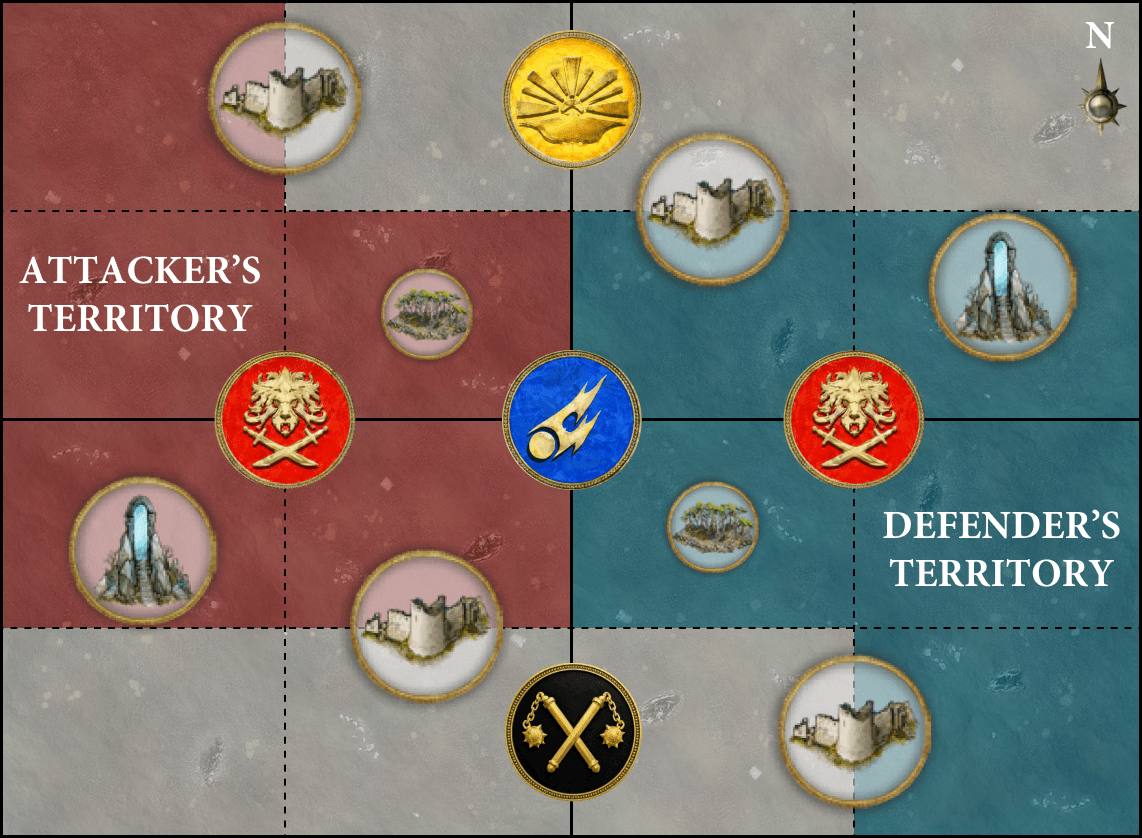
The battleplan maps show the player territories and the locations where terrain and objectives should be placed on the battlefield.Player Territories
Each battleplan map shows two territories: one red (Attacker’s Territory) and one blue (Defender’s Territory).Objectives Locations
The locations of Aqshian objectives are indicated on the battleplan maps by the following icons.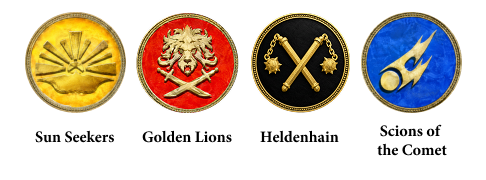 | ||
Each icon represents the Aqshian objective including its control zone. Where an objective icon is shown on the map, you must place the corresponding objective marker on the battlefield centred on the location of the objective icon shown on the map. For example, where the map shows a Heidenhain objective icon, place a Heidenhain objective on the battlefield in that location.
Terrain Locations
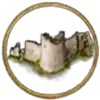
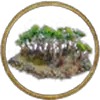
The terrain location icons show where terrain features should be set up and what type of terrain should be placed in each terrain location. The following key shows which terrain features correspond to which icons:
| |||||||||||

| |||||||||||

| |||||||||||


Battleplan 1 (Table 1) Into the FireTWIST: Both players’ armies have the 'Secure the Gateway' ability. While you are the underdog, your army has the 'Determined Defenders' ability. Each player scores victory points at the end of each of their turns as follows:
SECURE THE GATEWAYEffect: While you control the Place of Power wholly within friendly territory, friendly units’ melee weapons have Anti-charge (+1 Rend) while they are contesting an objective you control.
DETERMINED DEFENDERSEffect: Add 3 to the control scores of friendly units while they are wholly outside enemy territory.
 | ||||||||||||||||||||||||||
 Passive
Battleplan 2 (Table 1) Bloodstained CoastsTWIST: From the second battle round onwards, both players can use the following abilities:
EMBERSTONE-AUGMENTED WEAPONSDeclare: Pick a friendly unit that charged this turn and has any emberstone slivers to be the target. Effect: Pick 1 of the following effects to apply for the rest of the turn:
Then, if you are the underdog, remove all of the target’s emberstone slivers. Otherwise, remove all emberstone slivers from each friendly unit.
EMBERSTONE CACHEDeclare: Pick a friendly unit contesting an objective you control to be the target. Effect: Give the target an emberstone sliver.
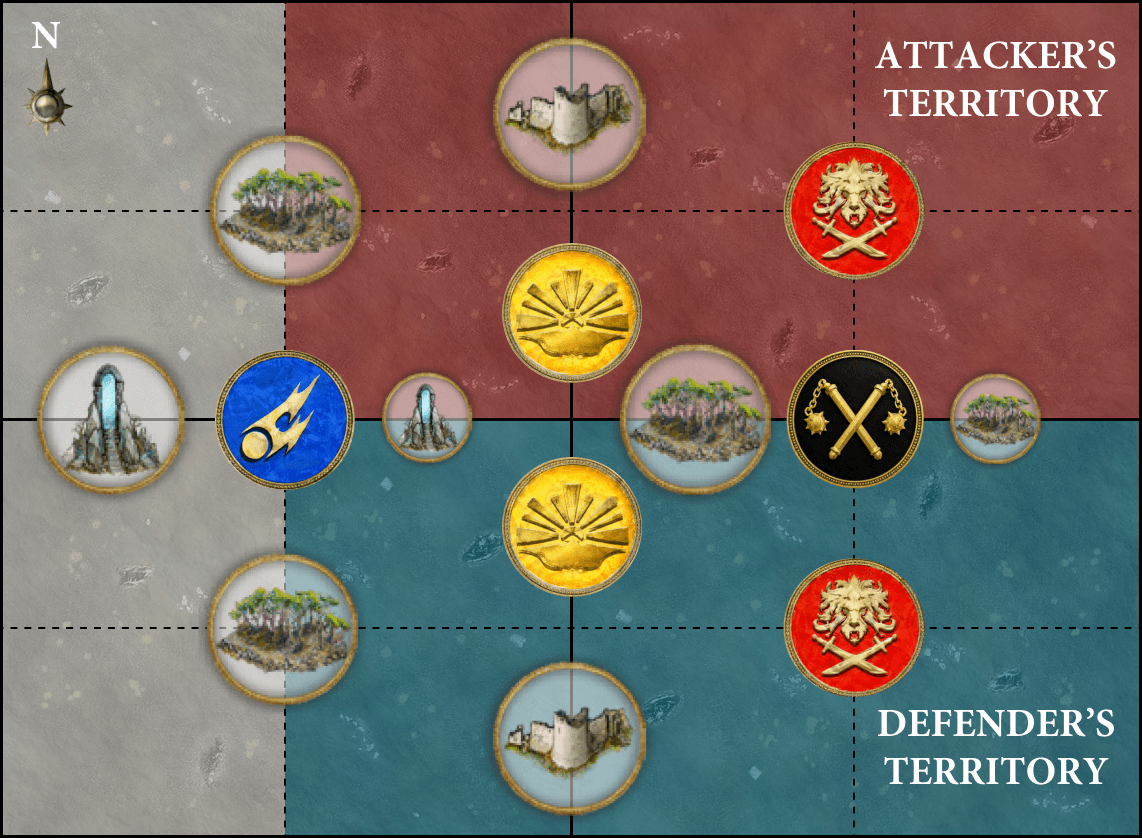 | ||||||||||||||||||||||||||
Battleplan 3 (Table 1) Avalanche of AshTWIST: If you are the underdog, you must use the following ability. Each player scores victory points at the end of each of their turns as follows:
COLLAPSING PASSDeclare: Pick each objective to be the targets. Then, pick 1 of the targets to be the focus. Effect: Roll a dice for each target. Add 1 to the roll for each unit (friendly and enemy) that is contesting it. If the target is the focus, you can add 3 to or subtract 3 from the roll. On a 8+, remove the target from the battlefield.
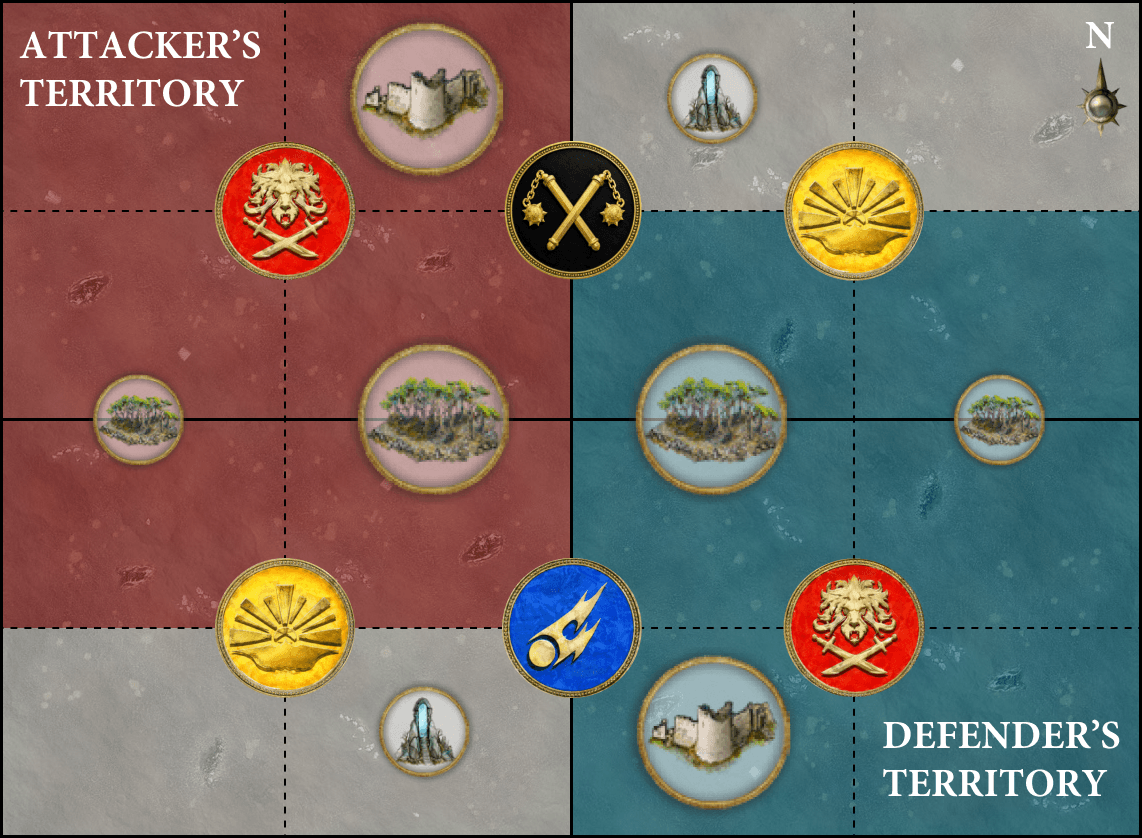 | ||||||||||||||||||||||
Battleplan 4 (Table 1) Caverns of SlaughterTWIST: If you are the underdog, you can use the ’Shifting Passages’ ability. Both players can use the "Navigate the Tunnels" ability
SHIFTING PASSAGESDeclare: Pick 2 non-FACTION TERRAIN terrain features to be the targets. Effect: Remove all hidden passage tokens from the battlefield (if any). Then, give each target a hidden passage token.
NAVIGATE THE TUNNELSDeclare: Pick a friendly unit wholly within 6" of a terrain feature that has a hidden passage token to be the target. Effect: Remove the target from the battlefield and set it up again wholly within 6" of a different terrain feature that has a hidden passage token and more than 9" from all enemy units.
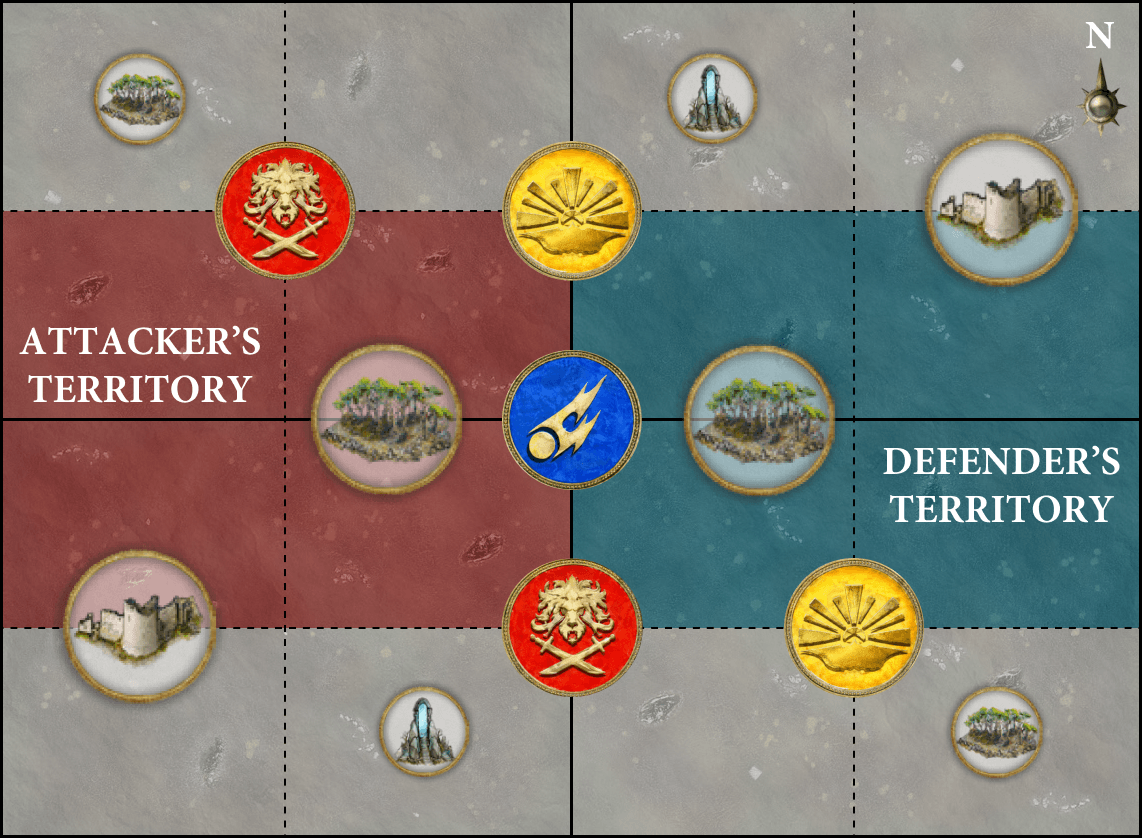 | ||||||||||||||||||||||||||
Battleplan 5 (Table 1) What's Yours Is OursTWIST: While the battle round number is odd, the pair of Golden Lions Each player scores victory points at the end of each of their turns as follows: objectives is the coveted pair of objectives. objectives is the coveted pair of objectives.While the battle round number is even, the pair of Sun Seekers  objectives is the coveted pair of objectives. objectives is the coveted pair of objectives.If you are the underdog, you can use the following ability:
ALL THE RAGEDeclare: Pick a pair of objectives to be the target. Effect: For the rest of the battle round, the target is the coveted pair of objectives instead of the other pair of objectives.
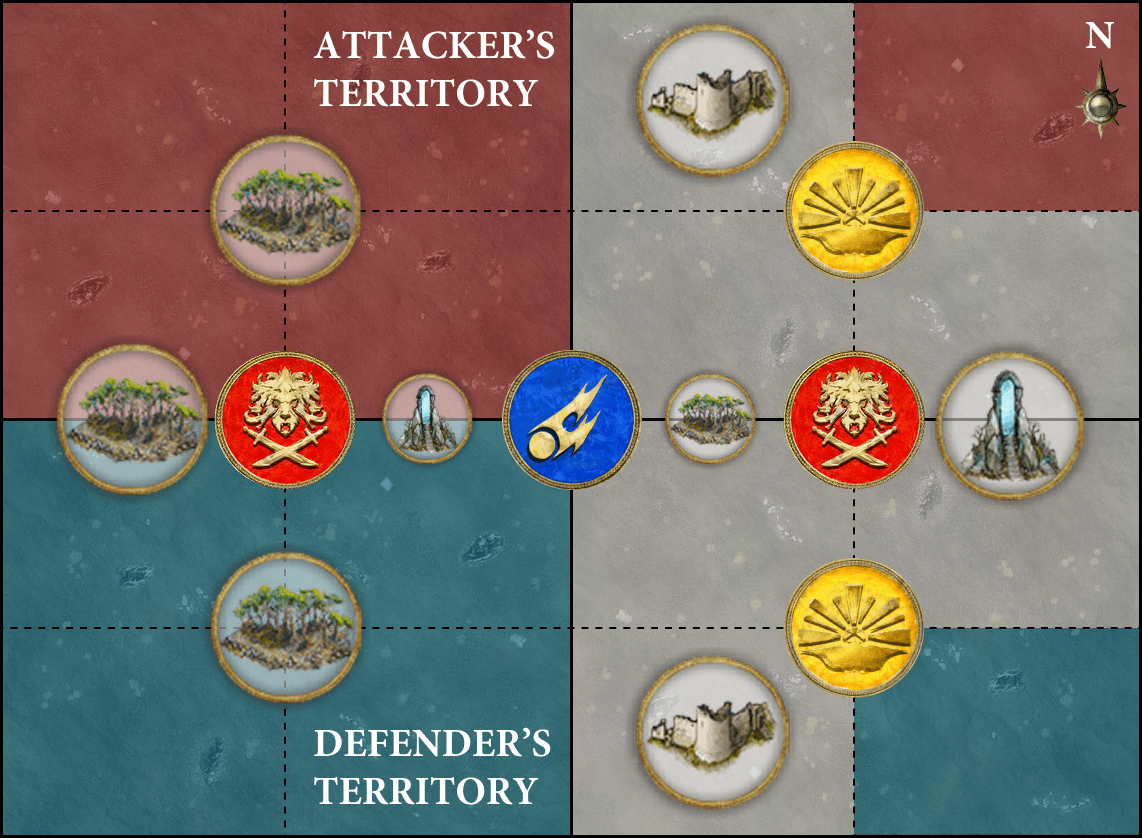 | ||||||||||||||||||||||
Battleplan 6 (Table 1) Hidden Under Ash-CloudsTWIST: At the start of each battle round, the underdog must pick whether or not the ash-clouds are low-lying. If there is no underdog, the ash-clouds are low-lying.The following passive ability applies this battle:
ROLLING ASH-CLOUDSEffect: While the ash-clouds are low-lying:
 FAQ / ErrataShow FAQ
Errata Hidden Under Ash-Clouds In the effect of ‘Rolling Ash-clouds’, in all bullet points change ‘ and MANIFESTATIONS’ to ‘, terrain features and MANIFESTATIONS’. | ||||||||||||||||||||||||||
Battleplan 7 (Table 2) Warped RuinsEach non-FACTION TERRAIN terrain feature must be set up within 12" of at least 1 other non-FACTION TERRAIN terrain feature. Each player scores victory points at the end of each of their turns as follows:TWIST: If you are the underdog, you must use the following ability.
SPREADING WARPFIREDeclare: If there are no flaming terrain features on the battlefield, pick a non-FACTION TERRAIN terrain feature to be the target. Otherwise, pick a non-FACTION TERRAIN terrain feature that is not flaming and that is within 12" of a flaming terrain feature to be the target. Effect: The target is flaming for the rest of the battle. Then, inflict D3 mortal damage on each unit (friendly and enemy) within 6" of any flaming terrain features.
 | ||||||||||||||||||||||
Battleplan 8 (Table 2) Curse of the GnawTWIST: At the start of the battle, the instability level is 1. Each time either player uses the 'Activate Place of Power' ability, add 1 to the instability level, to a maximum of 6. Each player scores victory points at the end of each of their turns as follows:After deciding who will take the first turn, the underdog can use the following ability.
ECHOES OF BLIGHT CITYDeclare: Pick an objective to be the target. Effect: Inflict an amount of mortal damage on each unit (friendly and enemy) contesting the target equal to the Instability level. Then, reset the Instability level to 1.
 | ||||||||||||||||||||||
Battleplan 9 (Table 2) Seize the EmbersTWIST: Both players can use the following abilities:
SEARCH THE RUINDeclare: Pick a friendly unit that does not have an emberstone nugget and is contesting a Sun Seekers objective to be the target.Effect: Give the target an emberstone nugget. If you are the underdog, the target can immediately move 6" but cannot end that move in combat. The target cannot use the ‘Back to Base Camp’ or ‘Power Through’ ability for the rest of the turn.
BACK TO BASE CAMPDeclare: Pick a friendly unit that has an emberstone nugget, was not set up this turn and is contesting a Golden Lions objective to be the target.Effect: Remove the target’s emberstone nugget.
 FAQShow
| ||||||||||||||||||||||||||||||
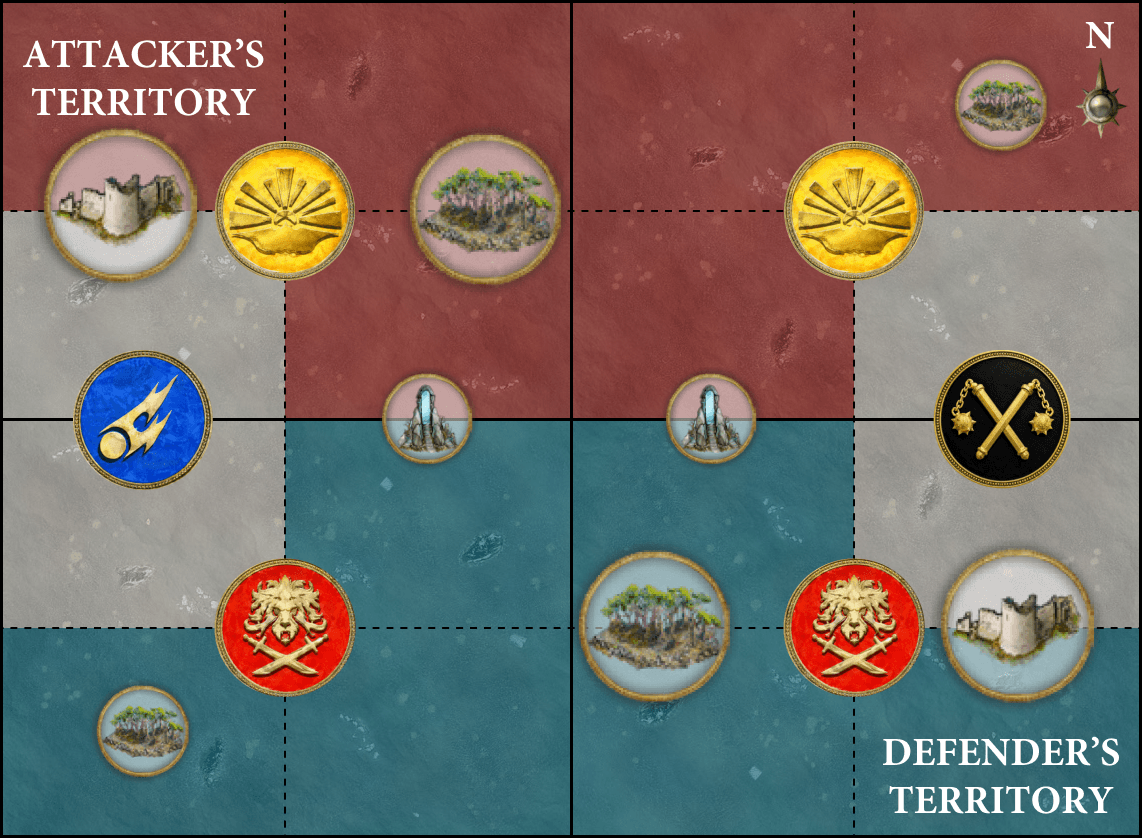
Battleplan 10 (Table 2) Treacherous GroundTWIST: At the start of the battle, all objectives are stable.Both players must use the 'Tread Carefully' ability. Then, from the second battle round onwards, if you are the underdog, you can use the 'Violent Tremor' ability.
TREAD CAREFULLYDeclare: Pick an objective within friendly territory to be the target. Effect: The target is no longer stable.
VIOLENT TREMORDeclare: Pick a pair of objectives to be the targets. Effect: The stable target objective is no longer stable. The other target objective is stable instead.
 | ||||||||||||||||||||||||||
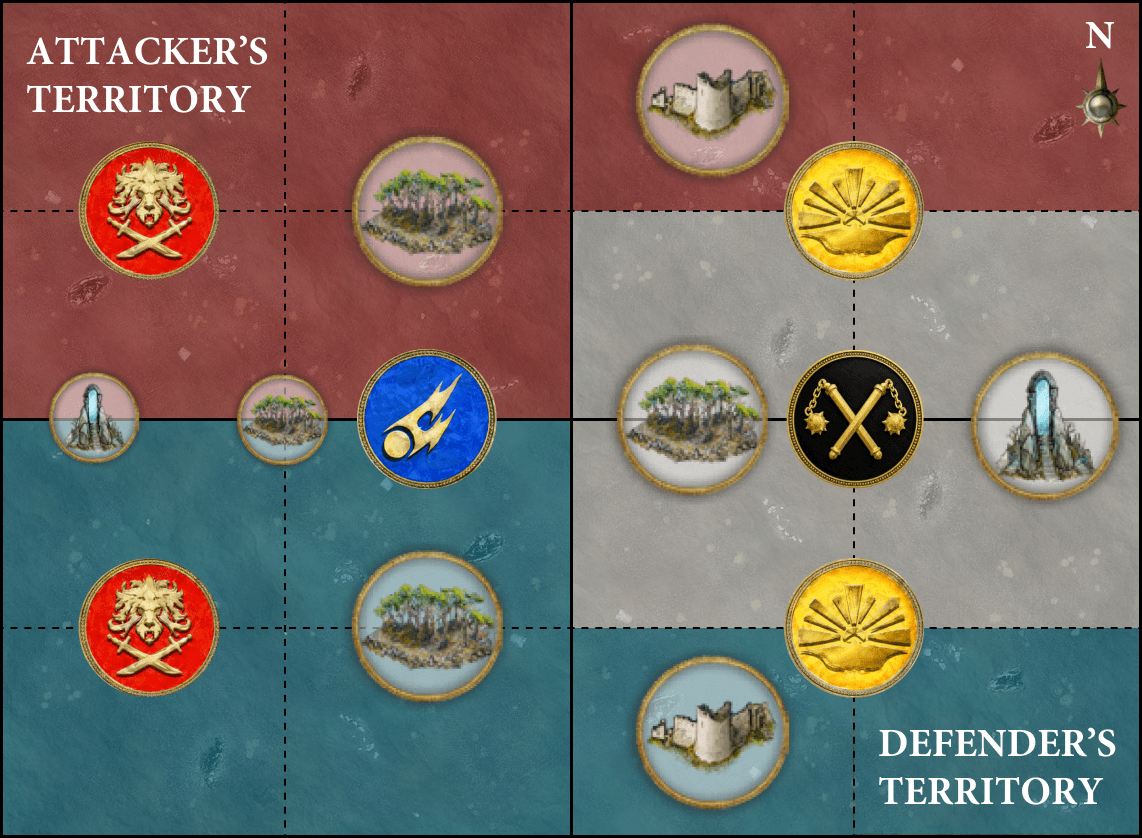
Battleplan 11 (Table 2) Escape from the CoastTWIST: If you are the underdog, you can use the following ability. Each player scores victory points at the end of each of their turns as follows:
TO THE SHIPS!Declare: Pick the Heldenhain  or a Sun Seekers objective to be the target. or a Sun Seekers objective to be the target.Effect: Remove the target from the battlefield.
 | ||||||||||||||||||||||
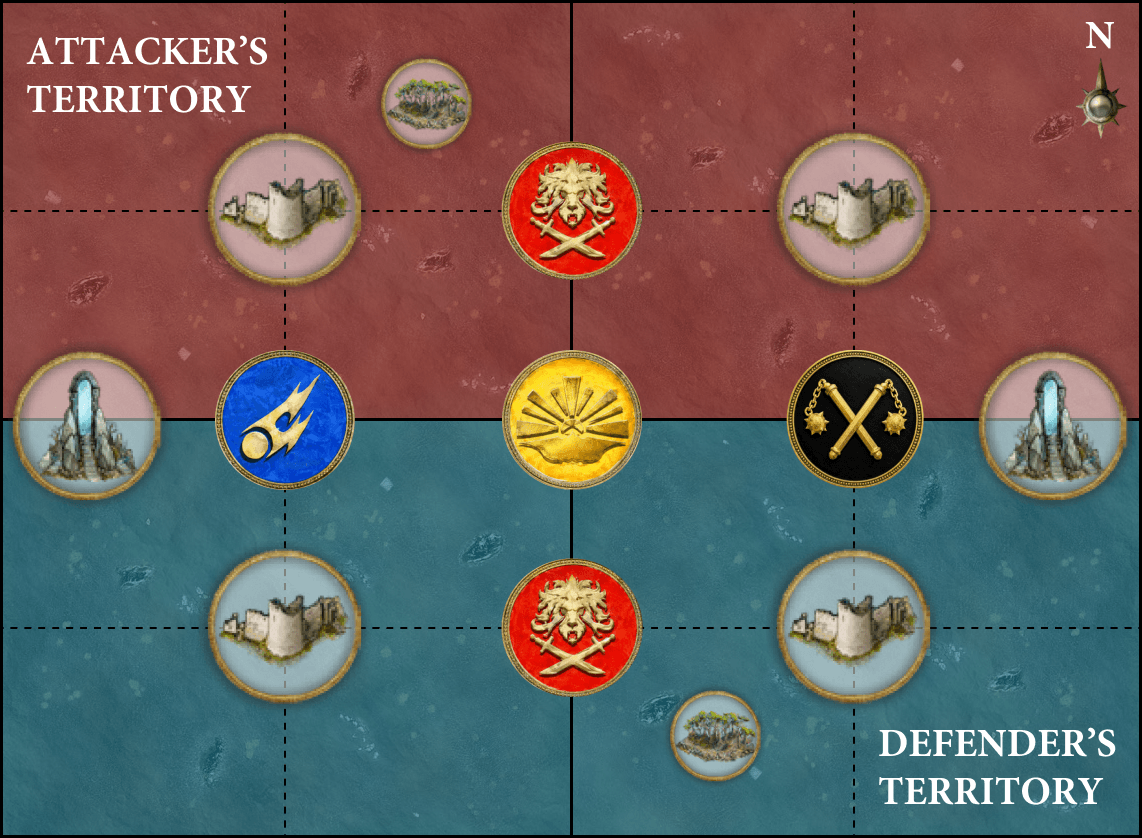
Battleplan 12 (Table 2) Power of the RealmsTWIST: At the start of the battle, the Sun Seekers objective is the primary objective and the other objectives are secondary objectives.If you are the underdog, you can use the following ability.
ARCANE CHARGEDeclare: Pick a Place of Power you control to be the target. Effect: Draw a straight line from the centre of the primary objective to the target. If that line crosses any secondary objectives, the first secondary objective that the line crosses is now the primary objective and all other objectives are now secondary objectives.
 | ||||||||||||||||||||||
Tournament Organiser Pack 2026-27
Why Run a Warhammer Age of Sigmar Event?
Organised events are a hugely enjoyable and exciting way to play Warhammer Age of Sigmar, but without tournament organisers (TOs), no one would get to experience them. Running an event is not only fun for the TO, it is also a different way to enjoy the hobby. There are few things as rewarding as watching over a group of enthusiastic hobbyists playing competitive Warhammer Age of Sigmar at an event that you have organised. Moreover, it’s a well-known fact that TOs are the true heroes of the Mortal Realms!
But what does it mean to be a TO? Ultimately, a TO is in charge of setting up and running an event. This includes organising the venue, preparing a ‘pack’ that sets out everything players need to know to prepare for and attend the event, welcoming players to the venue, making decisions on rules queries (or bringing in an appointed judge) and compèring the closing ceremony while the awards are being handed out.
This section of the General’s Handbook provides you with all the information you need to be a TO for your own event. It contains lots of hints and tips on how you can customise the event to your own preferences as well as an example tournament pack.
We have split the information into two main categories: what a TO needs to consider when planning an event and what a TO will need to do during the event. Remember, though, these are simply guidelines intended to assist you in planning and running your event; they are not hard and fast rules.
Planning Your Event
There is a saying that TOs in the Warhammer Age of Sigmar event community often use: ‘Run the event that you would like to play in’.
The Pack
Every event should have a document called a ‘pack’. The pack provides the players with all the details about the event, such as where it is, what battlepack will be played and what awards can be won. An example pack can be downloaded from warhammer-community.com.
The Battlepack
One of your first decisions should be what battlepack you want to use for your event – and there are many different battlepacks published by Games Workshop for you to choose from! We also periodically publish new battlepacks in White Dwarf or on warhammer-community.com.
The General’s Handbook 2026-27 battlepack is designed for Matched Play events; however, there are multiple ways to play Warhammer Age of Sigmar, and you should pick a battlepack that reflects the type of event you wish to run. For example, the Spearhead battlepack City of Ash is fantastic for small, quick games of Warhammer Age of Sigmar using fixed army rosters, the Matched Play battlepack First Blood is excellent for introducing players to competitive play, while the Path to Glory battlepack Blighted Wilds provides a framework for narrative play and campaigns. The General’s Handbook 2026-27 battlepack also introduces Joint Crusades as a way to run events for teams of multiple players fighting side-by-side.
It’s worth having a good read of each battlepack to make sure that it fits your vision for your event. Not only will this ensure that you understand the rules of the battlepack, it will also give you an indication of how much pre-event preparation is required. For instance, creating the opening narrative of a Path to Glory event will take a little more effort to prepare than an off-the-shelf First Blood event, but it will be no less exciting or rewarding.
Maximum Points Limit
The maximum points limit will determine how large each player’s army can be. The higher you set the maximum points limit, the longer it will take players to finish their games.
The most common points limit for Matched Play events is 2000 points; however, feel free to set a higher or lower points limit if it would better suit your event.
Army Rosters
With regard to army rosters, it is worth bearing in mind that new rules can change the points of existing units or otherwise change army composition options. As both events and new miniature and battletome releases often take place on a weekend, this means that new rules can come into effect after the first round of an event has started. Therefore, many TOs will specify a ‘cut-off date’ for rules – any rules introduced after this date cannot be used at the event. The timing of the cut‑off date is entirely at your discretion, but we suggest either the same day as the pre-event list submission deadline (see below) or 1-2 weeks before the event to give players time to adjust their lists.
As TO, you might be happy for players to bring their army rosters to their event and show them to their opponents before each game, or you might prefer players to submit their army rosters a week or so prior to the event. Having a pre-event list submission deadline means that you have time to independently check army rosters for mistakes and allows you to share the lists among all the players, should you wish. This kind of event is often called an ‘open-list event’.
One advantage of open-list events is that the players also get a chance to look over and discuss their potential opponents’ lists, so they can help to identify any inconsistencies that might need to be fixed before the event.
Whichever option you decide is best for your event, we recommend that you ask players to use the Warhammer Age of Sigmar App to build their army roster so that the rosters are clear and all follow the same format.
Number of Rounds
You will need to choose how many rounds you want to have at your event. Each player will play 1 game of Warhammer Age of Sigmar per round, so at a three-round event, each player will play 3 games. The table below gives an indication of how long a typical 2000-point event will take depending on the suggested number of rounds. Note that your event can contain as many rounds as you like; the numbers below are indications on how long an event with that many rounds will take.
| Number of Rounds | Approximate Duration | Event Notes |
|---|---|---|
| 3 | 1 day | Often called a ‘one-dayer’ and usually held on a Saturday or Sunday. Works well with 4 or more players. |
| 5 | 2 days | A standard event length that fits nicely into a weekend. Works well with 6 or more players. |
| 8 | 3 days | Often used for Grand Tournaments or other large events with 80+ players. |
Scheduling Round Timings
You will need to decide how much time will be allotted for each round and how this will determine the schedule for your event. For a 2000-point game, we suggest allowing around 2 to 3 hours per round. If your players are relatively experienced at playing Matched Play games, they should be able to finish more quickly and you can have shorter round times.
Players will need a break between each round and you, as the TO, will need enough time after all the games have finished to collate the results and work out the pairings for the next round. We suggest a minimum of 30 minutes between rounds.
Suggested Game Speed Milestones and Time Breakdown
Outside of tournaments, many players do not complete their games against a set clock. As a result, when a loudspeaker shouts ‘Two hours remaining!’, most players do not naturally think ‘We should almost be done with the entire first battle round!’. To help with this, rather than simply calling time left, we recommend calling time based upon the game speed milestone players should have (on average) arrived at. These time calls exist to help keep the flow of play moving, and are not binding. The suggested milestones are:
For clarity, this provides each player with, on average, the following time breakdown for the typical game:
| Time Remaining | Milestone |
|---|---|
| 3:00 | Start round (formally) |
| 2:50 | Complete pre-game discussions and decisions |
| 2:30 | Deployment complete, begin Round 1 |
| 1:50 | First Battle Round complete, begin Round 2 |
| 1:10 | Second Battle Round complete, begin Round 3 |
| 0:40 | Third Battle Round complete, begin Round 4 |
| 0:20 | Fourth Battle Round complete, begin Round 5 |
| 0:10 | Do not begin a new Battle Round without a judge’s permission |
| Activity | Time per Player |
|---|---|
| Pre-game activities, review army lists, select secondaries | 5 minutes |
| Deploying their models | 10 minutes |
| Playing their First Turn | 20 minutes |
| Playing their Second Turn | 20 minutes |
| Playing their Third Turn | 15 minutes |
| Playing their Fourth Turn | 10 minutes |
| Playing their Fifth Turn | 10 minutes |
We also recommend letting the players know that if they are concerned about finishing their game on time, they should not hesitate to call a judge. It is a good approach that, to ensure all games finish within the allotted time, judge assistance is an active part of time-constrained games.
Battleplans
You can pick battleplans before your event or randomly determine them before each round. If you pick them before the event and make them public, players can tailor their lists to be the most efficient for those battleplans. Conversely, using ‘secret’ or randomly determined battleplans will mean that players will likely need to bring ‘all-rounder’ army rosters in order to do well.
If you aren’t sure what battleplans to choose for your event, the General’s Handbook 2026-27 also contains a selection of pre-made Aqshian Crusades that have a set list of battleplans alongside a short thematic link.
You will also need to consider terrain placement. The General’s Handbook 2026-27 battlepack contains 2 rules sets for terrain placement: in the first, placement is determined by the attacker/defender roll-off, while the second uses preset terrain layouts.
For larger events using preset terrain layouts, it may be more convenient to leave the same terrain set up over multiple battles. In order to facilitate this, each preset terrain layout lists at the top of the page which other battleplans are compatible with that terrain layout.
Pairing Players
While the first round of most tournaments is randomly paired, subsequent round pairing can be done in a number of ways. The first pairing metric should be player record, i.e. pairing a 3-1 player with another 3-1 player, and so on. Given that most rounds will include numerous players with the same record, however, deciding pairings beyond this metric can be quite nuanced, and the different methods available can have significant impacts on the experience of players at an event. We recommend pairing players by the following criteria:
- First – by record (i.e. the number of wins, losses and draws)
- Second – by win path (i.e. the timing of the rounds in which a player won or lost their games)
- Third – randomly within players of the same ranking
Win Path
A player’s ‘win path’ refers not to their number of wins and losses but to the timing of those wins and losses. While pairing by win path has an incidental tendency to pair people by strength of schedule, its greatest impact is on the overall enjoyment experienced by all players, as it tends to pair players based upon shared experience.
For example, let’s take two 3-1 players. One of them lost their first game; they likely lowered their expectations for winning the whole event after this but are probably in a great mood after three consecutive victories. The other player won their first three games then lost their fourth – a sharp disappointment after a 3-0 start. Should these players face off, their shared enjoyment may be at odds as they are in very different emotional places. Using win path as the second pairing metric would ensure that these players do not face each other in round 5. They would instead face players that won and lost in the same rounds.
Win path ensures players enter their match with recent common experiences upon which to build a friendship during their next game of Warhammer.
Ranking Players
You will need a scoring system so that you can both rank your players and work out which player is the champion! The simplest scoring system is a win/loss/draw ranking system where the player who wins the most games is the champion. However, Matched Play battleplans also further categorise the result of a game into a major victory, a minor victory or a draw (with major losses and minor losses implied rather than called out).
Therefore, we recommend a scoring system that ranks players according to the number of major victories they have achieved, then the number of minor victories, draws, minor losses and major losses.
With any system, even small events can end up having players with the same scores, and so it is important to have a tie-breaker system in place. We recommend using the following as tie-breakers:
1. Opponent Game Winning Percentage (i.e. a player with more wins against opponents with better win records would place higher)
2. Total number of victory points scored
3. Total number of battle tactics completed
4. Total number of battle tactics that their opponents failed to complete
5. Total victory point differential
Awards
In addition to rewarding the players with the highest scores, some event organisers also like to present a variety of other awards to celebrate other aspects of the hobby such as the theme of an army, the quality of the painting of an army or the sportspersonship displayed by players during the event..
You can decide whether you wish to include awards such as these in your event. If you do, you will also need to determine the methodology of how these awards are won by the players.
Logistical Decisions
There are a number of logistical decisions that you will need to consider when you are planning your event.
Venue
You will need a venue for your event. If your event is too big to host in your house, garden or hobby room, consider speaking to local halls or your friendly local gaming store (FLGS) to see if you can use their space.
Number of Players/Tables
You will need to decide how many players you want to host at your event. This might be restricted by physical factors such as the size of your venue or the amount of terrain you have available. Most importantly, make sure you choose an even number so that everyone has an opponent in each round! We would also recommend having a spare player on hand in case you end up with an odd number of attendees at your event (see the Spare Player section below). This could be a second event judge who plays against odd persons out as necessary without being eligible for awards or placings themselves. Having a spare player ensures everyone who wants to play has equal opportunity.
Terrain
We recommend that you use the terrain layouts presented in the battleplans you have picked for your event. You will need to either provide enough appropriate terrain for each table or ask your players to bring terrain with them. Be aware that if you choose the latter option, you will have little control over the type of terrain that will be used at your event.
Food
Your venue may be able to provide food for your players or you could arrange for some form of catering. If you decide to go down this route, make sure you inform your players of their options and find out if there are any allergies or specific dietary requirements that will need to be catered for. Alternatively, you may decide not to provide food, in which case you will need to allow enough time in your schedule for players to find somewhere to buy food if they have not brought any with them. Either way, make sure that your players are aware of your decision prior to the event so that they can prepare accordingly.
Tickets (Price, Method of Purchase, Refund Policy)
You will need to set the ticket price, tell your players how they can purchase a ticket and clarify your refund policy. We suggest including a cut-off date after which refunds will not be provided – this means you will not end up out of pocket if several players are unexpectedly unable to attend your event.
Judges
If possible, you should have a judge – someone who can mediate any disputes that may arise. Be clear to your players that judges have final say on rules disputes on a game-by‑game basis. To avoid conflicts of interest, we recommend having a player who is not participating in the event to be your judge. Additionally, this person can serve as a spare player as mentioned above, should the need arise.
The first port of call for judges should always be to double-check the exact wording of the rules in question (whether in the Core Rules, a battletome or another supplement). We regularly answer additional rules queries and address any errata on warhammer‑community.com. In the event that they cannot find clear guidance, the judge should make what they feel is the most reasonable and fair ruling to allow the game to progress.
Active Judging
Active judging is a proactive method of judging Warhammer events and is often adopted by experienced TOs. If you feel confident enough to do so, we recommend adopting an active judging approach for your event.
Active judging is just that: taking an active approach to judging the event as opposed to waiting for questions or issues to arise. Active judging requires judges to be constantly moving between tables and observing play. This allows the judge to immediately correct any misplays and also implicitly communicates that judges are closely watching games, which will help to dissuade any intentional misplays. It is important that you inform your players that active judging is in effect and that judges do not need to be called prior to resolving an issue.
Recording Scores
You will need to record scores during your event. You could use a custom-built spreadsheet or, alternatively, there are several websites and apps that can record scores for you. The Warhammer Events team uses Best Coast Pairings (BCP) to manage pairings and placings at our events.
Using Best Coast Pairings will also allow you to submit both competitive and hobby track scores to the International Tournament Circuit (ITC). The ITC is the global ranking system for both competitive events and hobbying. Tens of thousands of players compete in the ITC and including your event in it can help to bring in more attendees!
Pre- and Post-gaming
You will need to allow time in your schedule for a welcome briefing (which should include health and safety information, such as the locations of fire exits and welfare facilities) and an award ceremony after the games have all finished.
Permissible Models
Players will need to know what models will be permissible at your event and to what standard they must be painted. We recommend that all models should be fully assembled and painted to at least a Games Workshop Battle Ready standard. You can find further information on this at warhammer-community.com.
Prizes
If you decide to give out awards at your event, you will need to determine what the prizes will be. We recommend at least 1 prize for gaming, 1 prize for painting and 1 prize for sportspersonship. If you have sufficient prize support, you could award first, second and third places. Common prizes include trophies, certificates and boxes of Citadel Miniatures. Downloadable certificates can be found on warhammer-community.com.
Spare Player
Sometimes, real life gets in the way of Warhammer and players have to drop out of an event unexpectedly. This could leave you with an uneven number of players, meaning that each round, one player would not have an opponent. Given that players will have come to your event to play Warhammer Age of Sigmar, the best option is to make sure you have a spare player, such as a friend or a clubmate, who can step in and play if needed. If this is not possible, you could award maximum points to the player who did not have an opponent that round.
Contact Details (Event-specific Email Address/Phone Number)
Your players may need to get in touch with you to clarify some details about the event, so we recommend providing them with an email address and/or telephone number that they can contact you on.
What To Do With Overruns
Despite a TO’s best efforts, games will sometimes overrun the time allotted for a round. You will need to decide how you will deal with these situations. If the game is almost at an end, you could let the players continue playing the game to its natural conclusion, provided that to do so would not impact the start of the next round.
If there is not enough time to allow the battle to finish without impacting the start of the next round, we recommend encouraging the players to talk through the most likely outcome of the remaining battle round(s), facilitated by a judge. These instances should be a rarity, as the best situation is to ensure that there is sufficient time and that milestones are clearly communicated so that all games reach their natural conclusion.
Dropped Players
Sometimes, in exceptional circumstances, a player might need to leave an event and are unable to complete their remaining games. To make sure that all remaining players can be paired with an opponent, we recommend that you have a spare player available to step in.
If a player has to leave mid-game, we recommend that they receive a major loss and their opponent wins a major victory. Their opponent scores maximum victory points for each remaining round and the player who had to leave scores no further victory points.
Each unit can only count as contesting a single objective for the purposes of determining objective control (see 32.2). Before determining objective control, for each of their units contesting two or more objectives, the active player must pick one of those objectives for it to contest. Then, their opponent does the same.
Designer’s Note: For purposes other than determining objective control, a unit can contest more than one objective.
Errata
‘Each unit can only count as contesting a single objective for the purposes of determining objective control (see 32.2). Before determining objective control, for each of their units contesting two or more objectives, the active player must pick one of those objectives for it to contest. Then, their opponent does the same.
Designer’s Note: For purposes other than determining objective control, a unit can contest more than one objective.’
‘contesting: Models contest objectives within their combat range (3"). When determining objective control, the same unit cannot contest more than 1 objective at the same time; the player must pick 1 if more than 1 is within range. (Core Rules, 32.1)’

 Your Movement Phase Your Movement Phase |
Effect: Inflict D3 mortal damage on that unit. That unit can move a distance up to its Move characteristic. That unit can move through the combat ranges of any enemy units but cannot end that move within an enemy unit’s combat range.
| KEYWORDS | CORE, MOVE, RETREAT |
A model is considered to be in combat with an enemy unit if that unit is within the model’s combat range and visible to it’
| ||
FAQ / Errata
| Q: | If a model in base-to-base contact with an enemy model retreats 3" directly away from the enemy model, is it still in combat with that enemy model? |
| A: | No. |
‘A model is considered to be in combat with an enemy unit if that unit is within the model’s combat range and visible to it.’
| Critical hits have no effect on their own but often trigger additional effects (see 20.0 Weapon Abilities). | ||
| Passive |
| Once Per Turn (Army), End of Any Turn |
Effect: Pick 1 of the melee weapons that the unit using this ability is armed with. Then, spend up to 3 rage dice.
Resolve a number of combat attacks against the target using the melee weapon you picked equal to the number of rage dice you spent.
Those attacks cannot score critical hits. Instead, for each unmodified hit roll of 6 for those attacks:
- Inflict an additional D3 mortal damage on each enemy unit in combat with the unit using this ability.
- Your opponent must increase their fury level by 1, to a maximum of 7.
For each unmodified hit roll of 1 for those attacks, allocate D3 mortal damage to this unit after the damage sequence has been resolved (ward rolls cannot be made for those damage points).
Designer’s Note: Rage dice do not add to the Attacks characteristic of the weapon you pick; if you spend 3 rage dice to use this ability, you only make 3 combat attacks.
| KEYWORDS | ATTACK, FIGHT |
When allocating damage points to a unit, the damage points in its damage pool are allocated to it one at a time. Each time the number of damage points allocated to the unit equals the Health characteristic of that unit, 1 model in that unit is slain (and removed from play) and the number of damage points allocated to that unit is reset to 0. Keep allocating damage points until there are none left in the damage pool.
If the number of damage points allocated to a unit is not enough to slay a model, keep track of the number of damage points currently allocated to the unit (most players place a dice or markers next to the unit). While a unit has any damage points allocated to it, it is damaged.
| Passive |
Each HERO’s battle profile lists which units can be added to their regiment, and each non-HERO unit’s battle profile lists any relevant keywords it has. The battle profiles of some HEROES may say that they can be added to the regiment of another HERO in place of a non-HERO unit in that regiment.
While some abilities allow you to take extra enhancements, the same unit can never have more than 1 enhancement of the same type, and you can never include the same enhancement in your army more than once. Enhancements cannot be given to Regiment of Renown units, unless they have a keyword that matches that faction’s name.
You can pick 1 prayer lore available to your faction. If you do, all PRIESTS in your army with the same faction keyword as your general know all prayers from that lore.
You can pick 1 manifestation lore available to your faction. If you do, all WIZARDS in your army know all spells from that lore, and all PRIESTS in your army know all prayers from that lore.
- You cannot include more than one Regiment of Renown in your army unless otherwise specified in the notes column of that regiment’s battle profile.
- Units in a Regiment of Renown cannot use (but can be picked as the target of, if otherwise eligible) any faction rules from the faction they are allied into, including enhancements and lores.
- If an ability allows you to set up a replacement unit (Core Rules, 24.2) for a unit in a Regiment of Renown, that unit also counts as being part of that Regiment of Renown.
| Your Charge Phase |
Effect: That unit can move a distance up to the value of the charge roll. That unit can move through the combat ranges of any enemy units and must end that move within 1/2" of a visible enemy unit. If it does so, the unit using this ability has charged.
| KEYWORDS | CORE, MOVE, CHARGE |
| Passive |
- That unit is only visible to enemy units that are within its combat range.
- The Range characteristic of that unit’s ranged weapons is halved (rounding down to the nearest inch).
Terrain Abilities: Cover, Obscuring, Unstable
If a rule or ability requires a target to be both within a given range of and visible to the unit using that ability, or to a model in that unit, both conditions must be met by the same model in the target. You could not, for instance, target a unit where one model is within range but not visible and another model is not in range but is visible.
| ||
| In some cases, it might not be immediately clear whether a model is visible. If so, stoop down to get a look from behind the observing model. If any part of the other model is visible, even if it is just the tip of a spear, then that model is visible for rules purposes. | ||
FAQ / Errata
| Q: | If a non-FLY INFANTRY HERO (e.g. a Scinari Cathallar) is a Shrine Guardian of a Shrine Luminor, and that Shrine Guardian is within 1" of an obscuring terrain feature, is the Shrine Guardian visible to enemy abilities that target the Shrine Guardian? |
| A: | Yes. |
‘If a rule or ability requires a target to be both within a given range of and visible to the unit using that ability, or to a model in that unit, both conditions must be met by the same model in the target. You could not, for instance, target a unit where one model is within range but not visible and another model is not in range but is visible.’
1. Determine the Active Player: If it is the first battle round, the player who finished setting up their army first decides who will take the first turn (unless otherwise specified in the battlepack or battleplan).
If it is not the first battle round, the players make a roll-off called the priority roll and the winner decides who will take the first turn. If the roll-off is a tie, the player who took the first turn in the previous battle round decides who will take the first turn in the current battle round.
When it is a player’s turn, regardless of whether they take the first or second turn, they are referred to as the active player.
2. Determine the Underdog: Whichever player has the fewest victory points is the underdog for the battle round. If the players are tied (e.g. in the first battle round), then there is no underdog, unless otherwise specified.
3. Start of Battle Round Abilities: The active player can use any
FAQ / Errata
| Q: | When determining the active player, how do you determine when a player has ‘finished setting up their army’? |
| A: | A player has finished setting up their army when all units in their army have been deployed. This means that non-DEPLOY Deployment Phase abilities (e.g. The Masque’s ‘The Endless Dance’ ability) happen after your army has ‘finished setting up’. |
‘underdog: Player with fewest victory points. If tied, there is no underdog for that battle round.’
- That unit is only visible to enemy units that are within its combat range.
- The Range characteristic of that unit’s ranged weapons is halved (rounding down to the nearest inch).
If the unmodified casting roll includes 2 or more rolls of 1, the spell is miscast: the spell fails, its effect is not resolved, D3 mortal damage is inflicted on the WIZARD that used it, and that WIZARD cannot use any more spells in that phase.
Enemy reactions can only be used if the casting roll equals or exceeds the spell’s casting value. So long as the spell is not unbound (see 4.0), then it is successfully cast: resolve its effect.
| Your Hero Phase | 6 |
Effect: The target has WARD (6+) this turn.
| KEYWORDS | SPELL |
Otherwise, pick one of the following:
- Give a number of ritual points to the PRIEST equal to the chanting roll (ritual points can be accumulated over multiple turns).
- You can add the PRIEST’s ritual points to the chanting roll. If the chanting roll equals or exceeds the prayer’s chanting value (at the top-right corner of the prayer), it is answered: resolve the effect of the prayer, then reset the PRIEST’s ritual points total to 0.
All PRIESTS know the following prayer:
| Your Hero Phase |
Effect: Give a number to ritual points to the PRIEST equal to the unmodified chanting roll and do not reset the PRIEST’s ritual points to 0.
| KEYWORDS | PRAYER, UNLIMITED |
 Once Per Battle, Your Hero Phase Once Per Battle, Your Hero Phase | 7 |
Effect: Pick a friendly INFANTRY HERO that has been slain and return them to the battlefield. Set up that HERO wholly within 3" of this PRIEST.
| KEYWORDS | PRAYER |
| Reaction: Opponent declared a SPELL ability |
Effect: Make an unbinding roll of 2D6. If the roll exceeds the casting roll for the spell, then the spell is unbound and its effect is not resolved. This reaction cannot be used more than once per casting roll.
| KEYWORDS | UNBIND |
| Your Hero Phase |
Effect: If the banishment roll equals or exceeds the banishment value listed on the MANIFESTATION’s warscroll, it is banished and removed from play.
| KEYWORDS | BANISH |
| Once Per Turn (Army), Start of Any Turn |
Effect: Roll a dice. On a 1, inflict D3 mortal damage on that HERO. On a 2+, pick 1 of the following effects:
- Ignite Fury: Gain 2 rage dice, then increase your fury level by 2, to a maximum of 7.
- Channel Wrath: If that HERO is a WIZARD or PRIEST, add 1 to casting rolls or chanting rolls for that HERO for the rest of the turn.
- Dizzying Rage: For the rest of the turn, if that HERO is not a WIZARD or PRIEST, they can use the ’Unbind’ or ’Banish Manifestation’ ability as if they had WIZARD (1).
| KEYWORDS | CORE |
Terrain Abilities: Cover
Terrain Abilities: Cover, Place of Power, Unstable
- Starting with the active player, each player determines the control score of each of their units that is contesting that objective. A unit’s control score is the combined Control characteristics of all the models in that unit that are contesting the objective. Some abilities modify a unit’s control score, but it cannot be reduced to less than 1.
- Each player adds up the control scores of all of their units contesting that objective. This is their army control score for that objective.
- The players compare their army control scores for that objective. If one player’s score is higher, that player gains control of that objective. Once a player gains control of an objective, it remains under their control until their opponent gains control of it.
| Sometimes objective markers get accidentally nudged while you are moving models around. This is perfectly fine - just remember to put them back in their proper positions when determining objective control. | ||
Errata
‘In the deployment phase after all Deployment Phase abilities have been used and at the end of each turn, follow this sequence for each objective in an order chosen by the active player:’
- In the combat phase, they are treated as if they were units for the purposes of movement, combat range and being in combat.
- They are affected by all enemy abilities as if they were units.
- They can be damaged in the same manner as units. However, when they are removed from play, they count as being demolished instead of slain or destroyed (this means that they do not count as destroyed units for the purposes of abilities, scoring battle tactics, etc.).
- Enemy units can finish a charge move within ½" of a terrain feature that is garrisoned (see 1.5.1). Faction terrain features cannot contest objectives even while they are garrisoned.
- If a terrain feature has any melee or ranged weapons, it can use the 'Fight' and 'Shoot' CORE abilities as if it were a unit.
- Terrain features that have a Move characteristic of 0" ('-') cannot move (note that pile-in moves are a type of move).
- Faction terrain features with a Move characteristic greater than '-' are treated as if they were units in all phases for the purposes of movement, combat range, being in combat and setting up terrain features, other manifestations and other units.
Some faction terrain features allow you to place a unit on them (this will be clearly specified in that terrain feature’s rules). When doing so, instead of measuring range or visibility to and from the unit that is on that terrain feature, measure to and from the terrain feature instead. Unless otherwise specified, units on a faction terrain feature cannot use FIGHT abilities.
If a unit placed on a terrain feature is removed from it (e.g. if an ability removes them from the battlefield), that unit counts as having left that terrain feature and loses any special role or benefits it had as a result of being placed on it.
| The Citadel Terrain List shows the number of scenery pieces each terrain feature can consist of. If you are using terrain features that are not included on that list, agree with your opponent before setting up the battlefield how many scenery pieces make up each terrain feature. | ||
If the unit is in combat, it can only target units that are in combat with it. If a model has more than one attack, you can split the attacks between eligible targets as you wish.
- Combat attacks are made with melee weapons. The target unit(s) must be within the combat range of the attacking model and visible to it. The model must attack with all of the melee weapons it is armed with.
- Shooting attacks are made with ranged weapons. The target unit(s) must be within a distance equal to the Range characteristic of the weapon being used and visible to the attacking model. Models cannot make shooting attacks if their unit is in combat, unless otherwise specified (see 20.0 Weapon Abilities).
FAQ
| Q: | When making shooting attacks, can all models in the attacking unit shoot even if the target unit is not visible to some of those models? |
| A: | No, the only models in the attacking unit that can make shooting attacks are those that the target unit is visible to. |
| Q: | When a unit uses a SHOOT ability, does it have to shoot with all of the ranged weapons that it is armed with? |
| A: | Yes. |
 Your Shooting Phase Your Shooting Phase |
Effect: Resolve shooting attacks against the target unit(s).
| KEYWORDS | CORE, ATTACK, SHOOT |
| Any Combat Phase |
Effect: Resolve combat attacks against the target unit(s).
| KEYWORDS | CORE, ATTACK, FIGHT |
Manifestations are not units but can be interacted with in similar ways, as explained next:
|
|
|
| Once Per Turn (Army), Start of Any Turn |
Effect: Roll a dice. On a 1, inflict D3 mortal damage on that HERO. On a 2+, pick 1 of the following effects:
- Ignite Fury: Gain 2 rage dice, then increase your fury level by 2, to a maximum of 7.
- Channel Wrath: If that HERO is a WIZARD or PRIEST, add 1 to casting rolls or chanting rolls for that HERO for the rest of the turn.
- Dizzying Rage: For the rest of the turn, if that HERO is not a WIZARD or PRIEST, they can use the ’Unbind’ or ’Banish Manifestation’ ability as if they had WIZARD (1).
| KEYWORDS | CORE |
| End of Any Turn | 1 |
Effect: Inflict D3 mortal damage on the target. Then, the unit using this ability can move a distance up to its Move characteristic. It can pass through and end that move within the combat ranges of enemy units that were in combat with it at the start of the move, but not those of other enemy units. It does not have to end the move in combat.
| KEYWORDS | MOVE |