Warhammer Doubles


Books


BookKindEditionVersionLast update
  Chapter Approved 2026-27: Mission Deck
  Chapter Approved 2026-27: Mission DeckExpansion11
  Warhammer Event Companion
  Warhammer Event CompanionExpansion111.2August 2026
  Warhammer Doubles - Event Companion
  Warhammer Doubles - Event CompanionExpansion111.1August 2026

FAQ

Q:The Plunder Secondary Mission references ‘One unit within a terrain area that is not within your territory.’ Is the requirement to be ‘not within your territory’ referring to the unit or the terrain area?
A:
The terrain area.
Q:If the unit I select to be my Beacon unit upon drawing the Beacon Secondary Mission is destroyed prior to achieving the mission, can I select a new Beacon unit?
A:
No, which means you will be unable to achieve that mission. We recommend discarding it on your turn to gain 1CP!
Q:For the purposes of VP scoring limits, is the end of the battle the same timing as the end of the fifth battle round?
A:
No, VP scored at the end of the battle are not subject to the 15VP per battle round scoring limit.
Q:When a mission action places an operation marker and applies a status (e.g. ‘decoyed’), does removing that operation marker also remove that status?
A:
Yes.
Q:Some Primary Mission cards let a player place operation markers on the battlefield. Can I remove these?
A:
Your Primary Mission card will specify how and when you can remove operation markers from the battlefield. If it doesn’t, you cannot remove operation markers.
Q:For the Death Trap Primary Mission, one objective reads ‘One or more enemy units that started the turn within a terrain area were destroyed, if that terrain area is trapped.’ Does that terrain area have to have been trapped at the point that enemy unit was destroyed?
A:
No.
Q:For the Surveil the Foe Primary Mission, one objective reads ‘One or more enemy units were surveilled this turn, unless each of those units is within range of one or more objectives that have one or more operation markers within range of them.’ For an enemy unit within range of an objective with an operation marker, can I achieve this objective if I remove the operation marker after surveilling that unit, as long as it is within the same turn?
A:
Yes.
Q:For the Vital Link Primary Mission, if there is more than one central objective, can I score the cumulative VP for my operation markers regardless of which central objective(s) they are within?
A:
Yes, as long as you control the objective(s) those operation markers are within.

Introduction

This companion is used alongside the Warhammer Event Companion to create the best experiences for all hobbyists playing a Doubles event. A Doubles event is one in which players compete in teams of two, with a team’s armies fighting as a single force against another team’s armies.

The recommendations are presented as follows:

Designer’s Note: This companion does not use the full contents of the Chapter Approved Mission Deck; it has been written to provide the best experience in a Warhammer Event. For this reason we have not included the Deployment or Twist cards, which are left for pick-up-and-play games.

Warhammer Doubles Event Mission Sequence

Before attending a Warhammer Doubles Event, each team completes the following step:

1

Muster Armies

Before attending a Warhammer Doubles Event, each team – consisting of two players – completes the following step:

MUSTER ARMIES
Muster armies as described in the Core Rules, with the following exceptions:
  • EPIC HERO units, datasheets that cannot be included more than once in your army, enhancements, and any other ‘once per army’ items cannot be included more than once across both armies within a team.
  • A particular upgrade can be included more than once in a player’s army following the usual muster armies rules, but cannot be included in both armies in a team (for example, a team could not include a Genestealer Cults Patriarch more than once, or the same upgrade in both armies, even if both players have selected the same detachments).
  • Each team selects one CHARACTER model from either army to be their team’s WARLORD.
  • Each team selects one Force Disposition card available to either of the armies in that team and records that on their roster.

Designer’s Note: Players within a team can choose to use the same faction keywords or different keywords, and can choose to use the same detachments or a different selection of detachments. See the Terminology and Core Rules Changes section for more information about how this affects your team’s armies.

A Warhammer Doubles Event battle is then waged by completing the remaining steps below:

2

Determine Mission

Each team finds the opposing team's Force Disposition symbol on their Force Disposition card. The Primary Mission that is listed below that symbol is that team's Primary Mission, which describes how to score VP.

3

Determine a Layout

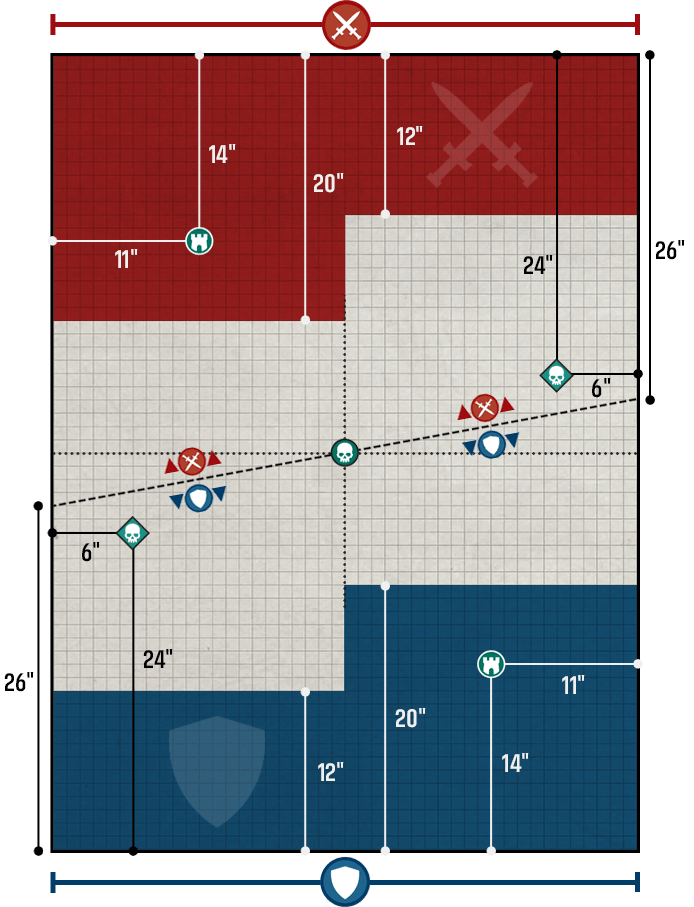
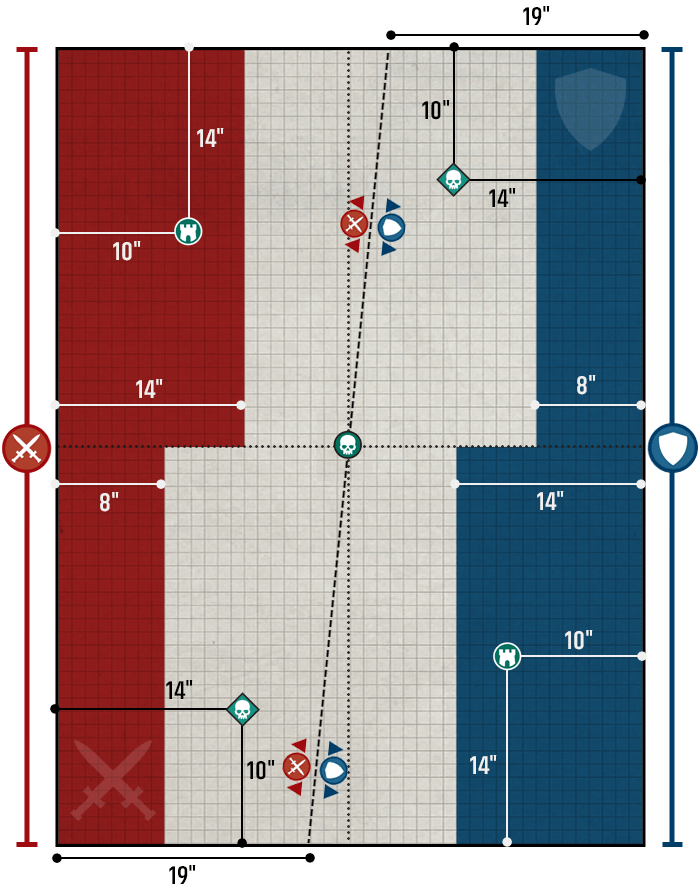
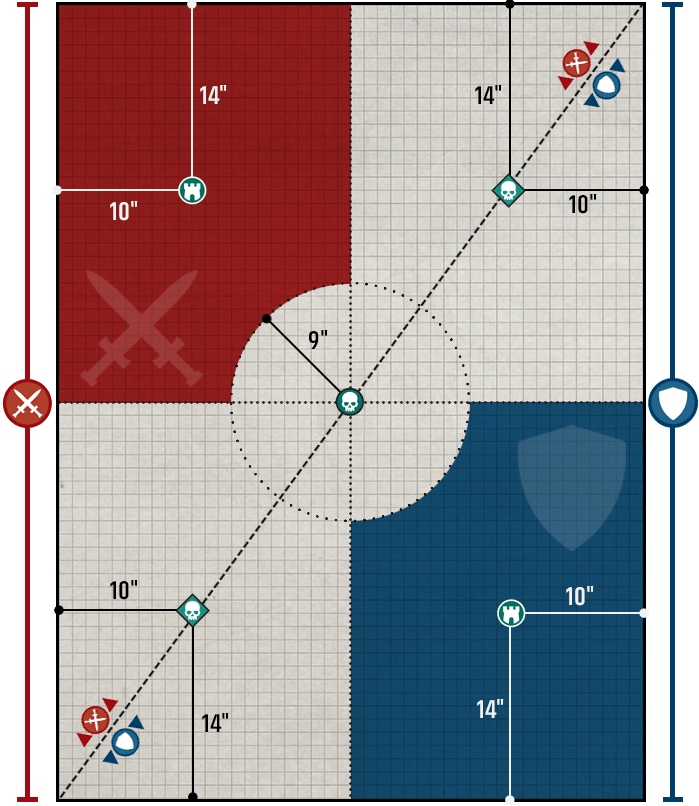
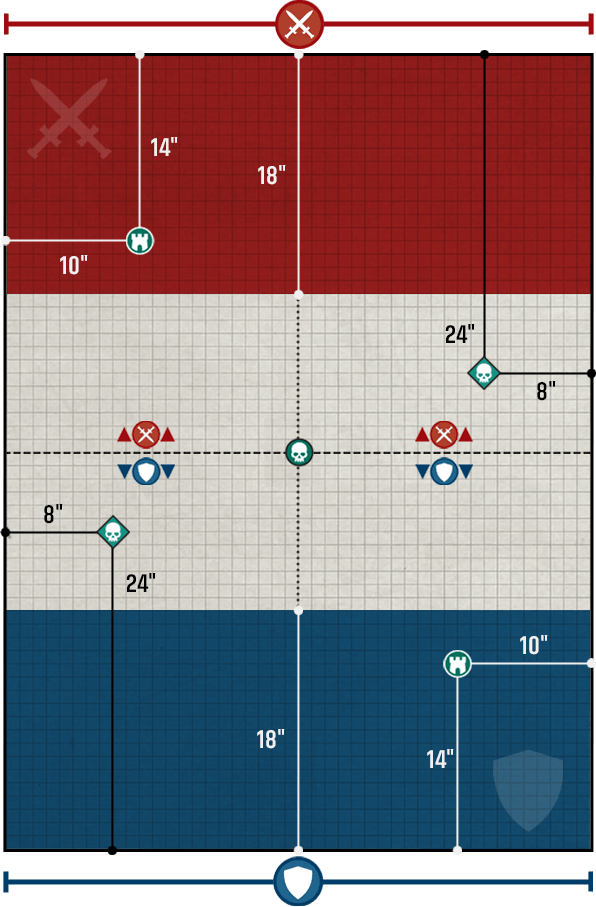
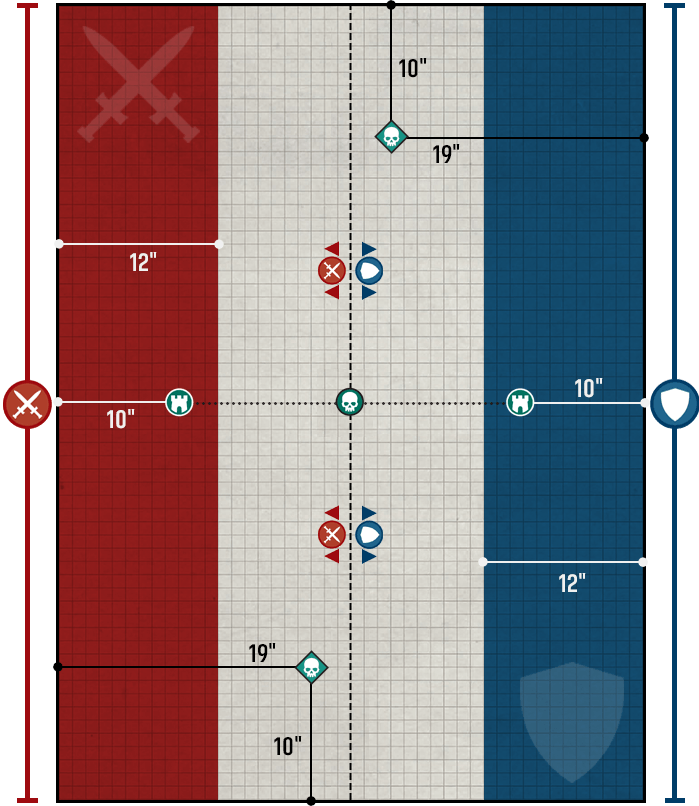
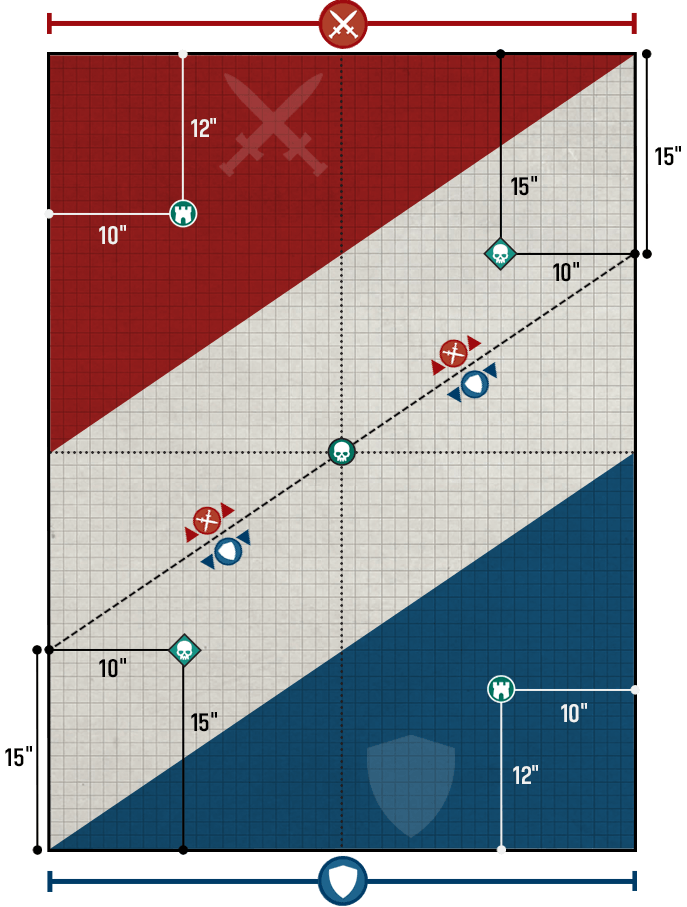
Each combination of Primary Missions has three recommended layouts, labelled A, B and C. These can be found in the Warhammer 40,000 app and in the Mission Generator below. As directed by the Warhammer Doubles Event organiser, the players either use the layout specified or randomly determine which of these layouts to use.

We recommend running through layouts A, B and C sequentially, repeating this as needed for the number of games being played.

Examples: For a 5 round event, we recommend the layout order A, B, C, A, B. For a 6 round event, we recommend A, B, C, A, B, C. For an 8 round event, we recommend A, B, C, A, B, C, A, B.

4

Create the Battlefield

Missions are played on rectangular battlefields 44" by 60" in size. Players set up the terrain areas as shown in the selected layout, then set up terrain features on those terrain areas as shown in the selected layout.

5

Determine Attacker and Defender

Players look at the selected layout and agree which edges of the battlefield the players have set up correspond with the Attacker’s and Defender’s battlefield edges labelled on the card.

Roll off: the winner decides who will be the Attacker and who will be the Defender.

6

Select Secondary Missions

Each team now secretly notes down whether they will use Tactical or Fixed Secondary Missions. If using Fixed Missions, they also note down which two Fixed Missions they will use (see below). Teams then reveal these decisions.

FIXED MISSIONS
Fixed Missions are those marked with the symbol shown on the left. If your team is using Fixed Missions, display your selected Fixed Mission cards face-up. Fixed Missions cannot be discarded and are active for your team throughout the battle.

TACTICAL MISSIONS
If your team is using Tactical Missions, shuffle your Secondary Mission deck face-down.
  • At the start of your Command phase, draw two Secondary Missions face-up from your Secondary Missions deck; these Secondary Missions are active for your team.
  • (Once per battle) At the end of your Command phase, you can spend 1CP to discard one of your active Secondary Mission cards and draw one new Secondary Mission card.

ACHIEVING SECONDARY MISSIONS
At the end of each team's turn, each team does the following, starting with the team whose turn it is:
  • First, if your team met the conditions on one or more Secondary Missions, you can gain the VP specified on that card. If you do, and if you are using Tactical Secondary Missions, discard that Secondary Mission – it is achieved.
  • Then, if it is your turn and you are using Tactical Secondary Missions, you can discard one or more of your active Secondary Missions. If you do, you gain 1CP.
7

Declare Battle Formations

Players secretly note down, in order:
  • Which of their units will start the battle embarked within which TRANSPORTS.
  • Which of their units will start the battle in strategic reserves.
Teams then reveal these decisions.

8

Deploy Armies

Teams take it in turns to set up their units (excluding those in strategic reserves) one at a time, wholly within their deployment zone, starting with the Defender. If you set up a TITANIC unit when it is your team's turn to set up a unit, skip your team's next turn to set up a unit. Once your team has finished setting up your units, if the opposing team has any units that have not been set up, they set up those units.

9

Redeploy Units

Some rules let you redeploy certain units after both armies are deployed. Unless otherwise stated, you resolve those rules in this step. Players alternate resolving any such rules, starting with the Attacker. Units placed in strategic reserves in this step do not count towards the combined points value of your strategic reserves units.

10

Determine First Turn

Roll off: the winner takes the first turn.

11

Resolve Pre-battle Rules

Teams alternate resolving any pre-battle rules units from their army may have, starting with the team who will take the first turn.

12

Begin the Battle

The first battle round begins. The players in a team take their turn together, as if they were a single player.

13

End the Battle

The battle ends after five battle rounds have been completed. Even if your team has no models remaining in your army at the start of your turn, teams continue to play out their turns until the battle ends.

14

Determine Victor

Each team scores 10VP if their armies are painted to a Battle Ready standard. At the end of the battle, the team with the most VP is the victor. If the teams are tied, the battle is a draw. The maximum VP that can be scored from each source of VP is listed below. Any VP your team scores in excess of these maximums are ignored.

VP SOURCEMAXIMUM VP
PRIMARY MISSION45VP
Up to 15VP per battle round
SECONDARY MISSIONS45VP
Up to 15VP per battle round*
BATTLE READY ARMY10VP
* In addition, you can gain a maximum of 20VP per Fixed Secondary Mission card.

Designer’s Notes

‘Cumulative’ and ‘Or’ Conditions

Some cards include a condition marked as ‘cumulative’ that follows a normal condition. If a player achieves the cumulative condition, they gain the VP for both that and the normal condition.

Some cards include one or more conditions marked ‘or’ that follow a normal condition. A player can only gain VP for one of these conditions or the normal condition.

Leaves the Battelefield

Some cards refer to a unit or units leaving the battlefield. A unit leaves the battlefield if it is destroyed, if it embarks on a TRANSPORT, or if a rule removes that unit from the battlefield (e.g. to place it in strategic reserves).

One

When a card states ‘one’, underlined, it means exactly one, not one or more.

VP Up to a Limit

Some cards award VP up to a limit, e.g. (up to 5VP). In such cases, any VP you score in excess of this limit are ignored.

When Drawn

Some Secondary Mission cards begin with a ‘When Drawn’ section. Note that this section only applies if you are using Tactical Secondary Missions.

Pairings and Rankings

There are countless different ways in which a Warhammer Doubles Event can be run. While broad-stroke concepts like pairing off teams with the same record are straightforward enough, the nuance of running a successful Warhammer tournament is the subject of continuous conversation and evolution. The following recommendations are followed at most official Games Workshop events, and are designed to create the fairest, most fun experience possible for every attendee, regardless of standing.

Pairing Teams

While the first round of most tournaments is randomly paired, subsequent round pairing can be done in a number of ways. The first pairing metric will almost always be team record, e.g pairing a team with a win/loss record of 3-1 with another team with the same win/loss record, and so on. Given that most rounds will include numerous teams with the same record, however, deciding pairings beyond this metric can be quite nuanced, and the different methods available can have significant impacts on the experience of players at an event. We recommend pairing teams by the following criteria:
  • First – by record (i.e. the number of wins, losses and draws)
  • Second – by win path (i.e. the timing of the rounds in which a team won or lost their games)
  • Third – randomly within teams of the same ranking

Win Path

A team’s ‘win path’ refers not to their number of wins and losses, but to the timing of those wins and losses. While pairing by win path has an incidental tendency to pair people by strength of schedule, its greatest impact is on the overall enjoyment experienced by all players, as it tends to pair teams based upon shared experience.

For example, let’s take two 3-1 teams. One of them lost their first game; they likely lowered their expectations for winning the whole event after this, but are probably in a great mood after three consecutive victories. The other won their first three games then lost their fourth – a sharp disappointment after a 3-0 start. Should these teams face off, their shared enjoyment may be at odds as they are in very different emotional places. Win path ensures teams enter their match with recent common experiences upon which to build a friendship during their next game of Warhammer.

Ranking Teams

In many tournaments, the overall Best General will be the single remaining undefeated team at the end of the event. Sometimes, however, there are not enough rounds available to determine a single undefeated team, and teams often wish to know their ranking regardless of whether they won the whole event. To help break ties between teams who end an event with the same record, we recommend ranking teams by the following criteria:
  • First – by overall record (wins, losses and draws)
  • Second – by their opponents’ win records (i.e. those with more wins against opponents with better win records would place higher)
  • Third – by total Victory points (VP)

Designer’s Note: Traditionally, many organisers use total VP or VP differential to determine ranking. However, the number of VP scored within any one game of Warhammer 40,000 rarely tells a clear story about how close that game actually was. Often, a more challenging opponent will be harder to score against (and thus yield a lower score despite the victory being all the more hard-earned), or the nature of how the two armies match up may dictate a risky strategy that doesn’t pay off (and thus yield a wide score disparity despite almost working out).

As such, we do not recommend using VP as a pairing metric, nor as a ranking metric until all other metrics have been exhausted, or when further tie-breaking is required (e.g. in larger events where identical rankings become more likely). By contrast, opponent win record is an ideal metric, because when two teams end up with the same record, the overall skill of their opponents is a better indicator of which team had the more challenging path along the way.

The Rules Appendix, Errata and FAQs

There are myriad ways to enjoy the Warhammer hobby, and these all manifest themselves at a tournament: gifted hobbyists with beautiful armies, skilled competitors aiming for Best General, casual players looking to face new opponents and make new friends (by far the most common type of attendee), and even practitioners of the niche hobby of Rules Lawyer! These particular hobbyists often find unusual rules interactions at the very fringes of Warhammer 40,000, which can create interesting challenges for tournament organisers looking to provide clear answers and an easy gaming experience for their attendees.

To address any such uncertainties, the Warhammer 40,000 app contains a comprehensive Rules Appendix, along with faction-specific errata and FAQ entries. Should an odd rules interaction come up during your event and the Core Rules do not provide a clear answer, we recommend consulting these resources.

Terminology and Core Rules Changes

Terminology

Warhammer Doubles Events use the following terminology:
  • Force: The combined armies of a pair of players.
  • Unified Force: A force where both armies have all the same faction keywords in common.
    • For ADEPTUS ASTARTES forces to be a unified force, units in one army do not need to have the same Chapter keyword as units in the other army.
  • Force of Convenience: Any force which is not a unified force.
Designer’s Note: Ignore units included as allies – for example, an IMPERIAL KNIGHTS unit included in another IMPERIUM army – when determining whether a force is a unified force or a force of convenience.

Core Rules Changes

Warhammer Doubles Events use the following Core Rules modifications:

UNITS AND MODELS 01.02
In a unified force, models/units in both armies that make up that force are friendly models/units.
  • For example, in a unified force with the ADEPTUS ASTARTES faction keyword, units in one army can benefit from the Blessings of the Omnissiah ability of a Techmarine in their teammate’s army.

Otherwise, models/units in your force that are not part of your army are neither friendly nor enemy models/units.
  • For example, in a force of convenience, units in one army (even one in which units have the IMPERIUM keyword) will not benefit from their teammate’s ability that affects friendly IMPERIUM units.

GAIN CORE CP 08.02
Each force (rather than each player) gains 1 Command Point (CP). Forces may not generate more than one extra CP per battle round.

USING STRATAGEMS 15.01
A force’s CP total is shared by both players on the team. Rules limiting the use of stratagems are applied to a force, rather than to each player or army.
  • For example, a unit in your force can only be the target of one of your force’s stratagems per phase, and use of the Insane Bravery stratagem is limited to once per battle, per force.

TRANSPORTS 18.00
In a unified force, units/models from one army can embark within/begin the battle embarked within a TRANSPORT model from the other army, as long as that unit could normally embark within that TRANSPORT.
  • For example, in a unified force with the ADEPTUS ASTARTES faction keyword, a Techmarine from one army can embark within/begin the battle embarked within an Impulsor from the other army.

ARMY AND DETACHMENT RULES
In a unified force, the force uses its army rules as if it were a single army.
  • For example, if a unified force has the DRUKHARI faction keyword, there will be one pain token pool, and the force (rather than each army in the force) will gain pain tokens as described in the Power From Pain rule.

Otherwise, each army within a force uses its own army rules.

In a unified force, if both players have chosen the same detachments, the force uses its detachment rules as if it were a single army.

Otherwise, each player’s detachment rules can only affect enemy units and units in their own army (even in a unified force).
  • For example, if the players of a unified force with the ADEPTUS ASTARTES faction keyword have selected different detachments, one player could not target the other player’s units with a stratagem (even a stratagem that targets a friendly ADEPTUS ASTARTES unit), or grant them the benefit of any detachment rules (even those that affect all friendly ADEPTUS ASTARTES units).

POINT RESTRICTIONS
Rules that have restrictions based on the size of a player’s army are based on the points limit of the army of that individual player.
  • For example, if a player wishes to bring Chaos Daemons as allies, doing so would be based on the points limit of that player’s army within their force.

Afterword

What is the Point of a Warhammer Event?

Warhammer is more popular than ever, and this popularity has extended to the tournament scene. Over the last few years, more than one million games of Warhammer 40,000 were played in tournaments around the world, and that growth will only continue in the future. With so many Warhammer hobbyists participating in the game within growing communities, it’s important to ruminate on the point of a tournament. First and foremost, it is not about celebrating the ultimate victor; someone who goes undefeated and wins Best General needs very little acclaim beyond the outcome itself (after all, they won!). Instead, it is the experience of every single attendee that truly matters, and the recognition that, for most people who attend a tournament, community and friendship are both the purpose and the outcome.

Before you roll a single dice against an opponent to start your tournament experience, remember two things:
  1. The person across the table from you shares your love of Warhammer.
  2. By the time the dust settles on the event, almost everyone will have lost a game (typically, at most, only one or two people will manage to leave the event without a loss).

While any game often yields winners and losers on the tabletop, the magic of Warhammer in an event setting is the opportunity it provides every participant to become a bigger part of the Warhammer community, and to build friendships with fellow hobbyists that can last a lifetime. As an organiser or a player, if you focus on this inalienable truth, then while most of you will have lost a game or two, you’ll all share victory in your experience of what it is to attend a Warhammer Event.

- The Warhammer Design Studio and
the Warhammer Events Team

Terrain Layouts

The layouts are presented for Warhammer Doubles Event organisers and players to use in all of their games of Warhammer 40,000 using the most recent Chapter Approved Mission Deck. These are the layouts that are used at Games Workshop events and are designed for the best experience by the Warhammer Studio team, to reflect battlefields that create risk-and-reward decisions with each player’s objectives in mind.

Each combination of Primary Missions has three recommended layouts, labelled A, B and C. As directed by the Warhammer Doubles Event organiser, the players either use the layout specified or randomly determine which of these layouts to use.

We have listed the terrain area footprints these recommended layouts use. You can find a PDF with these footprints ready for you to print on warhammer-community.com.

TERRAIN AREA FOOTPRINT SIZEQUANTITY
6" x 4"4
10" x 2.5"2
6" x 2"4
7" x 11.5"4
8" x 11.5" Polygon2

Terrain Features

Each layout is shown with the terrain features from the Battlefields: Armageddon box using the ‘Warhammer recommended’ build configuration from the construction booklet. We’ve denoted each terrain feature from that set as either a dense or light terrain feature in these layouts. The configurations of the terrain features and terrain areas are designed to create the best experience with the Hidden rule and movement rules for various units, and to create plenty of interesting decisions during a battle. We’ve also purposely left space between a terrain feature and the edge of the terrain area to allow a line of models to be on the terrain area from the ‘outside’.

If you do not have the Battlefields: Armageddon terrain, it is possible to recreate these layouts with your own terrain that is close to the same size of the various terrain features by denoting for all players if they are dense or light terrain features.

Deployment Card Key


Dense Terrain (coloured green)
Light Terrain (coloured yellow)
The letters marking each terrain feature correspond with the component markings on the Battlefields: Armageddon terrain set.
Separate Terrain Areas
Single Terrain Area

ATTACKER’S DEPLOYMENT ZONE
The Attacker sets up their units wholly within this area.

DEFENDER’S DEPLOYMENT ZONE
The Defender sets up their units wholly within this area.

NO MAN’S LAND
The region of the battlefield that is not within either player’s deployment zone.

ATTACKER’S TERRITORY
The half of the battlefield that includes the Attacker’s deployment zone.

DEFENDER’S TERRITORY
The half of the battlefield that includes the Defender’s deployment zone.

ATTACKER’S BATTLEFIELD EDGE


DEFENDER’S BATTLEFIELD EDGE


OBJECTIVE POINTS
The type, quantity and locations of objectives are shown with these icons:

Home Objective
Central Objective
Expansion Objective

Mission Generator

The mission generator presented here will generate a game for you using the rules described in the mission sequence above.

To use the mission generator, first choose a Force Disposition for each team (this comes from the detachments on the team roster — one Force Disposition card is selected per team). By default each team's Primary Mission is taken from that pair of Force Dispositions. You can instead pick any Primary Mission for each team from the dropdown — the same as in the GW app, even if that mission does not match the chosen Force Dispositions. Then choose a layout (A, B or C) for your pair of Force Dispositions, or Random to pick one when you press ‘Start New Game’. Note that ‘Start New Game’ and changing Force Disposition, Primary Mission or layout also reset both teams’ Secondary Mission decks.

Next, choose whether you want to use Tactical or Fixed Secondary Missions using the slider. If you select Fixed, the cards available to you will appear below, and you can use the ‘Pick’ () and ‘Reject’ () buttons to select two cards. Once you have your selection, click ‘Confirm’ to begin the game. Fixed Missions cannot be discarded.

During the battle, if you use Tactical Missions, at the start of each Command phase use the ‘Draw’ button twice to draw two Secondary Mission cards face-up; these remain active alongside any you still hold from earlier turns. Use the ‘Discard’ () button when a card is achieved. At the end of your team’s turn you may discard one or more active cards to gain 1CP. Once per battle, at the end of your Command phase, press ‘1CP’, then the Discard & Draw button () on a card to discard that Secondary Mission and draw a replacement from your deck. The same button also appears on some cards whose When Drawn rule lets you discard that card and draw a new one without spending CP. In the few cases where a When Drawn rule sends a card back to the deck, a ‘Reshuffle’ button () will appear. If you press this instead of the ‘Discard’ button, the card will still be available to draw later in the game.

Note that:
  • If you accidentally close the browser or refresh the page your progress will be safe. It is saved on your device in the browser’s local storage.
  • If you change Force Disposition, Primary Mission or layout, the generator will see it as a new game and reset the Secondary Mission decks, losing all progress on your current game.
  • It is not recommended to use this generator on multiple tabs of the same browser on the same device. Doing so is pointless and has a high chance of breaking the Mission Generator.
  • The ‘Show both teams’ decks’ option shows Attacker’s and Defender’s secondary areas for both teams at once. Each team still uses a single Secondary Mission deck during play.

Start New Game
Team 1 FD:
Team 2 FD:
Layout:

Team 1 Primary Mission

HideHide

Team 2 Primary Mission

HideHide

Layout

HideHide
Team 1’s Hand
Attacker’s Hand
Choose whether to use Fixed or Tactical Missions during the battle and press ‘Confirm’ button.
TACTICAL MISSION 
 FIXED MISSION
CONFIRM

Selected Secondary Missions

Attacker’s Selected Secondary Missions


Secondary Mission Deck

Attacker’s Secondary Mission Deck

Defender’s Hand
Choose whether to use Fixed or Tactical Missions during the battle and press ‘Confirm’ button.
TACTICAL MISSION 
 FIXED MISSION
CONFIRM

Defender’s Selected Secondary Missions


Defender’s Secondary Mission Deck


Card Decks

Force Disposition Cards

Purge the Foe
Force Disposition Cards

Let others concern themselves with the taking and holding of ground,you demand only bloodshed.

PLAYER
OPPONENT
MISSION
UNSTOPPABLE FORCE
MISSION
MEATGRINDER
MISSION
PUNISHMENT
MISSION
CONSECRATE
MISSION
DESTROYER'S WRATH
Disruption
Force Disposition Cards

The enemy battle plan has become clear. It must be sabotaged at all costs. Do not allow their strategy to come to fruition.

PLAYER
OPPONENT
MISSION
DEATH TRAP
MISSION
DELAYING ACTION
MISSION
OUTMANOEUVRE
MISSION
SMOKE AND MIRRORS
MISSION
LOCATE AND DENY
Reconnaissance
Force Disposition Cards

Only a fool blunders into the jaws of a trap. You deploy forward recon units to probe for threats and weaknesses.

PLAYER
OPPONENT
MISSION
RECONNAISSANCE SWEEP
MISSION
TRIANGULATION
MISSION
SURVEIL THE FOE
MISSION
GATHER INTEL
MISSION
SEARCH AND SCOUR
Priority Assets
Force Disposition Cards

You orderyour forces to prioritise the recovery, defence or destruction of strategic assets.

PLAYER
OPPONENT
MISSION
SECURE ASSET
MISSION
VITAL LINK
MISSION
EXTRACT RELIC
MISSION
VANGUARD OPERATION
MISSION
SABOTAGE
Take and Hold
Force Disposition Cards

Confident of your strategic superiority, you order your troops to press forward and secure your grip upon this warzone.

PLAYER
OPPONENT
MISSION
IMMOVABLE OBJECT
MISSION
DETERMINED ACQUISITION
MISSION
PURGE AND SECURE
MISSION
INESCAPABLE DOMINION

Primary Mission deck

BATTLEFIELD DOMINANCE
Primary Mission

This battlefield holds great significance for the wider war effort. You must seize control of it. Let nothing stand in your way.

FIRST AND SECOND BATTLE ROUND
WHEN: End of your turn.
You control more objectives than your opponent.2VP
SECOND BATTLE ROUND ONWARDS
WHEN: End of your Command phase (or the end of your turn in the fifth battle round).
For each objective you control.3VP
+For each of those objectives (excluding your home objective) if you control your home objective.+2VPCUMULATIVE
Opponent
IMMOVABLE OBJECT
Primary Mission

Obstinance is often the key to victory. Weather everything the enemy throws at you. If your opponent is to take any ground, they will have to wade through their own dead to do so.

ANY BATTLE ROUND
WHEN: End of your turn.
You control one or more central objectives.3VP
SECOND TO FOURTH BATTLE ROUND
WHEN: End of your Command phase.
For each objective you control (excluding your home objective).5VP
FIFTH BATTLE ROUND
WHEN: End of your turn.
For each objective you control (excluding your home objective).5VP
Opponent
DETERMINED ACQUISITION
Primary Mission

The resistance arrayed against you is formidable indeed, yet your orders are clear; take and hold the ground ahead, heedless of the cost.

ANY BATTLE ROUND
WHEN: End of your turn.
For each objective you control that you did not control at the start of the turn (excluding your home objective).2VP
SECOND BATTLE ROUND ONWARDS
WHEN: End of your Command phase (or the end of your turn in the fifth battle round).
For each objective you control.3VP
+For each of those objectives that is within your opponent’s territory.+3VPCUMULATIVE
Opponent
PURGE AND SECURE
Primary Mission

Enemy pickets and reconnaissance have engaged your vanguard. Move forward, seize defensive positions and repel the assault at all costs.

ANY BATTLE ROUND
WHEN: End of your turn.
One or more enemy units were destroyed this turn by a friendly unit that was within range of one or more objectives.3VP
OROne or more enemy units that started the turn within range of one or more objectives were destroyed this turn.3VP
SECOND BATTLE ROUND ONWARDS
WHEN: End of your Command phase (or the end of your turn in the fifth battle round).
For each objective you control (excluding your home objective).4VP
WHEN: End of your turn.
You control one or more objectives you did not control at the start of the turn (excluding your home objective).3VP
Opponent
INESCAPABLE DOMINION
Primary Mission

Your first priority must be to dominate the battlefield. Seize strongpoints and dig in. Only then may you turn your full attention to slaughtering the foe.

ANY BATTLE ROUND
WHEN: End of your turn.
You control three or more objectives.4VP
SECOND BATTLE ROUND ONWARDS
WHEN: End of your Command phase (or the end of your turn in the fifth battle round).
You control two or more objectives.5VP
You control more objectives than your opponent.4VP
END OF THE BATTLE
You control your opponent’s home objective.5VP
Opponent

UNSTOPPABLE FORCE
Primary Mission

The enemy are arrayed before you in number, and well prepared for the coming assault. Smash through their defences. Grind them to dust.

ANY BATTLE ROUND
WHEN: End of your turn.
One or more enemy units were destroyed this turn.3VP
SECOND BATTLE ROUND ONWARDS
WHEN: End of your Command phase (or the end of your turn in the fifth battle round).
For each objective you control (excluding your home objective).4VP
WHEN: End of your turn.
You control one or more objectives you did not control at the start of the turn (excluding your home objective).3VP
END OF THE BATTLE
You control one or more central objectives.5VP
Opponent
MEATGRINDER
Primary Mission

Vicious and without relent, this battle has descended into base savagery. Only one path to victory remains: kill more of the enemy than they can kill of you.

ANY BATTLE ROUND
WHEN: End of your turn.
One or more enemy units were destroyed this turn.3VP
SECOND BATTLE ROUND ONWARDS
WHEN: End of your Command phase (or the end of your turn in the fifth battle round).
You control one or more objectives (excluding your home objective).4VP
SECOND BATTLE ROUND ONWARDS
WHEN: End of your turn.
More enemy units were destroyed this turn than friendly units were destroyed in the previous turn.5VP
You control your opponent’s home objective.5VP
Opponent
PUNISHMENT
Primary Mission

Those who resist must be punished. Make a bloody example of them, and leave none in doubt as to your mastery.

START OF YOUR TURN: Select one to three enemy units that are on the battlefield and within range of objectives and/or that destroyed one or more friendly units in the previous turn. If you cannot, select one enemy unit that is on the battlefield. Until the start of your next turn, those units are condemned.
ANY BATTLE ROUND
WHEN: End of a turn.
One or more condemned enemy units left the battlefield this turn.5VP
SECOND BATTLE ROUND ONWARDS
WHEN: End of your Command phase (or the end of your turn in the fifth battle round).
You control one or more objectives (excluding your home objective).4VP
You control more objectives than your opponent.5VP
END OF THE BATTLE
You control your opponent’s home objective.8VP
Opponent
CONSECRATE
Primary Mission

Whether in the name of grand ideals or simply to satisfy the thirst of their terrible gods, your warriors must consecrate this battlefield with the blood of their foes.

Each time a friendly unit destroys a unit, that friendly unit becomes a consecration unit. At the end of your turn, for each of your consecration units, you can select one objective it is within range of (excluding your home objective) that has not been consecrated. If you do, place one of your operation markers within range of that objective – that objective is consecrated and that unit is no longer a consecration unit.
ANY BATTLE ROUND
WHEN: End of your turn.
One or two objectives are consecrated.3VP
ORThree or more objectives are consecrated.6VP
SECOND BATTLE ROUND ONWARDS
WHEN: End of your Command phase (or the end of your turn in the fifth battle round).
You control one or more objectives (excluding your home objective).4VP
You control more objectives than your opponent.4VP
END OF THE BATTLE
Your opponent’s home objective is consecrated.5VP
Opponent
DESTROYER'S WRATH
Primary Mission

Victory here shall not be measured in ground taken or plunder seized, but in the mangled corpses of your foes and the grisly trophies hewn from their bodies.

ANY BATTLE ROUND
WHEN: End of your turn.
One or more enemy units were destroyed this turn.3VP
SECOND BATTLE ROUND ONWARDS
WHEN: End of your Command phase (or the end of your turn in the fifth battle round).
You control one or more objectives (excluding your home objective).4VP
You control more objectives than your opponent.6VP
WHEN: End of your turn.
More enemy units were destroyed this turn than friendly units were destroyed in the previous turn.4VP
Opponent

DEATH TRAP
Primary Mission

Even the most potent enemy force can be undone with sufficient preparation. Lay minefields, dig trenches and draw the enemy into pre-prepared killing zones.

ANY BATTLE ROUND
WHEN: End of your turn.
For each terrain area trapped this turn (see below).2VP
+For each of those terrain areas that is an objective.+3VPCUMULATIVE
ANY BATTLE ROUND
WHEN: End of your turn.
One or more enemy units that started the turn within a terrain area were destroyed, if that terrain area is trapped.3VP
SECOND BATTLE ROUND ONWARDS
WHEN: End of your Command phase (or the end of your turn in the fifth battle round).
You control one or more objectives (excluding your home objective).4VP
BOOBY TRAP
OBJECTIVE ACTION
STARTS: Your Shooting phase.
UNITS: One friendly unit within range of one objective (excluding your home objective) or within one terrain area that is not within your deployment zone, that you have not yet trapped (see below).
USE LIMIT: Unlimited. Each unit that starts this action this phase must be within a different terrain area.
COMPLETES: Immediately.
EFFECT: That terrain area is trapped: place one of your operation markers within that terrain area.
Opponent
DELAYING ACTION
Primary Mission

Your enemies are on the march. Commit your warriors to battle and make the foe pay a bloody price for every foot of ground.

ANY BATTLE ROUND
WHEN: End of your turn.
For each enemy unit destroyed this turn.2VP
SECOND BATTLE ROUND ONWARDS
WHEN: End of your Command phase (or the end of your turn in the fifth battle round).
You control one or more objectives (excluding your home objective).4VP
WHEN: End of your turn.
You control one or more central objectives and one or more expansion objectives.3VP
Opponent
OUTMANOEUVRE
Primary Mission

Speed and positioning are key in any battle. Outflank the enemy, seize high ground and routes of resupply. Choke them to death.

ANY BATTLE ROUND
WHEN: End of your turn.
You control your opponent’s home objective.10VP
FIRST BATTLE ROUND
WHEN: End of your turn.
For each objective you control (excluding your home objective).4VP
SECOND AND THIRD BATTLE ROUND
WHEN: End of your Command phase.
For each objective you control (excluding your home objective).5VP
FOURTH BATTLE ROUND ONWARDS
WHEN: End of your turn.
For each objective you control (excluding your home objective).6VP
Opponent
SMOKE AND MIRRORS
Primary Mission

Cunning is as potent a weapon as overwhelming force. Outnumbered or outgunned, you must make use of subterfuge and misdirection to pick the enemy apart.

ANY BATTLE ROUND
WHEN: End of your turn.
For each objective that is decoyed (see below).2VP
+For each of those objectives that is within your opponent’s territory.+2VPCUMULATIVE
SECOND BATTLE ROUND ONWARDS
WHEN: End of your Command phase (or the end of your turn in the fifth battle round).
You control one or more objectives (excluding your home objective).4VP
END OF THE BATTLE
Four or more objectives are decoyed.10VP
DECOY
OBJECTIVE ACTION
STARTS: Your Shooting phase.
UNITS: One friendly unit within range of one objective (excluding your home objective) that is not decoyed (see below).
USE LIMIT: Unlimited. Each unit that starts this action this phase must be within range of a different objective.
COMPLETES: End of your turn, if your unit controls that objective.
EFFECT: That objective is decoyed: place one of your operation markers within range of that objective.
Opponent
LOCATE AND DENY
Primary Mission

The enemy is searching for an asset of value. By cunning or by force of arms, prevent its retrieval.

START OF THE BATTLE: Select five terrain areas not within your deployment zone; for each one, place one of your operation markers within it. If you cannot, do so for each terrain area that is not within your deployment zone.
ANY BATTLE ROUND
WHEN: End of your turn.
One or more enemy units that started the turn within range of one or more objectives are destroyed.4VP
Only one of your operation markers is on the battlefield (see below), if one or more of your units are within the same terrain area as that marker, and no enemy units are within that terrain area.4VP
SECOND BATTLE ROUND ONWARDS
WHEN: End of your Command phase (or the end of your turn in the fifth battle round).
You control one or more objectives (excluding your home objective).4VP
END OF THE BATTLE
Only one of your operation markers is on the battlefield, if one or more of your units are within the same terrain area as that marker, and no enemy units are within that terrain area.5VP
SENSOR SWEEP
OBJECTIVE ACTION
STARTS: Your Shooting phase.
UNITS: One friendly unit within range of one central objective.
USE LIMIT: Once per turn.
COMPLETES: End of your turn, if your unit controls that objective.
EFFECT: Your unit performs a sensor sweep: remove one operation marker from the battlefield.
RESTRICTIONS: A unit cannot start this action if there is only one operation marker on the battlefield.
Opponent

RECONNAISSANCE SWEEP
Primary Mission

Enemy movements have aroused suspicion. Disperse your forces, probe their lines and decipher their intentions.

ANY BATTLE ROUND
WHEN: End of your turn.
Three or more friendly units are wholly within three different table quarters and not within 6" of the centre of the battlefield.3VP
ORFour or more friendly units are wholly within four different table quarters and not within 6" of the centre of the battlefield.6VP
ANY BATTLE ROUND
WHEN: End of your turn.
For each enemy unit destroyed this turn.1VP
SECOND BATTLE ROUND ONWARDS
WHEN: End of your Command phase (or the end of your turn in the fifth battle round).
You control one or more objectives (excluding your home objective).3VP
Opponent
TRIANGULATION
Primary Mission

By acquiring and transmitting precise coordinates, your forces will be able to summon reinforcements, saturate the battlefield with artillery fire or call in other means of support.

SECOND BATTLE ROUND ONWARDS
WHEN: End of your Command phase (or the end of your turn in the fifth battle round).
You control one or more objectives (excluding your home objective).4VP
SECOND BATTLE ROUND ONWARDS
WHEN: End of your turn.
One objective is triangulated (see below).3VP
ORTwo objectives are triangulated.6VP
ORThree or more objectives are triangulated.10VP
END OF THE BATTLE
You control four or more objectives.10VP
TRIANGULATE
OBJECTIVE ACTION
STARTS: Your Shooting phase, from the second battle round onwards.
UNITS: One friendly unit within range of one objective (excluding your home objective).
USE LIMIT: Once per turn.
COMPLETES: End of your turn, if your unit controls that objective.
EFFECT: That objective is triangulated: place one of your operation markers within range of that objective.
Opponent
SURVEIL THE FOE
Primary Mission

Information is power. Evaluate the strengths and weaknesses of the enemy and feed this crucial information back to your superiors.

Each time a friendly unit ends a move within range of one objective that has any of your opponent’s operation markers within range of it, remove those operation markers from the battlefield.
ANY BATTLE ROUND
WHEN: End of your turn.
One or more enemy units were surveilled this turn (see below), unless each of those units is within range of one or more objectives that have one or more operation markers within range of them.4VP
SECOND BATTLE ROUND ONWARDS
WHEN: End of your Command phase (or the end of your turn in the fifth battle round).
You control one or more objectives (excluding your home objective).4VP
You control more objectives than your opponent.4VP
WHEN: End of your turn.
None of your opponent’s operation markers are on the battlefield.5VP
SURVEIL THE FOE
OBJECTIVE ACTION
STARTS: Your Shooting phase.
UNITS: One friendly unit.
USE LIMIT: Unlimited.
COMPLETES: Immediately.
EFFECT: Select one enemy unit within 18" of and visible to your unit that has not been surveilled this turn: until the end of the turn, that enemy unit is surveilled.
Opponent
GATHER INTEL
Primary Mission

The nature and motivation of the foe remains unclear. Test their mettle and seize pertinent intelligence from the field of battle.

FIRST BATTLE ROUND
WHEN: End of your turn.
You control one or more central objectives.6VP
SECOND BATTLE ROUND ONWARDS
WHEN: End of your Command phase (or the end of your turn in the fifth battle round).
You control one or more objectives (excluding your home objective).4VP
SECOND BATTLE ROUND ONWARDS
WHEN: End of your turn.
For each friendly unit that completed the Extract Intelligence action this turn (see below).7VP
END OF THE BATTLE
Three or more of your operation markers are on the battlefield.5VP
One of your operation markers is within range of your opponent’s home objective.5VP
EXTRACT INTELLIGENCE
OBJECTIVE ACTION
STARTS: Your Shooting phase, from the second battle round onwards.
UNITS: One unit within range of one objective (excluding your home objective) that does not have any of your operation markers within range of it.
USE LIMIT: Unlimited. Each unit that starts this action this phase must be within range of a different objective.
COMPLETES: End of your turn, if your unit controls that objective.
EFFECT: Place one of your operation markers within range of that objective.
Opponent
SEARCH AND SCOUR
Primary Mission

Forward elements report enemy movement in this sector. Move out, locate the foes and halt their operation before it gathers momentum.

ANY BATTLE ROUND
WHEN: End of your turn.
You control one or more central objectives.3VP
One or more enemy units that started the turn within a terrain area are destroyed.2VP
SECOND BATTLE ROUND ONWARDS
WHEN: End of your Command phase (or the end of your turn in the fifth battle round).
For each objective you control (excluding your home objective).4VP
END OF THE BATTLE
No enemy units are wholly within your territory.5VP
Opponent

SECURE ASSET
Primary Mission

A vital asset has been lost amidst the chaos of battle. You must secure the item at all costs.

ANY BATTLE ROUND
WHEN: End of your turn.
A friendly unit secured the asset this turn (see below).4VP
One or more enemy units that started the turn within range of one or more central objectives are destroyed.2VP
SECOND BATTLE ROUND ONWARDS
WHEN: End of your Command phase (or the end of your turn in the fifth battle round).
You control one or more objectives (excluding your home objective).4VP
You control three or more objectives.4VP
SECURE ASSET
OBJECTIVE ACTION
STARTS: Your Shooting phase.
UNITS: One friendly unit within range of one objective (excluding your home objective).
USE LIMIT: Once per turn.
COMPLETES: End of your turn, if your unit controls that objective.
EFFECT: Your unit secures the asset.
Opponent
VITAL LINK
Primary Mission

A key communications node is located in the midst of this battlefield. Control of this node is crucial to the continued success of your armies. Ensure it does not fall into enemy hands.

ANY BATTLE ROUND
WHEN: End of your turn.
You control one or more central objectives.2VP
+For each of your operation markers within range of one of those objectives (see below).+1VPCUMULATIVE
SECOND BATTLE ROUND ONWARDS
WHEN: End of your Command phase (or the end of your turn in the fifth battle round).
You control one or more objectives (excluding your home objective).4VP
+One or more of those objectives is a central objective.+4VPCUMULATIVE
END OF THE BATTLE
You control your opponent’s home objective.10VP
MAINTAIN CONTROL
OBJECTIVE ACTION
STARTS: Your Shooting phase.
UNITS: One friendly unit within range of one central objective.
USE LIMIT: Once per turn.
COMPLETES: End of your turn, if your unit controls that objective.
EFFECT: Place one of your operation markers within range of that objective.
Opponent
EXTRACT RELIC
Primary Mission

A priceless relic saturated with eldritch power lies somewhere on the field of battle. Secure the sensor array at the heart of the battlefield and direct its energies to locating the prize.

ANY BATTLE ROUND
WHEN: End of your turn.
A friendly unit performed a sensor sweep this turn (see below).4VP
One or more enemy units that started the turn within range of one or more objectives are destroyed.3VP
Only one of your opponent’s operation markers is on the battlefield, if one or more of your units are within the same terrain area as that operation marker, and no enemy units are within that terrain area.4VP
SECOND BATTLE ROUND ONWARDS
WHEN: End of your Command phase (or the end of your turn in the fifth battle round).
You control one or more objectives (excluding your home objective).4VP
END OF THE BATTLE
Only one of your opponent’s operation markers is on the battlefield, if one or more of your units are within the same terrain area as that operation marker, and no enemy units are within that terrain area.5VP
SENSOR SWEEP
OBJECTIVE ACTION
STARTS: Your Shooting phase.
UNITS: One friendly unit within range of one central objective.
USE LIMIT: Once per turn.
COMPLETES: End of your turn, if your unit controls that objective.
EFFECT: Your unit performs a sensor sweep: remove one operation marker from the battlefield.
RESTRICTIONS: A unit cannot start this action if there is only one operation marker on the battlefield.
Opponent
VANGUARD OPERATION
Primary Mission

Striking deep beyond the front lines, your forces must employ speed and cunning to secure their objectives before the enemy responds.

ANY BATTLE ROUND
WHEN: End of your turn.
A friendly unit performed a vanguard operation this turn (see below).4VP
One or more enemy units were destroyed this turn.2VP
SECOND BATTLE ROUND ONWARDS
WHEN: End of your Command phase (or the end of your turn in the fifth battle round).
You control one or more objectives (excluding your home objective).4VP
END OF THE BATTLE
You control your opponent’s home objective.10VP
VANGUARD OPERATION
OBJECTIVE ACTION
STARTS: Your Shooting phase.
UNITS: One friendly unit within one terrain area that is within your opponent’s territory.
USE LIMIT: Once per turn.
COMPLETES: End of your turn, if no enemy units are within that terrain area.
EFFECT: Your unit performs a vanguard operation.
Opponent
SABOTAGE
Primary Mission

Strike deep behind enemy lines, sabotage supply routes, fortifications and heavy weapons. By doing so you may lay the groundwork for future offensives.

ANY BATTLE ROUND
WHEN: End of your turn.
For each friendly unit that committed sabotage this turn (see below).3VP
+For each of those units that is within range of one or more objectives in your opponent’s territory.+2VPCUMULATIVE
SECOND BATTLE ROUND ONWARDS
WHEN: End of your Command phase (or the end of your turn in the fifth battle round).
You control one or more objectives (excluding your home objective).4VP
SABOTAGE
OBJECTIVE ACTION
STARTS: Your Shooting phase.
UNITS: One unit within range of one objective (excluding your home objective).
USE LIMIT: Unlimited. Each unit that starts this action this phase must be within range of a different objective.
COMPLETES: End of your turn, if that unit controls that objective.
EFFECT: Your unit commits sabotage.
Opponent

Deployment deck

TIPPING POINT
DEPLOYMENT CARD
SWEEPING ENGAGEMENT
DEPLOYMENT CARD
SEARCH AND DESTROY
DEPLOYMENT CARD
HAMMER AND ANVIL
DEPLOYMENT CARD
DAWN OF WAR
DEPLOYMENT CARD
CRUCIBLE OF BATTLE
DEPLOYMENT CARD

Secondary Mission deck

NO PRISONERS
Secondary MissionSecondary Missions: AttackerSecondary Missions: Defender

Show no mercy. Exterminate your enemies.

ANY BATTLE ROUND
WHEN: End of a turn.
For each enemy unit destroyed this turn.2VP(UP TO 5VP)
OVERWHELMING FORCE
Secondary MissionSecondary Missions: AttackerSecondary Missions: Defender

The enemy holds your assigned objectives. Commit your forces in full and sweep them from these locations post-haste.

ANY BATTLE ROUND
WHEN: End of a turn.
For each enemy unit that started the turn within range of one or more objectives and is destroyed.3VP(UP TO 5VP)
PLUNDER
Secondary MissionSecondary Missions: AttackerSecondary Missions: Defender

Unguarded prizes lie strewn across the field of battle. Secure them and deny them to the enemy.

WHEN DRAWN: If the Cleanse Secondary Mission is active for you, you can draw one new Secondary Mission card and shuffle this card back into your Secondary Mission deck.
PLUNDER
OBJECTIVE ACTION
STARTS: Your Shooting phase.
UNITS: One unit within a terrain area that is not within your territory.
USE LIMIT: Once per turn.
COMPLETES: Immediately.
EFFECT: That terrain area is plundered.
ANY BATTLE ROUND
WHEN: End of your turn.
A terrain area was plundered this turn.5VP
DISPLAY OF MIGHT
Secondary MissionSecondary Missions: AttackerSecondary Missions: Defender

Intimidation is a potent weapon. Demonstrate your battlefield supremacy with a brutal show of force and erode what remains of the enemy's morale.

ANY BATTLE ROUND
WHEN: End of your turn.
There are more friendly units than enemy units (excluding AIRCRAFT and battle-shocked units) wholly within No Man’s Land.2VP
ANY BATTLE ROUND
WHEN: End of your opponent’s turn.
There are more friendly units than enemy units (excluding AIRCRAFT and battle-shocked units) wholly within No Man’s Land.5VP
OUTFLANK
Secondary MissionSecondary Missions: AttackerSecondary Missions: Defender

Exploit the flanks; use your speed and momentum to surround the foe and catch them in the jaws of a trap.

ANY BATTLE ROUND
WHEN: End of your turn.
One or more friendly units (excluding AIRCRAFT and battle-shocked units) are within 6" of one or more battlefield edges and not within your territory.3VP
ORTwo or more friendly units (excluding AIRCRAFT and battle-shocked units) are within 6" of opposite battlefield edges and one or more of those units is not within your territory.5VP
Designer’s Note: Opposite battlefield edges are those parallel to each other.
BEACON
Secondary MissionSecondary Missions: AttackerSecondary Missions: Defender

Bold and defiant, your chosen champions taunt the foe, drawing them on. Should they hold fast in the face of the inevitable response, the enemy’s momentum will surely falter.

WHEN DRAWN: Select one friendly unit on the battlefield or embarked within a TRANSPORT on the battlefield to be your beacon unit.
ANY BATTLE ROUND
WHEN: End of your opponent’s turn or the end of the fifth battle round (whichever comes first).
Your beacon unit is on the battlefield and not within your deployment zone.3VP
ORYour beacon unit is on the battlefield and not within your territory.5VP
CLEANSE
Secondary MissionSecondary Missions: AttackerSecondary Missions: Defender

Your forces have identified a series of tainted objectives in this area. Purify these locations.

WHEN DRAWN: If the Plunder Secondary Mission is active for you, you can draw one new Secondary Mission card and shuffle this card back into your Secondary Mission deck.
CLEANSE
OBJECTIVE ACTION
STARTS: Your Shooting phase.
UNITS: One friendly unit within range of one objective (excluding your home objective).
USE LIMIT: Unlimited. Each unit that starts this action this phase must be within range of a different objective.
COMPLETES: End of your turn, if that unit is controlling that objective.
EFFECT: That objective is cleansed by your army.
ANY BATTLE ROUND
WHEN: End of your turn.
One objective was cleansed by your army this turn.2VP
ORTwo or more objectives were cleansed by your army this turn.5VP
A GRIEVOUS BLOW
Secondary MissionSecondary Missions: AttackerSecondary Missions: Defender

Target and eliminate the most numerous and potent of enemy infantry to shatter their battle line.

WHEN DRAWN: If there are no enemy units with a starting strength of 13+ on the battlefield, you can discard this card and draw one new Secondary Mission card.
ANY BATTLE ROUND
WHEN: End of a turn.
For each enemy unit with a starting strength of 13+ destroyed this turn.4VPFIXED5VPTACTICAL(UP TO 5VP)
DEFEND STRONGHOLD
Secondary MissionSecondary Missions: AttackerSecondary Missions: Defender

You are charged with the defence of a critical objective. It must not be permitted to fall into enemy hands.

WHEN DRAWN: If it is the first battle round, draw one new Secondary Mission card and shuffle this card back into your Secondary Mission deck.
SECOND BATTLE ROUND ONWARDS
WHEN: End of your opponent’s turn or the end of the fifth battle round (whichever comes first).
You control your home objective.3VP
+No enemy units are within your deployment zone.+2VPCUMULATIVE
ENGAGE ON ALL FRONTS
Secondary MissionSecondary Missions: AttackerSecondary Missions: Defender

Probe their lines and engage any resistance. Stretch the foe to breaking point.

If one or more friendly units (excluding AIRCRAFT and battle-shocked units) are wholly within a table quarter, and those units are not within 6" of the centre of the battlefield, you have a presence in that table quarter.
ANY BATTLE ROUND
WHEN: End of your turn.
You have a presence in three table quarters.2VPFIXED3VPTACTICAL
ORYou have a presence in four table quarters.4VPFIXED5VPTACTICAL
SECURE NO MAN'S LAND
Secondary MissionSecondary Missions: AttackerSecondary Missions: Defender

You must advance swiftly into no man’s land and seize it before the enemy can, lest they take control of the battlefield.

ANY BATTLE ROUND
WHEN: End of your turn.
You control two or more objectives within No Man’s Land (excluding your home objective).5VP
FORWARD POSITION
Secondary MissionSecondary Missions: AttackerSecondary Missions: Defender

You must break the enemy line and establish a forward position to launch fresh assaults.

WHEN DRAWN: If it is the first battle round, you can draw one new Secondary Mission card and shuffle this card back into your Secondary Mission deck.
ANY BATTLE ROUND
WHEN: End of your turn.
You control your opponent’s home objective and/or each expansion objective.5VP
CENTRE GROUND
Secondary MissionSecondary Missions: AttackerSecondary Missions: Defender

The heart of the battlefield is key to victory. Dominate the centre ground, and you shall be one step closer to achieving your goals.

ANY BATTLE ROUND
WHEN: End of your turn.
One or more friendly units (excluding AIRCRAFT and battle-shocked units) are within 3" of the centre of the battlefield, and no enemy units are within 3" of the centre of the battlefield.3VP
OROne or more friendly units (excluding AIRCRAFT and battle-shocked units) are within 3" of the centre of the battlefield, and no enemy units are within 6" of the centre of the battlefield.5VP
ASSASSINATION
Secondary MissionSecondary Missions: AttackerSecondary Missions: Defender

The enemy looks to their champions for courage. Identify and eliminate them with extreme prejudice.

ANY BATTLE ROUND
WHEN: End of a turn.
For each enemy CHARACTER model destroyed this turn.3VPFIXED
+For each of those models with a W of 4 or more.+1VPFIXEDCUMULATIVE
One or more enemy CHARACTER models were destroyed this turn, or all enemy CHARACTER models have been destroyed during the battle.5VPTACTICAL
A TEMPTING TARGET
Secondary MissionSecondary Missions: AttackerSecondary Missions: Defender

An opportunity to seize a valuable asset has been identified, but the enemy are likely to use it as bait in a trap. Move to secure the site, but be wary of enemy ambushes.

WHEN DRAWN: Your opponent selects one objective (excluding home objectives) within No Man’s Land to be your tempting target.
ANY BATTLE ROUND
WHEN: End of your turn.
You control your tempting target.5VP
BEHIND ENEMY LINES
Secondary MissionSecondary Missions: AttackerSecondary Missions: Defender

Your orders are clear: break through the enemy and cut off their escape routes.

WHEN DRAWN: If it is the first battle round, you can draw one new Secondary Mission card and shuffle this card back into your Secondary Mission deck.
ANY BATTLE ROUND
WHEN: End of your turn.
For each friendly unit (excluding AIRCRAFT and battle-shocked units) wholly within your opponent’s deployment zone.3VP(UP TO 5VP)
BRING IT DOWN
Secondary MissionSecondary Missions: AttackerSecondary Missions: Defender

Prioritise the destruction of heavily armoured assets. Bring them down at all costs.

WHEN DRAWN: If there are no enemy models with a W of 10 or more on the battlefield, you can discard this card and draw one new Secondary Mission card.
ANY BATTLE ROUND
WHEN: End of a turn.
For each enemy model with a W of 10 or more destroyed this turn.4VPFIXED5VPTACTICAL(UP TO 5VP)
BURDEN OF TRUST
Secondary MissionSecondary Missions: AttackerSecondary Missions: Defender

The strategic prizes in this region must be guarded at all costs – a duty that falls upon a chosen few.

WHEN DRAWN/START OF YOUR TURN: For each objective, you can select one friendly unit on the battlefield to guard that objective. Until the start of your next turn, while that unit is within range of that objective and while you control that objective, that objective is guarded by your army.
ANY BATTLE ROUND
WHEN: End of your opponent’s turn or the end of the fifth battle round (whichever comes first).
For each objective guarded by your army.2VP(UP TO 5VP)

13.01 Placing Terrain
Before the battle, place a selection of terrain features on the battlefield using one or more of the following methods:
  • Place a well-defined boundary (such as a base or mat) in each location you want to furnish with terrain, then place one or more terrain features wholly within that boundary.
  • Place one terrain feature directly on the battlefield.
  • Place two or more terrain features directly on the battlefield in such a way that together they define the boundary of an area.

In each case, the area of the battlefield occupied by that boundary or terrain feature is known as a terrain area. A mission’s deployment map may define the location and dimensions of each terrain area. Otherwise, players must agree on this before the battle.

FAQ

Q:Are models that are within the boundary of a terrain area, but not on the ground floor of a terrain area (e.g. overhanging parts of FRAME VEHICLES or models on terrain features that are within that terrain area) within that terrain area?
A:
Yes

PLUNDER

Secondary Mission

Unguarded prizes lie strewn across the field of battle. Secure them and deny them to the enemy.

WHEN DRAWN: If the Cleanse Secondary Mission is active for you, you can draw one new Secondary Mission card and shuffle this card back into your Secondary Mission deck.
PLUNDER
OBJECTIVE ACTION
STARTS: Your Shooting phase.
UNITS: One unit within a terrain area that is not within your territory.
USE LIMIT: Once per turn.
COMPLETES: Immediately.
EFFECT: That terrain area is plundered.
ANY BATTLE ROUND
WHEN: End of your turn.
A terrain area was plundered this turn.5VP

BEACON

Secondary Mission

Bold and defiant, your chosen champions taunt the foe, drawing them on. Should they hold fast in the face of the inevitable response, the enemy’s momentum will surely falter.

WHEN DRAWN: Select one friendly unit on the battlefield or embarked within a TRANSPORT on the battlefield to be your beacon unit.
ANY BATTLE ROUND
WHEN: End of your opponent’s turn or the end of the fifth battle round (whichever comes first).
Your beacon unit is on the battlefield and not within your deployment zone.3VP
ORYour beacon unit is on the battlefield and not within your territory.5VP

05.04.04 Destroyed
Throughout a battle, models will suffer damage, lose wounds and be destroyed. When every model in a unit has been destroyed, that unit is destroyed.

When a model is destroyed, first resolve any rules that are triggered when it is destroyed, then it is removed from the battlefield. If any such rules apply, and if the model was destroyed as the result of an attack, unless otherwise stated, those rules are only resolved and that model is only removed after the attacking unit’s attacks have been resolved. Unless otherwise stated, destroyed models and units cannot use abilities or be selected or targeted by rules.

Some rules only trigger if an enemy model or unit was destroyed by you, or by a model or unit from your army. This means that the enemy model or unit was destroyed by an attack made by a model from your army, or by a player rule you have. Enemy models or units that are destroyed by any other means are not destroyed by you, or by a model or unit from your army.

DEATH TRAP

Primary Mission
Opponent

Even the most potent enemy force can be undone with sufficient preparation. Lay minefields, dig trenches and draw the enemy into pre-prepared killing zones.

ANY BATTLE ROUND
WHEN: End of your turn.
For each terrain area trapped this turn (see below).2VP
+For each of those terrain areas that is an objective.+3VPCUMULATIVE
ANY BATTLE ROUND
WHEN: End of your turn.
One or more enemy units that started the turn within a terrain area were destroyed, if that terrain area is trapped.3VP
SECOND BATTLE ROUND ONWARDS
WHEN: End of your Command phase (or the end of your turn in the fifth battle round).
You control one or more objectives (excluding your home objective).4VP
BOOBY TRAP
OBJECTIVE ACTION
STARTS: Your Shooting phase.
UNITS: One friendly unit within range of one objective (excluding your home objective) or within one terrain area that is not within your deployment zone, that you have not yet trapped (see below).
USE LIMIT: Unlimited. Each unit that starts this action this phase must be within a different terrain area.
COMPLETES: Immediately.
EFFECT: That terrain area is trapped: place one of your operation markers within that terrain area.

06.01 Visibility
Line of sight is used to determine visibility between models. For an observing model to have line of sight, it must be possible to draw an imaginary straight line, 1 mm wide, from any part of that model to any part of the model being observed. This line is the line of sight. While doing so, other models in the observing model’s unit and in the observed model’s unit are ignored.

Other models and units can be either visible or fully visible to the observing model, as shown below. Note that terrain applies additional rules to visibility (13.07).
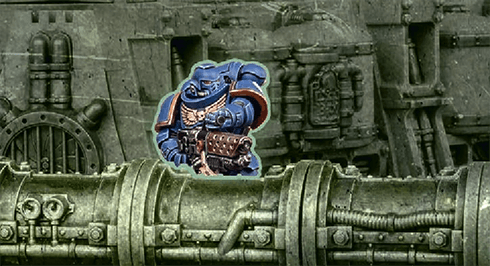
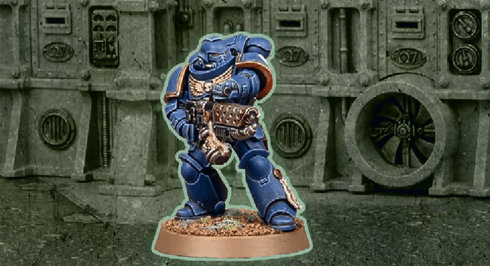
Model Visible
If any part of another model is visible to the observing model, that model is visible.

Model Fully Visible
If every part of another model that is facing the observing model is visible to the observing model (so the only thing blocking visibility to any part of that other model is that model itself), that model is fully visible.

Unit Visible
If one or more models in a unit are visible to the observing model, that unit is visible.

Unit Fully Visible
If every model in a unit is fully visible to the observing model, that unit is fully visible. When determining this, the observing model can see through other models in that unit.

FAQ

Q:When checking line of sight from one model to another, is this drawn between the bases of those models, or between any part of them?
A:
Line of sight is drawn from any part of the observing model to any part of the model being observed.

SURVEIL THE FOE

Primary Mission
Opponent

Information is power. Evaluate the strengths and weaknesses of the enemy and feed this crucial information back to your superiors.

Each time a friendly unit ends a move within range of one objective that has any of your opponent’s operation markers within range of it, remove those operation markers from the battlefield.
ANY BATTLE ROUND
WHEN: End of your turn.
One or more enemy units were surveilled this turn (see below), unless each of those units is within range of one or more objectives that have one or more operation markers within range of them.4VP
SECOND BATTLE ROUND ONWARDS
WHEN: End of your Command phase (or the end of your turn in the fifth battle round).
You control one or more objectives (excluding your home objective).4VP
You control more objectives than your opponent.4VP
WHEN: End of your turn.
None of your opponent’s operation markers are on the battlefield.5VP
SURVEIL THE FOE
OBJECTIVE ACTION
STARTS: Your Shooting phase.
UNITS: One friendly unit.
USE LIMIT: Unlimited.
COMPLETES: Immediately.
EFFECT: Select one enemy unit within 18" of and visible to your unit that has not been surveilled this turn: until the end of the turn, that enemy unit is surveilled.

VITAL LINK

Primary Mission
Opponent

A key communications node is located in the midst of this battlefield. Control of this node is crucial to the continued success of your armies. Ensure it does not fall into enemy hands.

ANY BATTLE ROUND
WHEN: End of your turn.
You control one or more central objectives.2VP
+For each of your operation markers within range of one of those objectives (see below).+1VPCUMULATIVE
SECOND BATTLE ROUND ONWARDS
WHEN: End of your Command phase (or the end of your turn in the fifth battle round).
You control one or more objectives (excluding your home objective).4VP
+One or more of those objectives is a central objective.+4VPCUMULATIVE
END OF THE BATTLE
You control your opponent’s home objective.10VP
MAINTAIN CONTROL
OBJECTIVE ACTION
STARTS: Your Shooting phase.
UNITS: One friendly unit within range of one central objective.
USE LIMIT: Once per turn.
COMPLETES: End of your turn, if your unit controls that objective.
EFFECT: Place one of your operation markers within range of that objective.

Select Enhancements
Select all of the enhancements you want to include from the detachments you selected and give each one to a different unit in your army. When you do, increase those units points values accordingly. The points values for enhancements can be found on faction pages.

Unless otherwise stated:
  • Only CHARACTER units can be given enhancements. If such a unit contains more than one model, select one CHARACTER model in that unit to have that enhancement.
  • EPIC HEROES models cannot be given enhancements.
  • Your army cannot include more than one of the same enhancement.

Upgrades: Some enhancements are tagged with ’Upgrade’. Unlike other enhancements:
  • These can be given to non-CHARACTER units.
  • You can include up to three of the same Upgrade in your army (the second and third instances of the same Upgrade do not count towards the total number of enhancements in your army, but you must still spend the stated points cost each time).

If you are playing an Incursion battle, you can select a 3DP detachment as your only detachment.
02.05.01 Using Keywords & Mixed Keywords in Units
When using keywords, the following points apply:
  • A unit has all the keywords of all models in that unit. A model only has its own keywords.
  • If a rule specifies that it applies to a unit with a keyword, it applies to a unit which includes one or more models with that keyword.
  • If a rule specifies that it applies to a model with a keyword, it only applies to a model with that keyword.
  • If a rule specifies that it applies to ‘non-KEYWORD’ models/units, it only applies to models/units that do not have that keyword. For example, if a rule applies to non-VEHICLE units, it only applies to units that do not have the VEHICLE keyword.
  • Some units can contain models that have different keywords. While this is the case, such a unit is considered to have all of the keywords of all of its models, and so is affected by any rule that applies to units with any of those keywords. Remember that attacks are made against units, not models.
  • If a rule only applies to models with a specific keyword, then it instead only applies to models in such a unit that have the correct keyword.
  • A rule with a comma-separated list of keywords, or a series of keywords separated by slashes (‘/’), or two keywords separated by the word ‘or’ (e.g. ‘an IMMORTALS, DEATHMARKS or LYCHGUARD unit’) refers to a model/unit that has any one of those keywords.
  • A rule with multiple adjacent keywords (e.g. ‘an AELDARI GUARDIANS unit’) only refers to a model/unit that has all of those keywords.
  • Some older rules use keywords without specifying model or unit: for example, MONSTER/VEHICLE or TRANSPORT. These rules refer to units with those keywords.
  • Singular and plural instances of the same keyword function in the same way.
Keywords
Datasheets have a list of keywords, separated into faction keywords and other keywords. The former are used when deciding which models to include in your army, but otherwise both are functionally the same. Keywords appear in full capitals, in KEYWORD BOLD.

Some rules are linked to one or more keywords. For example, a rule might say that it applies to INFANTRY units. This means it only applies to units that have the INFANTRY keyword. Singular and plural instances of the same keyword function in the same way.

SEE ALSO
  • Using Keywords & Mixed Keywords in Units 02.05.01

FAQ

Q:Do rules that affect a keyword include multi-word keywords that contain that keyword? For example, would rules that affect COMMISSAR units affect a unit that has the COMMISSAR GRAVES keyword?
A:
No.
01.05.05 Roll Off
Some rules instruct players to roll off.
  • To do so, both players roll one D6, and whoever rolls highest wins the roll-off.
  • If there is a tie for the highest roll, roll off again.
01.07.01 Battlefield Morale
The morale and organisation of troops can waver and break during battle. This is checked using battle-shock rolls, most commonly in the Command phase. Failing such a roll represents the unit’s courage faltering due to taking casualties or through other disruption, reducing its battlefield effectiveness. Similarly, some rules will require you to check a unit’s readiness by making a leadership roll.
01.07.02 Battle-shock Test
The term Battle-shock test is the same as battle-shock roll.
01.07 Battle-shock Rolls
To make a battle-shock roll for a unit, its controlling player makes a leadership roll for it (see above).
  • If that roll succeeds, that unit does not become battle-shocked.
  • If that roll fails, that unit, and each model in it, is battle-shocked.

While a unit is battle-shocked:
  • The Objective Control (OC) characteristic of all of its models is modified to ‘-’ (02.02).
  • Its controlling player cannot target that unit with stratagems (15).
  • It is not eligible to start an action (16), and any action it has started cannot be completed.

SEE ALSO
  • Battlefield Morale 01.07.01
  • Battle-shock Test 01.07.02

BATTLEFIELD MORALE
The morale and organisation of troops can waver and break during battle. This is checked using battle-shock rolls, most commonly in the Command phase. Failing such a roll represents the unit’s courage faltering due to taking casualties or through other disruption, reducing its battlefield effectiveness. Similarly, some rules will require you to check a unit’s readiness by making a leadership roll.

FAQ

Q:If a unit has a rule that allows it to start an action when it is battle-shocked can it also continue doing that action if it becomes battle-shocked after starting an action?
A:
Yes
Q:If a unit becomes battle-shocked after starting an action does it stop performing that action?
A:
Yes
01.05.01 Automatically Successful/Passes/Hits/Wounds
When a dice roll or test is automatically successful or automatically passes/hits/wounds, do not roll the dice and instead move to the next step of the sequence for that roll as if the required result had been rolled. Any rules that take effect on a particular dice result or roll result do not take effect.

Example: If a hit roll is automatically successful, move straight to the Wound Rolls step for that attack. Such a hit roll is not a critical hit.

Example: If a wound roll is automatically successful, move straight to the Save Rolls step for that attack. Such a wound roll is not a critical wound.
INSANE BRAVERY15.04
1CP
Core Stratagem
Indifferent to their own survival, these warriors hold their ground against seemingly impossible odds.
WHEN: Battle-shock step of your Command phase, just before you make a battle-shock roll for a friendly unit.

TARGET: That unit.

EFFECT: That battle-shock roll is automatically successful.

RESTRICTIONS: You cannot use this stratagem more than once per battle.
01.02.04 Not On The Battlefield
A unit that is embarked within a TRANSPORT or that is in strategic reserves is not on the battlefield. The following applies to such units:
  • That unit is not visible to any other units (units are visible to themselves).
  • Any other unit is not visible to that unit.
  • Players cannot measure distances to or from that unit (units are within range of their own abilities).

This means units not on the battlefield cannot be selected or targeted by any attack or rule that requires a unit to be visible or within a certain distance (other than their own abilities).

Such units can still use their other rules, and are still units in the controlling player’s army and so can be affected by rules that require a player to select a unit from an army, as well as rules that affect all units in an army.

The controlling player must make battle-shock rolls for units that are not on the battlefield in their Command phase if they are battle-shocked, or if they are at or below half-strength.
[ONE SHOT]24.26

Some weapons are so rare, or so complex and slow to reload, that they can only be used once.

Each weapon with this ability can only be selected to make attacks with once per battle.

If a destroyed model is returned to a unit, all of its [ONE SHOT] weapons that have already been selected to make attacks with during the battle cannot be selected to make attacks with again.

If a new unit is added to an army, all [ONE SHOT] weapons in that unit can be selected to make attacks with once per battle.
FIRING DECK24.14

Some transports have dedicated platforms or firing ports from which embarked passengers can lay down a withering hail of munitions.

This ability always takes the form Firing Deck X. In your Shooting phase, each time this TRANSPORT is selected to shoot, if one or more units are embarked within it, resolve the following sequence:
  1. Select up to X models embarked within this TRANSPORT (excluding models whose units have already been selected to shoot this phase).
  2. For each selected model, select one of its ranged weapons (excluding [ONE SHOT] weapons).
  3. Until this TRANSPORT has resolved all of its attacks, it has all of those selected weapons in addition to its other weapons.
  4. Until the end of the turn, units embarked within this TRANSPORT are not eligible to shoot.
18.02 Embarking
Once the first battle round has started, a friendly unit can embark within a friendly TRANSPORT model after making a normal, advance or fall-back move, if all of the following conditions apply:
  • Each model in that unit is within 3" of that TRANSPORT.
  • That unit was not set up on the battlefield this turn.
  • That unit is eligible to embark within that TRANSPORT, as described on that TRANSPORT’s datasheet.
  • That TRANSPORT has sufficient remaining transport capacity for each model in that unit.

When a unit embarks, the active player removes that unit from the battlefield and places it to one side – it is now embarked within that TRANSPORT and is not on the battlefield.

SEE ALSO
  • Not on the Battlefield 01.02.04

FAQ

Q:Do a unit's abilities continue to function while they are embarked within a TRANSPORT?
A:
Yes, within the restrictions specified by the ability itself. Embarked units are Not On The Battlefield (01.02.04), so any ability requiring visibility or measurement to another unit will fail.

Example: Azrael is attached to an Intercessor Squad unit and embarked within a TRANSPORT, and that TRANSPORT is making a shooting attack using the Firing Deck ability. While Azrael’s Supreme Grand Master ability is still technically active, it will have no effect, as the requirements of the ability are not met (the ability affects ‘weapons equipped by models’ in Azrael’s unit, and for the purposes of Firing Deck, the TRANSPORT itself is equipped with those weapons instead).
Q:If a rule says a unit can embark into a TRANSPORT in a turn that unit disembarked, does this ignore the core rules restriction on embarking in a turn that unit made a set up move (see 18.02)?
A:
Yes
Power from Pain

The Drukhari feed on suffering and terror. Every arc of blood that jets from a blade-slit artery, every scream of agonised horror, every vertiginous moment of shock or despair experienced by their prey surges through the Drukhari like an intoxicant. As the battle rages, the denizens of the Dark City drink deep of the floodtide of pain. Sinews singing with stolen strength, motions blurred to preternatural swiftness, they howl in exhilarated bloodlust and fight all the harder to extract yet sweeter agonies from those who dare resist them.

Pain Abilities
All DRUKHARI units have a Pain ability, tagged with the word ‘Pain’. Pain abilities only apply to a unit while it is Empowered. If your Army Faction is DRUKHARI, you can Empower units from your army with Pain abilities by spending Pain tokens (see below).

Designer’s Note: You can also spend Pain tokens to activate additional effects in certain other rules such as Enhancements and Stratagems.

Gaining Pain Tokens
If your Army Faction is DRUKHARI, you gain Pain tokens as follows:
  • 1 Pain token at the start of your Command phase.
  • 1 Pain token each time an enemy unit is destroyed.
  • 1 Pain token each time an enemy unit fails a Battle-shock test.
Each time you gain a Pain token, keep it to one side - this is your Pain token pool. Each time you spend a Pain token, reduce your Pain token pool by the same amount.

Empowered Through Pain
Each Pain ability will state when you can spend Pain tokens to Empower that unit. When you do, until the end of the phase, that unit is Empowered and all Pain abilities it has take effect. While an Attached unit is Empowered, the Pain abilities of all Leader and Bodyguard units in that unit take effect - you do not need to spend additional Pain tokens to activate each of those Pain abilities.

Example: At the start of your Charge phase, you spend 1 Pain token to Empower a unit of Wyches. The unit becomes Empowered, and so its Acrobatic Gladiators ability takes effect until the end of the phase. A Succubus is leading the unit, and so its Lithe Agility ability also takes effect until the end of the phase (no additional Pain token is required to activate that ability as well).
13.05 Dense
Dense terrain is an obstacle to even the largest war machines, and can shelter entire squads from enemy sight.
Examples: Buildings, ruins, armoured containers, woods.
13.04 Light
Light terrain can provide cover from incoming attacks, but will not slow an enemy’s advance or offer lasting defence.
Examples: Barricades, low walls, statuary.
13.09 Hidden
A model is hidden while all of the following apply to it:
  • That model has the INFANTRY/BEASTS/SWARM keyword and is within a terrain area that contains one or more light/dense terrain features.
  • That model’s unit did not make one or more ranged attacks during this turn or during the previous turn.
While a model is hidden, it can only be visible to enemy models that are within its detection range. Unless otherwise stated, a model’s detection range is 15".

Errata

13.09 - Change to First Bullet Point
Change to: ‘That model has the INFANTRY/BEASTS/SWARM keyword and is within a terrain area that contains one or more light/dense terrain features.’
01.04.05 Table Quarters
When a rule refers to a table quarter, or table quarters, divide the battlefield with imaginary lines 1mm thick drawn lengthwise and widthwise through the centre of the battlefield to create four equal rectangles. These rectangles are the table quarters.
01.02.01 Starting Strength and Half-Strength
The number of models a unit contains at the start of the first battle round is its starting strength. The starting strength of an attached unit is the number of models that unit contains at the start of the first battle round.

Some rules refer to units being below starting strength, or at – or below – half-strength. The meaning of these terms varies depending on a unit’s starting strength, as shown below.

UNIT STRENGTH
STARTING STRENGTH OF 1STARTING STRENGTH OF 2 OR MORE
BELOW STARTING STRENGTHModel’s remaining wounds are less than its W characteristic.Number of remaining models in the unit is less than its starting strength.
AT HALF-STRENGTHModel’s remaining wounds are half of its W characteristic.Number of remaining models in the unit is half of its starting strength.
BELOW HALF-STRENGTHModel’s remaining wounds are less than half of its W characteristic.Number of remaining models in the unit is less than half of its starting strength.

Example: A Captain (1 model) is attached to a unit of Intercessors (5 models). This attached unit has a starting strength of 6. If three Intercessors were destroyed, the unit would be at half-strength. If four Intercessors were destroyed, the unit would be below half-strength. If all of the Intercessors were destroyed, the remaining Captain would be below half-strength, despite having his full wounds remaining.

SOME UNITS CANNOT BE AT HALF-STRENGTH
If a model’s W characteristic or a unit’s starting strength cannot be evenly divided in half, that model or unit cannot be at half-strength (but can be below half-strength as described above).

INESCAPABLE DOMINION

Primary Mission
Opponent

Your first priority must be to dominate the battlefield. Seize strongpoints and dig in. Only then may you turn your full attention to slaughtering the foe.

ANY BATTLE ROUND
WHEN: End of your turn.
You control three or more objectives.4VP
SECOND BATTLE ROUND ONWARDS
WHEN: End of your Command phase (or the end of your turn in the fifth battle round).
You control two or more objectives.5VP
You control more objectives than your opponent.4VP
END OF THE BATTLE
You control your opponent’s home objective.5VP

UNSTOPPABLE FORCE

Primary Mission
Opponent

The enemy are arrayed before you in number, and well prepared for the coming assault. Smash through their defences. Grind them to dust.

ANY BATTLE ROUND
WHEN: End of your turn.
One or more enemy units were destroyed this turn.3VP
SECOND BATTLE ROUND ONWARDS
WHEN: End of your Command phase (or the end of your turn in the fifth battle round).
For each objective you control (excluding your home objective).4VP
WHEN: End of your turn.
You control one or more objectives you did not control at the start of the turn (excluding your home objective).3VP
END OF THE BATTLE
You control one or more central objectives.5VP

MEATGRINDER

Primary Mission
Opponent

Vicious and without relent, this battle has descended into base savagery. Only one path to victory remains: kill more of the enemy than they can kill of you.

ANY BATTLE ROUND
WHEN: End of your turn.
One or more enemy units were destroyed this turn.3VP
SECOND BATTLE ROUND ONWARDS
WHEN: End of your Command phase (or the end of your turn in the fifth battle round).
You control one or more objectives (excluding your home objective).4VP
SECOND BATTLE ROUND ONWARDS
WHEN: End of your turn.
More enemy units were destroyed this turn than friendly units were destroyed in the previous turn.5VP
You control your opponent’s home objective.5VP

PUNISHMENT

Primary Mission
Opponent

Those who resist must be punished. Make a bloody example of them, and leave none in doubt as to your mastery.

START OF YOUR TURN: Select one to three enemy units that are on the battlefield and within range of objectives and/or that destroyed one or more friendly units in the previous turn. If you cannot, select one enemy unit that is on the battlefield. Until the start of your next turn, those units are condemned.
ANY BATTLE ROUND
WHEN: End of a turn.
One or more condemned enemy units left the battlefield this turn.5VP
SECOND BATTLE ROUND ONWARDS
WHEN: End of your Command phase (or the end of your turn in the fifth battle round).
You control one or more objectives (excluding your home objective).4VP
You control more objectives than your opponent.5VP
END OF THE BATTLE
You control your opponent’s home objective.8VP

CONSECRATE

Primary Mission
Opponent

Whether in the name of grand ideals or simply to satisfy the thirst of their terrible gods, your warriors must consecrate this battlefield with the blood of their foes.

Each time a friendly unit destroys a unit, that friendly unit becomes a consecration unit. At the end of your turn, for each of your consecration units, you can select one objective it is within range of (excluding your home objective) that has not been consecrated. If you do, place one of your operation markers within range of that objective – that objective is consecrated and that unit is no longer a consecration unit.
ANY BATTLE ROUND
WHEN: End of your turn.
One or two objectives are consecrated.3VP
ORThree or more objectives are consecrated.6VP
SECOND BATTLE ROUND ONWARDS
WHEN: End of your Command phase (or the end of your turn in the fifth battle round).
You control one or more objectives (excluding your home objective).4VP
You control more objectives than your opponent.4VP
END OF THE BATTLE
Your opponent’s home objective is consecrated.5VP

DESTROYER'S WRATH

Primary Mission
Opponent

Victory here shall not be measured in ground taken or plunder seized, but in the mangled corpses of your foes and the grisly trophies hewn from their bodies.

ANY BATTLE ROUND
WHEN: End of your turn.
One or more enemy units were destroyed this turn.3VP
SECOND BATTLE ROUND ONWARDS
WHEN: End of your Command phase (or the end of your turn in the fifth battle round).
You control one or more objectives (excluding your home objective).4VP
You control more objectives than your opponent.6VP
WHEN: End of your turn.
More enemy units were destroyed this turn than friendly units were destroyed in the previous turn.4VP

DELAYING ACTION

Primary Mission
Opponent

Your enemies are on the march. Commit your warriors to battle and make the foe pay a bloody price for every foot of ground.

ANY BATTLE ROUND
WHEN: End of your turn.
For each enemy unit destroyed this turn.2VP
SECOND BATTLE ROUND ONWARDS
WHEN: End of your Command phase (or the end of your turn in the fifth battle round).
You control one or more objectives (excluding your home objective).4VP
WHEN: End of your turn.
You control one or more central objectives and one or more expansion objectives.3VP

OUTMANOEUVRE

Primary Mission
Opponent

Speed and positioning are key in any battle. Outflank the enemy, seize high ground and routes of resupply. Choke them to death.

ANY BATTLE ROUND
WHEN: End of your turn.
You control your opponent’s home objective.10VP
FIRST BATTLE ROUND
WHEN: End of your turn.
For each objective you control (excluding your home objective).4VP
SECOND AND THIRD BATTLE ROUND
WHEN: End of your Command phase.
For each objective you control (excluding your home objective).5VP
FOURTH BATTLE ROUND ONWARDS
WHEN: End of your turn.
For each objective you control (excluding your home objective).6VP

SMOKE AND MIRRORS

Primary Mission
Opponent

Cunning is as potent a weapon as overwhelming force. Outnumbered or outgunned, you must make use of subterfuge and misdirection to pick the enemy apart.

ANY BATTLE ROUND
WHEN: End of your turn.
For each objective that is decoyed (see below).2VP
+For each of those objectives that is within your opponent’s territory.+2VPCUMULATIVE
SECOND BATTLE ROUND ONWARDS
WHEN: End of your Command phase (or the end of your turn in the fifth battle round).
You control one or more objectives (excluding your home objective).4VP
END OF THE BATTLE
Four or more objectives are decoyed.10VP
DECOY
OBJECTIVE ACTION
STARTS: Your Shooting phase.
UNITS: One friendly unit within range of one objective (excluding your home objective) that is not decoyed (see below).
USE LIMIT: Unlimited. Each unit that starts this action this phase must be within range of a different objective.
COMPLETES: End of your turn, if your unit controls that objective.
EFFECT: That objective is decoyed: place one of your operation markers within range of that objective.

LOCATE AND DENY

Primary Mission
Opponent

The enemy is searching for an asset of value. By cunning or by force of arms, prevent its retrieval.

START OF THE BATTLE: Select five terrain areas not within your deployment zone; for each one, place one of your operation markers within it. If you cannot, do so for each terrain area that is not within your deployment zone.
ANY BATTLE ROUND
WHEN: End of your turn.
One or more enemy units that started the turn within range of one or more objectives are destroyed.4VP
Only one of your operation markers is on the battlefield (see below), if one or more of your units are within the same terrain area as that marker, and no enemy units are within that terrain area.4VP
SECOND BATTLE ROUND ONWARDS
WHEN: End of your Command phase (or the end of your turn in the fifth battle round).
You control one or more objectives (excluding your home objective).4VP
END OF THE BATTLE
Only one of your operation markers is on the battlefield, if one or more of your units are within the same terrain area as that marker, and no enemy units are within that terrain area.5VP
SENSOR SWEEP
OBJECTIVE ACTION
STARTS: Your Shooting phase.
UNITS: One friendly unit within range of one central objective.
USE LIMIT: Once per turn.
COMPLETES: End of your turn, if your unit controls that objective.
EFFECT: Your unit performs a sensor sweep: remove one operation marker from the battlefield.
RESTRICTIONS: A unit cannot start this action if there is only one operation marker on the battlefield.

RECONNAISSANCE SWEEP

Primary Mission
Opponent

Enemy movements have aroused suspicion. Disperse your forces, probe their lines and decipher their intentions.

ANY BATTLE ROUND
WHEN: End of your turn.
Three or more friendly units are wholly within three different table quarters and not within 6" of the centre of the battlefield.3VP
ORFour or more friendly units are wholly within four different table quarters and not within 6" of the centre of the battlefield.6VP
ANY BATTLE ROUND
WHEN: End of your turn.
For each enemy unit destroyed this turn.1VP
SECOND BATTLE ROUND ONWARDS
WHEN: End of your Command phase (or the end of your turn in the fifth battle round).
You control one or more objectives (excluding your home objective).3VP

TRIANGULATION

Primary Mission
Opponent

By acquiring and transmitting precise coordinates, your forces will be able to summon reinforcements, saturate the battlefield with artillery fire or call in other means of support.

SECOND BATTLE ROUND ONWARDS
WHEN: End of your Command phase (or the end of your turn in the fifth battle round).
You control one or more objectives (excluding your home objective).4VP
SECOND BATTLE ROUND ONWARDS
WHEN: End of your turn.
One objective is triangulated (see below).3VP
ORTwo objectives are triangulated.6VP
ORThree or more objectives are triangulated.10VP
END OF THE BATTLE
You control four or more objectives.10VP
TRIANGULATE
OBJECTIVE ACTION
STARTS: Your Shooting phase, from the second battle round onwards.
UNITS: One friendly unit within range of one objective (excluding your home objective).
USE LIMIT: Once per turn.
COMPLETES: End of your turn, if your unit controls that objective.
EFFECT: That objective is triangulated: place one of your operation markers within range of that objective.

GATHER INTEL

Primary Mission
Opponent

The nature and motivation of the foe remains unclear. Test their mettle and seize pertinent intelligence from the field of battle.

FIRST BATTLE ROUND
WHEN: End of your turn.
You control one or more central objectives.6VP
SECOND BATTLE ROUND ONWARDS
WHEN: End of your Command phase (or the end of your turn in the fifth battle round).
You control one or more objectives (excluding your home objective).4VP
SECOND BATTLE ROUND ONWARDS
WHEN: End of your turn.
For each friendly unit that completed the Extract Intelligence action this turn (see below).7VP
END OF THE BATTLE
Three or more of your operation markers are on the battlefield.5VP
One of your operation markers is within range of your opponent’s home objective.5VP
EXTRACT INTELLIGENCE
OBJECTIVE ACTION
STARTS: Your Shooting phase, from the second battle round onwards.
UNITS: One unit within range of one objective (excluding your home objective) that does not have any of your operation markers within range of it.
USE LIMIT: Unlimited. Each unit that starts this action this phase must be within range of a different objective.
COMPLETES: End of your turn, if your unit controls that objective.
EFFECT: Place one of your operation markers within range of that objective.

SEARCH AND SCOUR

Primary Mission
Opponent

Forward elements report enemy movement in this sector. Move out, locate the foes and halt their operation before it gathers momentum.

ANY BATTLE ROUND
WHEN: End of your turn.
You control one or more central objectives.3VP
One or more enemy units that started the turn within a terrain area are destroyed.2VP
SECOND BATTLE ROUND ONWARDS
WHEN: End of your Command phase (or the end of your turn in the fifth battle round).
For each objective you control (excluding your home objective).4VP
END OF THE BATTLE
No enemy units are wholly within your territory.5VP

SECURE ASSET

Primary Mission
Opponent

A vital asset has been lost amidst the chaos of battle. You must secure the item at all costs.

ANY BATTLE ROUND
WHEN: End of your turn.
A friendly unit secured the asset this turn (see below).4VP
One or more enemy units that started the turn within range of one or more central objectives are destroyed.2VP
SECOND BATTLE ROUND ONWARDS
WHEN: End of your Command phase (or the end of your turn in the fifth battle round).
You control one or more objectives (excluding your home objective).4VP
You control three or more objectives.4VP
SECURE ASSET
OBJECTIVE ACTION
STARTS: Your Shooting phase.
UNITS: One friendly unit within range of one objective (excluding your home objective).
USE LIMIT: Once per turn.
COMPLETES: End of your turn, if your unit controls that objective.
EFFECT: Your unit secures the asset.

EXTRACT RELIC

Primary Mission
Opponent

A priceless relic saturated with eldritch power lies somewhere on the field of battle. Secure the sensor array at the heart of the battlefield and direct its energies to locating the prize.

ANY BATTLE ROUND
WHEN: End of your turn.
A friendly unit performed a sensor sweep this turn (see below).4VP
One or more enemy units that started the turn within range of one or more objectives are destroyed.3VP
Only one of your opponent’s operation markers is on the battlefield, if one or more of your units are within the same terrain area as that operation marker, and no enemy units are within that terrain area.4VP
SECOND BATTLE ROUND ONWARDS
WHEN: End of your Command phase (or the end of your turn in the fifth battle round).
You control one or more objectives (excluding your home objective).4VP
END OF THE BATTLE
Only one of your opponent’s operation markers is on the battlefield, if one or more of your units are within the same terrain area as that operation marker, and no enemy units are within that terrain area.5VP
SENSOR SWEEP
OBJECTIVE ACTION
STARTS: Your Shooting phase.
UNITS: One friendly unit within range of one central objective.
USE LIMIT: Once per turn.
COMPLETES: End of your turn, if your unit controls that objective.
EFFECT: Your unit performs a sensor sweep: remove one operation marker from the battlefield.
RESTRICTIONS: A unit cannot start this action if there is only one operation marker on the battlefield.

VANGUARD OPERATION

Primary Mission
Opponent

Striking deep beyond the front lines, your forces must employ speed and cunning to secure their objectives before the enemy responds.

ANY BATTLE ROUND
WHEN: End of your turn.
A friendly unit performed a vanguard operation this turn (see below).4VP
One or more enemy units were destroyed this turn.2VP
SECOND BATTLE ROUND ONWARDS
WHEN: End of your Command phase (or the end of your turn in the fifth battle round).
You control one or more objectives (excluding your home objective).4VP
END OF THE BATTLE
You control your opponent’s home objective.10VP
VANGUARD OPERATION
OBJECTIVE ACTION
STARTS: Your Shooting phase.
UNITS: One friendly unit within one terrain area that is within your opponent’s territory.
USE LIMIT: Once per turn.
COMPLETES: End of your turn, if no enemy units are within that terrain area.
EFFECT: Your unit performs a vanguard operation.

BATTLEFIELD DOMINANCE

Primary Mission
Opponent

This battlefield holds great significance for the wider war effort. You must seize control of it. Let nothing stand in your way.

FIRST AND SECOND BATTLE ROUND
WHEN: End of your turn.
You control more objectives than your opponent.2VP
SECOND BATTLE ROUND ONWARDS
WHEN: End of your Command phase (or the end of your turn in the fifth battle round).
For each objective you control.3VP
+For each of those objectives (excluding your home objective) if you control your home objective.+2VPCUMULATIVE

IMMOVABLE OBJECT

Primary Mission
Opponent

Obstinance is often the key to victory. Weather everything the enemy throws at you. If your opponent is to take any ground, they will have to wade through their own dead to do so.

ANY BATTLE ROUND
WHEN: End of your turn.
You control one or more central objectives.3VP
SECOND TO FOURTH BATTLE ROUND
WHEN: End of your Command phase.
For each objective you control (excluding your home objective).5VP
FIFTH BATTLE ROUND
WHEN: End of your turn.
For each objective you control (excluding your home objective).5VP

DETERMINED ACQUISITION

Primary Mission
Opponent

The resistance arrayed against you is formidable indeed, yet your orders are clear; take and hold the ground ahead, heedless of the cost.

ANY BATTLE ROUND
WHEN: End of your turn.
For each objective you control that you did not control at the start of the turn (excluding your home objective).2VP
SECOND BATTLE ROUND ONWARDS
WHEN: End of your Command phase (or the end of your turn in the fifth battle round).
For each objective you control.3VP
+For each of those objectives that is within your opponent’s territory.+3VPCUMULATIVE

PURGE AND SECURE

Primary Mission
Opponent

Enemy pickets and reconnaissance have engaged your vanguard. Move forward, seize defensive positions and repel the assault at all costs.

ANY BATTLE ROUND
WHEN: End of your turn.
One or more enemy units were destroyed this turn by a friendly unit that was within range of one or more objectives.3VP
OROne or more enemy units that started the turn within range of one or more objectives were destroyed this turn.3VP
SECOND BATTLE ROUND ONWARDS
WHEN: End of your Command phase (or the end of your turn in the fifth battle round).
For each objective you control (excluding your home objective).4VP
WHEN: End of your turn.
You control one or more objectives you did not control at the start of the turn (excluding your home objective).3VP

Disable Ads


Boosty subscribers may disable ads:
1. Enter e-mail you have used to login on Boosty.
2. Press Get new pin code button (if you don’t have it already)
3. Enter pin code.

Note that login database updated once a day. So, if you are a new booster - try tomorrow. And thank you!
© Vyacheslav Maltsev 2013-2026