The Plunder Secondary Mission references ‘One unit within a terrainarea that is not within your territory.’ Is the requirement to be ‘not within your territory’ referring to the unit or the terrain area?
A:
The terrain area.
Q:
If the unit I select to be my Beacon unit upon drawing the Beacon Secondary Mission is destroyed prior to achieving the mission, can I select a new Beacon unit?
A:
No, which means you will be unable to achieve that mission. We recommend discarding it on your turn to gain 1CP!
Q:
For the purposes of VP scoring limits, is the end of the battle the same timing as the end of the fifth battle round?
A:
No, VP scored at the end of the battle are not subject to the 15VP per battle round scoring limit.
Q:
When a mission action places an operation marker and applies a status (e.g. ‘decoyed’), does removing that operation marker also remove that status?
A:
Yes.
Q:
Some Primary Mission cards let a player place operation markers on the battlefield. Can I remove these?
A:
Your Primary Mission card will specify how and when you can remove operation markers from the battlefield. If it doesn’t, you cannot remove operation markers.
Q:
For the DeathTrap Primary Mission, one objective reads ‘One or more enemy units that started the turn within a terrainarea were destroyed, if that terrain area is trapped.’ Does that terrain area have to have been trapped at the point that enemy unit was destroyed?
A:
No.
Q:
For the SurveiltheFoe Primary Mission, one objective reads ‘One or more enemy units were surveilled this turn, unless each of those units is within range of one or more objectives that have one or more operation markers within range of them.’ For an enemy unit within range of an objective with an operation marker, can I achieve this objective if I remove the operation marker after surveilling that unit, as long as it is within the same turn?
A:
Yes.
Q:
For the VitalLink Primary Mission, if there is more than one central objective, can I score the cumulative VP for my operation markers regardless of which central objective(s) they are within?
A:
Yes, as long as you control the objective(s) those operation markers are within.
Introduction
Welcome to the Warhammer Event Companion! This document is designed to help you run and play in organised events, from local leagues to the world championships. It uses the most recent Chapter Approved Mission Deck to create the best experiences for all hobbyists.
Within this companion, you’ll find a ready-made framework for levelling the playing field and getting games underway quickly. Its recommendations will be followed in full at most Games Workshop Warhammer Events, and are considered the official way to play Warhammer 40,000 in an event setting, but can be adapted to suit your own circumstances.
The recommendations are presented as follows:
Warhammer Event Mission Sequence: Adjustments to the steps players would normally follow to generate a mission and prepare the battlefield.
Chapter Approved Mission Deck Errata & FAQs: Updates to certain cards and answers to frequently asked questions.
Pairings and Rankings: Advice for fairly pairing players and determining rankings.
Terrain Layouts: A suite of carefully designed terrain setups to be used in conjunction with the Chapter Approved Mission Deck.
Designer’s Note:This companion does not use the full contents of the Chapter Approved Mission Deck; it has been written to provide the best experience in a Warhammer Event. For this reason we have not included the Deployment or Twist cards, which are left for pick-up-and-play games.
This companion does not include rules and recommendations for doubles, teams or Dominatus Warhammer Events. These can be found on warhammer-community.com.
Generating Command Points
Excluding Core CP, each player can gain a maximum of 1CP per battle round (including he CP gained when a player discards an active Secondary Mission card).
Warhammer Event Mission Sequence
Before attending a Warhammer Event, each player completes the following step:
1
Muster Armies
Muster armies as described in the Core Rules, with the following exception: once they have mustered their army, a player selects one Force Disposition card available to them and records that on their roster.
A Warhammer Event battle is then waged by completing the remaining steps below:
2
Determine Mission
Each player finds their opponent’s Force Disposition symbol on their Force Disposition card. The Primary Mission that is listed below that symbol is that player’s Primary Mission, which describes how to score VP.
3
Determine a Layout
Each combination of Primary Missions has three recommended layouts, labelled A, B and C. These can be found in the Warhammer 40,000 app and in the Mission Generator below. As directed by the Warhammer Event organiser, the players either use the layout specified or randomly determine which of these layouts to use.
We recommend running through layouts A, B and C sequentially, repeating this as needed for the number of games being played.
Examples: For a 5 round event, we recommend the layout order A, B, C, A, B. For a 6 round event, we recommend A, B, C, A, B, C. For an 8 round event, we recommend A, B, C, A, B, C, A, B.
4
Create the Battlefield
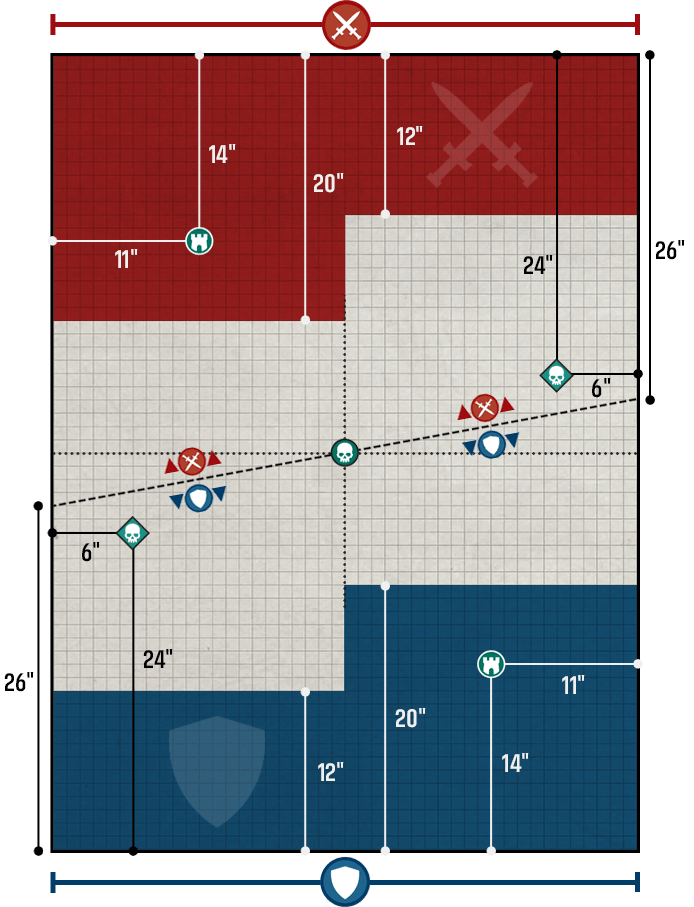
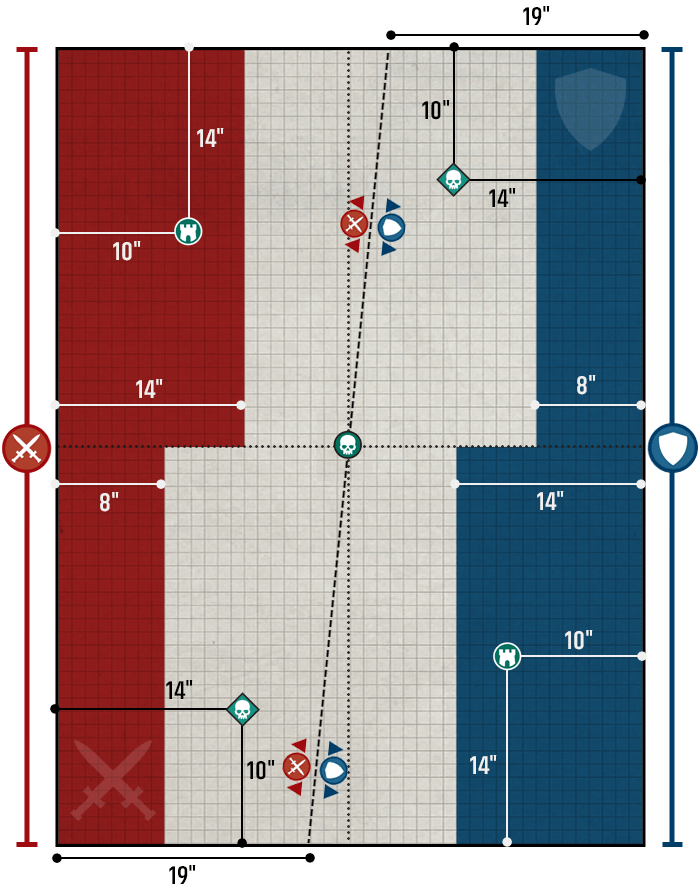
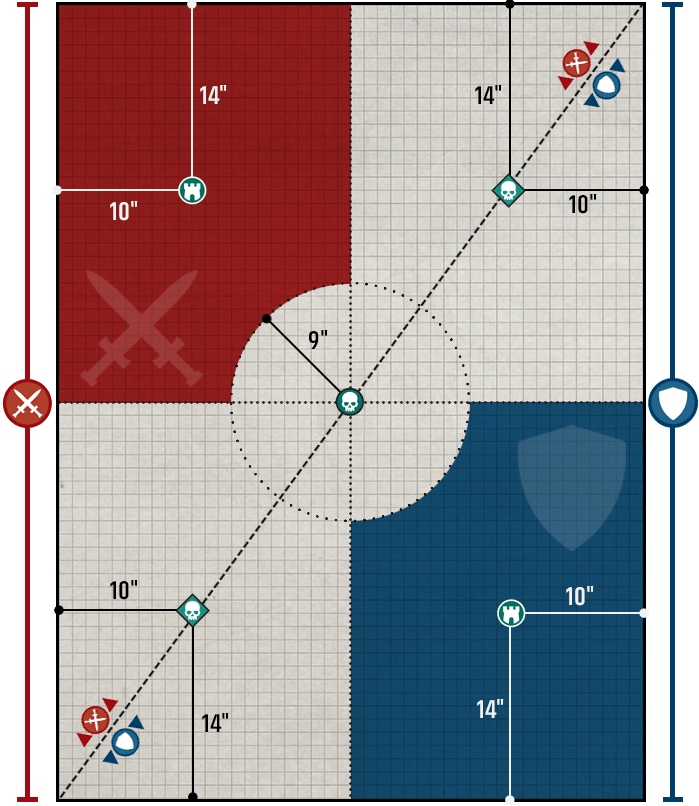
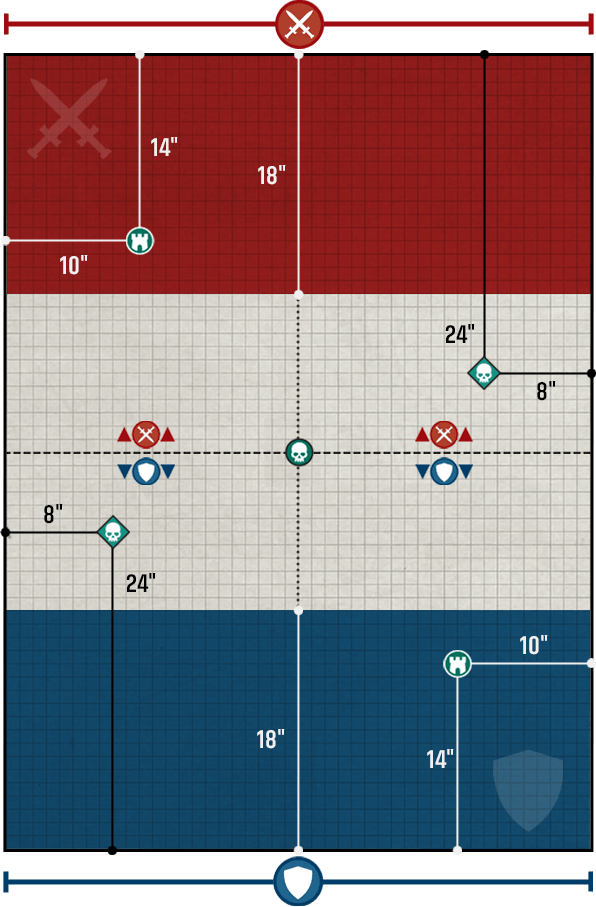
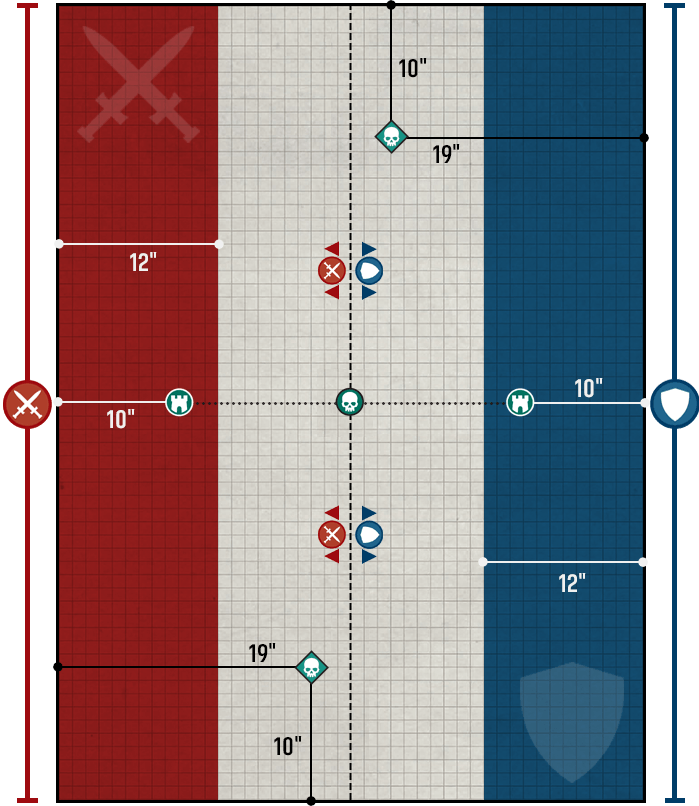
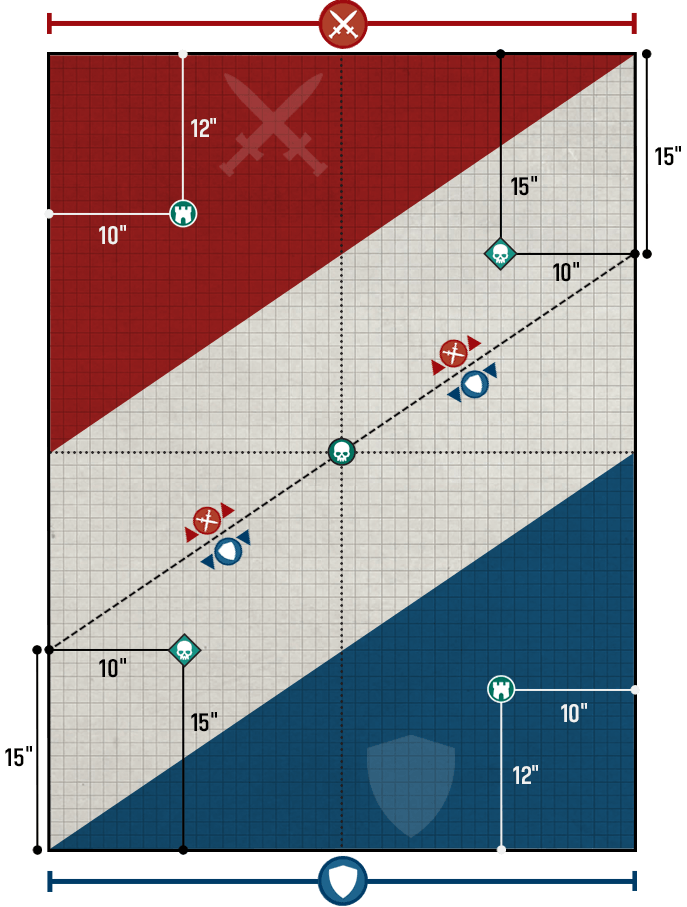
Missions are played on rectangular battlefields 44" by 60" in size. Players set up the terrainareas as shown in the selected layout, then set up terrain features on those terrain areas as shown in the selected layout.
5
Determine Attacker and Defender
Players look at the selected layout and agree which edges of the battlefield the players have set up correspond with the Attacker’s and Defender’s battlefield edges labelled on the card.
Rolloff: the winner decides who will be the Attacker and who will be the Defender.
6
Select Secondary Missions
Secondary Mission cards detail additional ways to score VP. Players now secretly note down whether they will use Tactical or Fixed Secondary Missions. If using Fixed Missions, they also note down which two Fixed Missions they will use (see below). Players then reveal these decisions.
FIXED MISSIONS Fixed Missions are those marked with the symbol shown on the left. If you are using Fixed Missions, display your selected Fixed Mission cards face-up. Fixed Missions cannot be discarded and are active for you throughout the battle.
TACTICAL MISSIONS If you are using Tactical Missions, shuffle your Secondary Mission deck face-down.
At the start of your Command phase, draw two Secondary Missions face-up from your Secondary Missions deck; these Secondary Missions are active for you.
(Once per battle) At the end of your Command phase, you can spend 1CP to discard one of your active Secondary Mission cards and draw one new Secondary Mission card.
ACHIEVING SECONDARY MISSIONS At the end of each player’s turn, each player does the following, starting with the player whose turn it is:
First, if you met the conditions on one or more Secondary Missions, you can gain the VP specified on that card. If you do, and if you are using Tactical Secondary Missions, discard that Secondary Mission – it is achieved.
Then, if it is your turn and you are using Tactical Secondary Missions, you can discard one or more of your active Secondary Missions. If you do, you gain 1CP.
7
Declare Battle Formations
Players secretly note down, in order:
Which of their units will start the battle embarked within which TRANSPORTS.
Players take it in turns to set up their units (excluding those in strategic reserves) one at a time, wholly within their deployment zone, starting with the Defender. If you set up a TITANIC unit when it is your turn to set up a unit, skip your next turn to set up a unit. Once you have finished setting up your units, if your opponent has any units that have not been set up, they set up those units.
9
Redeploy Units
Some rules let you redeploy certain units after both armies are deployed. Unless otherwise stated, you resolve those rules in this step. Players alternate resolving any such rules, starting with the Attacker. Units placed in strategic reserves in this step do not count towards the combined points value of your strategic reserves units.
10
Determine First Turn
Rolloff: the winner takes the first turn.
11
Resolve Pre-battle Rules
Players alternate resolving any pre-battle rules units from their army may have, starting with the player who will take the first turn.
The battle ends after five battle rounds have been completed. Even if you have no models remaining in your army at the start of your turn, players continue to play out their turns until the battle ends.
14
Determine Victor
Each player scores 10VP if their army is painted to a Battle Ready standard. At the end of the battle, the player with the most VP is the victor. If the players are tied, the battle is a draw. The maximum VP that can be scored from each source of VP is listed below. Any VP you score in excess of these maximums are ignored.
VPSOURCE
MAXIMUMVP
PRIMARYMISSION
45VP Up to 15VP per battle round
SECONDARYMISSIONS
45VP Up to 15VP per battle round*
BATTLEREADYARMY
10VP
* In addition, you can gain a maximum of 20VP per Fixed Secondary Mission card.
Designer’s Notes
‘Cumulative’ and ‘Or’ Conditions
Some cards include a condition marked as ‘cumulative’ that follows a normal condition. If a player achieves the cumulative condition, they gain the VP for both that and the normal condition.
Some cards include one or more conditions marked ‘or’ that follow a normal condition. A player can only gain VP for one of these conditions or the normal condition.
Leaves the Battelefield
Some cards refer to a unit or units leaving the battlefield. A unit leaves the battlefield if it is destroyed, if it embarks on a TRANSPORT, or if a rule removes that unit from the battlefield (e.g. to place it in strategic reserves).
One
When a card states ‘one’, underlined, it means exactly one, not one or more.
VP Up to a Limit
Some cards award VP up to a limit, e.g. (up to 5VP). In such cases, any VP you score in excess of this limit are ignored.
When Drawn
Some Secondary Mission cards begin with a ‘When Drawn’ section. Note that this section only applies if you are using Tactical Secondary Missions.
Pairings and Rankings
There are countless different ways in which a Warhammer Event can be run. While broad-stroke concepts like pairing off players with the same record are straightforward enough, the nuance of running a successful Warhammer tournament is the subject of continuous conversation and evolution. The following recommendations are followed at most official Games Workshop events, and are designed to create the fairest, most fun experience possible for every attendee, regardless of standing.
Pairing Players
While the first round of most tournaments is randomly paired, subsequent round pairing can be done in a number of ways. The first pairing metric will almost always be player record, e.g pairing a player with a win/ loss record of 3-1 with another player with the same win/loss record, and so on. Given that most rounds will include numerous players with the same record, however, deciding pairings beyond this metric can be quite nuanced, and the different methods available can have significant impacts on the experience of players at an event. We recommend pairing players by the following criteria:
First – by record (i.e. the number of wins, losses and draws)
Second – by win path (i.e. the timing of the rounds in which a player won or lost their games)
Third – randomly within players of the same ranking
Win Path
A player’s ‘win path’ refers not to their number of wins and losses, but to the timing of those wins and losses. While pairing by win path has an incidental tendency to pair people by strength of schedule, its greatest impact is on the overall enjoyment experienced by all players, as it tends to pair players based upon shared experience.
For example, let’s take two 3-1 players. One of them lost their first game; they likely lowered their expectations for winning the whole event after this, but are probably in a great mood after three consecutive victories. The other won their first three games then lost their fourth – a sharp disappointment after a 3-0 start. Should these players face off, their shared enjoyment may be at odds as they are in very different emotional places. Win path ensures players enter their match with recent common experiences upon which to build a friendship during their next game of Warhammer.
Ranking Players
In many tournaments, the overall Best General will be the single remaining undefeated player at the end of the event. Sometimes, however, there are not enough rounds available to determine a single undefeated player, and players often wish to know their ranking regardless of whether they won the whole event. To help break ties between players who end an event with the same record, we recommend ranking players by the following criteria:
First – by overall record (wins, losses and draws)
Second – by their opponents’ win records (i.e. those with more wins against opponents with better win records would place higher)
Third – by total Victory points (VP)
Designer’s Note: Traditionally, many organisers use total VP or VP differential to determine ranking. However, the number of VP scored within any one game of Warhammer 40,000 rarely tells a clear story about how close that game actually was. Often, a more challenging opponent will be harder to score against (and thus yield a lower score despite the victory being all the more hard-earned), or the nature of how the two armies match up may dictate a risky strategy that doesn’t pay off (and thus yield a wide score disparity despite almost working out).
As such, we do not recommend using VP as a pairing metric, nor as a ranking metric until all other metrics have been exhausted, or when further tie-breaking is required (e.g. in larger events where identical rankings become more likely). By contrast, opponent win record is an ideal metric, because when two players end up with the same record, the overall skill of their opponents is a better indicator of which player had the more challenging path along the way.
The Rules Appendix, Errata and FAQs
There are myriad ways to enjoy the Warhammer hobby, and these all manifest themselves at a tournament: gifted hobbyists with beautiful armies, skilled competitors aiming for Best General, casual players looking to face new opponents and make new friends (by far the most common type of attendee), and even practitioners of the niche hobby of Rules Lawyer! These particular hobbyists often find unusual rules interactions at the very fringes of Warhammer 40,000, which can create interesting challenges for tournament organisers looking to provide clear answers and an easy gaming experience for their attendees.
To address any such uncertainties, the Warhammer 40,000 app contains a comprehensive Rules Appendix, along with faction-specific errata and FAQ entries. Should an odd rules interaction come up during your event and the Core Rules do not provide a clear answer, we recommend consulting these resources.
Afterword
What is the Point of a Warhammer Event?
Warhammer is more popular than ever, and this popularity has extended to the tournament scene. Over the last few years, more than one million games of Warhammer 40,000 were played in tournaments around the world, and that growth will only continue in the future. With so many Warhammer hobbyists participating in the game within growing communities, it’s important to ruminate on the point of a tournament. First and foremost, it is not about celebrating the ultimate victor; someone who goes undefeated and wins Best General needs very little acclaim beyond the outcome itself (after all, they won!). Instead, it is the experience of every single attendee that truly matters, and the recognition that, for most people who attend a tournament, community and friendship are both the purpose and the outcome.
Before you roll a single dice against an opponent to start your tournament experience, remember two things:
The person across the table from you shares your love of Warhammer.
By the time the dust settles on the event, almost everyone will have lost a game (typically, at most, only one or two people will manage to leave the event without a loss).
While any game often yields winners and losers on the tabletop, the magic of Warhammer in an event setting is the opportunity it provides every participant to become a bigger part of the Warhammer community, and to build friendships with fellow hobbyists that can last a lifetime. As an organiser or a player, if you focus on this inalienable truth, then while most of you will have lost a game or two, you’ll all share victory in your experience of what it is to attend a Warhammer Event.
- The Warhammer Design Studio and the Warhammer Events Team
Terrain Layouts
The layouts are presented for Warhammer Event organisers and players to use in all of their games of Warhammer 40,000 using the most recent Chapter Approved Mission Deck. These are the layouts that are used at Games Workshop events and are designed for the best experience by the Warhammer Studio team, to reflect battlefields that create risk-and-reward decisions with each player’s objectives in mind.
Each combination of Primary Missions has three recommended layouts, labelled A, B and C. As directed by the Warhammer Event organiser, the players either use the layout specified or randomly determine which of these layouts to use.
Recommended Terrain Area Footprints
We have listed the terrainarea footprints these recommended layouts use. You can find a PDF with these footprints ready for you to print on warhammer-community.com.
TERRAINAREAFOOTPRINTSIZE
QUANTITY
6" x 4"
4
10" x 2.5"
2
6" x 2"
4
7" x 11.5"
4
8" x 11.5" Polygon
2
Terrain Features
Each layout is shown with the terrain features from the Battlefields: Armageddon box using the ‘Warhammer recommended’ build configuration from the construction booklet. We’ve denoted each terrain feature from that set as either a dense or lightterrainfeature in these layouts. The configurations of the terrain features and terrainareas are designed to create the best experience with the Hidden rule and movement rules for various units, and to create plenty of interesting decisions during a battle. We’ve also purposely left space between a terrain feature and the edge of the terrain area to allow a line of models to be on the terrain area from the ‘outside’.
If you do not have the Battlefields: Armageddon terrain, it is possible to recreate these layouts with your own terrain that is close to the same size of the various terrain features by denoting for all players if they are dense or light terrain features.
Deployment Card Key
Dense Terrain (coloured green)
Light Terrain (coloured yellow)
The letters marking each terrain feature correspond with the component markings on the Battlefields: Armageddon terrain set.
Separate Terrain Areas
Single Terrain Area
ATTACKER’S DEPLOYMENT ZONE The Attacker sets up their units wholly within this area.
DEFENDER’S DEPLOYMENT ZONE The Defender sets up their units wholly within this area.
NO MAN’S LAND The region of the battlefield that is not within either player’s deployment zone.
ATTACKER’S TERRITORY The half of the battlefield that includes the Attacker’s deployment zone.
DEFENDER’S TERRITORY The half of the battlefield that includes the Defender’s deployment zone.

ATTACKER’S BATTLEFIELD EDGE
DEFENDER’S BATTLEFIELD EDGE
OBJECTIVE POINTS The type, quantity and locations of objectives are shown with these icons:
Home Objective
Central Objective
Expansion Objective
Mission Generator
The mission generator presented here will generate a game for you using the rules described in the mission sequence above.
To use the mission generator, first choose a Force Disposition for each player (this comes from the detachments on their army roster). By default each player’s Primary Mission is taken from that pair of Force Dispositions. You can instead pick any Primary Mission for each player from the dropdown — the same as in the GW app, even if that mission does not match the chosen Force Dispositions. Then choose a layout (A, B or C) for your pair of Force Dispositions, or Random to pick one when you press ‘Start New Game’. Note that ‘Start New Game’ and changing Force Disposition, Primary Mission or layout also reset both players’ Secondary Mission decks.
Next, choose whether you want to use Tactical or Fixed Secondary Missions using the slider. If you select Fixed, the cards available to you will appear below, and you can use the ‘Pick’ () and ‘Reject’ () buttons to select two cards. Once you have your selection, click ‘Confirm’ to begin the game. Fixed Missions cannot be discarded.
During the battle, if you use Tactical Missions, at the start of each Command phase use the ‘Draw’ button twice to draw two Secondary Mission cards face-up; these remain active alongside any you still hold from earlier turns. Use the ‘Discard’ () button when a card is achieved. At the end of your turn you may discard one or more active cards to gain 1CP. Once per battle, at the end of your Command phase, press ‘1CP’, then the Discard & Draw button () on a card to discard that Secondary Mission and draw a replacement from your deck. The same button also appears on some cards whose When Drawn rule lets you discard that card and draw a new one without spending CP. In the few cases where a When Drawn rule sends a card back to the deck, a ‘Reshuffle’ button () will appear. If you press this instead of the ‘Discard’ button, the card will still be available to draw later in the game.
Note that:
If you accidentally close the browser or refresh the page your progress will be safe. It is saved on your device in the browser’s local storage.
If you change Force Disposition, Primary Mission or layout, the generator will see it as a new game and reset the Secondary Mission decks, losing all progress on your current game.
It is not recommended to use this generator on multiple tabs of the same browser on the same device. Doing so is pointless and has a high chance of breaking the Mission Generator.
Start New Game
Player FD:
Opponent FD:
Layout:
Player Primary Mission
HideHide
Opponent Primary Mission
HideHide
Layout
HideHide
Player’s Hand
Attacker’s Hand
Choose whether to use Fixed or Tactical Missions during the battle and press ‘Confirm’ button.
TACTICAL MISSION
FIXED MISSION
CONFIRM
Selected Secondary Missions
Attacker’s Selected Secondary Missions
Secondary Mission Deck
Attacker’s Secondary Mission Deck
Defender’s Hand
Choose whether to use Fixed or Tactical Missions during the battle and press ‘Confirm’ button.
TACTICAL MISSION
FIXED MISSION
CONFIRM
Defender’s Selected Secondary Missions
Defender’s Secondary Mission Deck
Card Decks
Force Disposition Cards
Purge the Foe
Force Disposition Cards
Let others concern themselves with the taking and holding of ground,you demand only bloodshed.
PLAYER
OPPONENT
MISSION
UNSTOPPABLEFORCE
MISSION
MEATGRINDER
MISSION
PUNISHMENT
MISSION
CONSECRATE
MISSION
DESTROYER'SWRATH
Disruption
Force Disposition Cards
The enemy battle plan has become clear. It must be sabotaged at all costs. Do not allow their strategy to come to fruition.
PLAYER
OPPONENT
MISSION
DEATHTRAP
MISSION
DELAYINGACTION
MISSION
OUTMANOEUVRE
MISSION
SMOKEANDMIRRORS
MISSION
LOCATEANDDENY
Reconnaissance
Force Disposition Cards
Only a fool blunders into the jaws of a trap. You deploy forward recon units to probe for threats and weaknesses.
PLAYER
OPPONENT
MISSION
RECONNAISSANCESWEEP
MISSION
TRIANGULATION
MISSION
SURVEILTHEFOE
MISSION
GATHERINTEL
MISSION
SEARCHANDSCOUR
Priority Assets
Force Disposition Cards
You orderyour forces to prioritise the recovery, defence or destruction of strategic assets.
PLAYER
OPPONENT
MISSION
SECUREASSET
MISSION
VITALLINK
MISSION
EXTRACTRELIC
MISSION
VANGUARDOPERATION
MISSION
SABOTAGE
Take and Hold
Force Disposition Cards
Confident of your strategic superiority, you order your troops to press forward and secure your grip upon this warzone.
This battlefield holds great significance for the wider war effort. You must seize control of it. Let nothing stand in your way.
FIRST AND SECOND BATTLE ROUND
WHEN: End of your turn.
You control more objectives than your opponent.2VP
SECOND BATTLE ROUND ONWARDS
WHEN: End of your Command phase (or the end of your turn in the fifth battle round).
For each objective you control.3VP
+For each of those objectives (excluding your home objective) if you control your home objective.+2VPCUMULATIVE
Opponent
IMMOVABLE OBJECT
Primary Mission
Obstinance is often the key to victory. Weather everything the enemy throws at you. If your opponent is to take any ground, they will have to wade through their own dead to do so.
For each objective you control (excluding your home objective).5VP
FIFTH BATTLE ROUND
WHEN: End of your turn.
For each objective you control (excluding your home objective).5VP
Opponent
DETERMINED ACQUISITION
Primary Mission
The resistance arrayed against you is formidable indeed, yet your orders are clear; take and hold the ground ahead, heedless of the cost.
ANY BATTLE ROUND
WHEN: End of your turn.
For each objective you control that you did not control at the start of the turn (excluding your home objective).2VP
SECOND BATTLE ROUND ONWARDS
WHEN: End of your Command phase (or the end of your turn in the fifth battle round).
For each objective you control.3VP
+For each of those objectives that is within your opponent’s territory.+3VPCUMULATIVE
Opponent
PURGE AND SECURE
Primary Mission
Enemy pickets and reconnaissance have engaged your vanguard. Move forward, seize defensive positions and repel the assault at all costs.
ANY BATTLE ROUND
WHEN: End of your turn.
One or more enemy units were destroyed this turn by a friendly unit that was within range of one or more objectives.3VP
OROne or more enemy units that started the turn within range of one or more objectives were destroyed this turn.3VP
SECOND BATTLE ROUND ONWARDS
WHEN: End of your Command phase (or the end of your turn in the fifth battle round).
For each objective you control (excluding your home objective).4VP
WHEN: End of your turn.
You control one or more objectives you did not control at the start of the turn (excluding your home objective).3VP
Opponent
INESCAPABLE DOMINION
Primary Mission
Your first priority must be to dominate the battlefield. Seize strongpoints and dig in. Only then may you turn your full attention to slaughtering the foe.
WHEN: End of your Command phase (or the end of your turn in the fifth battle round).
You control two or more objectives.5VP
You control more objectives than your opponent.4VP
END OF THE BATTLE
You control your opponent’s home objective.5VP
Opponent
UNSTOPPABLE FORCE
Primary Mission
The enemy are arrayed before you in number, and well prepared for the coming assault. Smash through their defences. Grind them to dust.
ANY BATTLE ROUND
WHEN: End of your turn.
One or more enemy units were destroyed this turn.3VP
SECOND BATTLE ROUND ONWARDS
WHEN: End of your Command phase (or the end of your turn in the fifth battle round).
For each objective you control (excluding your home objective).4VP
WHEN: End of your turn.
You control one or more objectives you did not control at the start of the turn (excluding your home objective).3VP
END OF THE BATTLE
You control one or more central objectives.5VP
Opponent
MEATGRINDER
Primary Mission
Vicious and without relent, this battle has descended into base savagery. Only one path to victory remains: kill more of the enemy than they can kill of you.
ANY BATTLE ROUND
WHEN: End of your turn.
One or more enemy units were destroyed this turn.3VP
SECOND BATTLE ROUND ONWARDS
WHEN: End of your Command phase (or the end of your turn in the fifth battle round).
You control one or more objectives (excluding your home objective).4VP
SECOND BATTLE ROUND ONWARDS
WHEN: End of your turn.
More enemy units were destroyed this turn than friendly units were destroyed in the previous turn.5VP
You control your opponent’s home objective.5VP
Opponent
PUNISHMENT
Primary Mission
Those who resist must be punished. Make a bloody example of them, and leave none in doubt as to your mastery.
START OF YOUR TURN: Select one to three enemy units that are on the battlefield and within range of objectives and/or that destroyed one or more friendly units in the previous turn. If you cannot, select one enemy unit that is on the battlefield. Until the start of your next turn, those units are condemned.
ANY BATTLE ROUND
WHEN: End of a turn.
One or more condemned enemy units left the battlefield this turn.5VP
SECOND BATTLE ROUND ONWARDS
WHEN: End of your Command phase (or the end of your turn in the fifth battle round).
You control one or more objectives (excluding your home objective).4VP
You control more objectives than your opponent.5VP
END OF THE BATTLE
You control your opponent’s home objective.8VP
Opponent
CONSECRATE
Primary Mission
Whether in the name of grand ideals or simply to satisfy the thirst of their terrible gods, your warriors must consecrate this battlefield with the blood of their foes.
Each time a friendly unit destroys a unit, that friendly unit becomes a consecration unit. At the end of your turn, for each of your consecration units, you can select one objective it is within range of (excluding your home objective) that has not been consecrated. If you do, place one of your operation markers within range of that objective – that objective is consecrated and that unit is no longer a consecration unit.
ANY BATTLE ROUND
WHEN: End of your turn.
One or two objectives are consecrated.3VP
ORThree or more objectives are consecrated.6VP
SECOND BATTLE ROUND ONWARDS
WHEN: End of your Command phase (or the end of your turn in the fifth battle round).
You control one or more objectives (excluding your home objective).4VP
You control more objectives than your opponent.4VP
END OF THE BATTLE
Your opponent’s home objective is consecrated.5VP
Opponent
DESTROYER'S WRATH
Primary Mission
Victory here shall not be measured in ground taken or plunder seized, but in the mangled corpses of your foes and the grisly trophies hewn from their bodies.
ANY BATTLE ROUND
WHEN: End of your turn.
One or more enemy units were destroyed this turn.3VP
SECOND BATTLE ROUND ONWARDS
WHEN: End of your Command phase (or the end of your turn in the fifth battle round).
You control one or more objectives (excluding your home objective).4VP
You control more objectives than your opponent.6VP
WHEN: End of your turn.
More enemy units were destroyed this turn than friendly units were destroyed in the previous turn.4VP
Opponent
DEATH TRAP
Primary Mission
Even the most potent enemy force can be undone with sufficient preparation. Lay minefields, dig trenches and draw the enemy into pre-prepared killing zones.
ANY BATTLE ROUND
WHEN: End of your turn.
For each terrain area trapped this turn (see below).2VP
+For each of those terrainareas that is an objective.+3VPCUMULATIVE
ANY BATTLE ROUND
WHEN: End of your turn.
One or more enemy units that started the turn within a terrain area were destroyed, if that terrain area is trapped.3VP
SECOND BATTLE ROUND ONWARDS
WHEN: End of your Command phase (or the end of your turn in the fifth battle round).
You control one or more objectives (excluding your home objective).4VP
UNITS: One friendly unit within range of oneobjective (excluding your home objective) or within oneterrain area that is not within your deployment zone, that you have not yet trapped (see below).
USE LIMIT: Unlimited. Each unit that starts this action this phase must be within a different terrain area.
COMPLETES: Immediately.
EFFECT: That terrain area is trapped: place one of your operation markers within that terrain area.
Opponent
DELAYING ACTION
Primary Mission
Your enemies are on the march. Commit your warriors to battle and make the foe pay a bloody price for every foot of ground.
ANY BATTLE ROUND
WHEN: End of your turn.
For each enemy unit destroyed this turn.2VP
SECOND BATTLE ROUND ONWARDS
WHEN: End of your Command phase (or the end of your turn in the fifth battle round).
You control one or more objectives (excluding your home objective).4VP
WHEN: End of your turn.
You control one or more central objectives and one or more expansion objectives.3VP
Opponent
OUTMANOEUVRE
Primary Mission
Speed and positioning are key in any battle. Outflank the enemy, seize high ground and routes of resupply. Choke them to death.
ANY BATTLE ROUND
WHEN: End of your turn.
You control your opponent’s home objective.10VP
FIRST BATTLE ROUND
WHEN: End of your turn.
For each objective you control (excluding your home objective).4VP
For each objective you control (excluding your home objective).5VP
FOURTH BATTLE ROUND ONWARDS
WHEN: End of your turn.
For each objective you control (excluding your home objective).6VP
Opponent
SMOKE AND MIRRORS
Primary Mission
Cunning is as potent a weapon as overwhelming force. Outnumbered or outgunned, you must make use of subterfuge and misdirection to pick the enemy apart.
ANY BATTLE ROUND
WHEN: End of your turn.
For each objective that is decoyed (see below).2VP
+For each of those objectives that is within your opponent’s territory.+2VPCUMULATIVE
SECOND BATTLE ROUND ONWARDS
WHEN: End of your Command phase (or the end of your turn in the fifth battle round).
You control one or more objectives (excluding your home objective).4VP
UNITS: One friendly unit within range of oneobjective (excluding your home objective) that is not decoyed (see below).
USE LIMIT: Unlimited. Each unit that starts this action this phase must be within range of a different objective.
COMPLETES: End of your turn, if your unit controls that objective.
EFFECT: That objective is decoyed: place one of your operation markers within range of that objective.
Opponent
LOCATE AND DENY
Primary Mission
The enemy is searching for an asset of value. By cunning or by force of arms, prevent its retrieval.
START OF THE BATTLE: Select five terrainareas not within your deployment zone; for each one, place one of your operation markers within it. If you cannot, do so for each terrain area that is not within your deployment zone.
ANY BATTLE ROUND
WHEN: End of your turn.
One or more enemy units that started the turn within range of one or more objectives are destroyed.4VP
Only one of your operation markers is on the battlefield (see below), if one or more of your units are within the same terrain area as that marker, and no enemy units are within that terrain area.4VP
SECOND BATTLE ROUND ONWARDS
WHEN: End of your Command phase (or the end of your turn in the fifth battle round).
You control one or more objectives (excluding your home objective).4VP
END OF THE BATTLE
Only one of your operation markers is on the battlefield, if one or more of your units are within the same terrain area as that marker, and no enemy units are within that terrain area.5VP
UNITS: One friendly unit within range of onecentral objective.
USE LIMIT: Once per turn.
COMPLETES: End of your turn, if your unit controls that objective.
EFFECT: Your unit performs a sensor sweep: remove one operation marker from the battlefield.
RESTRICTIONS: A unit cannot start this action if there is only one operation marker on the battlefield.
Opponent
RECONNAISSANCE SWEEP
Primary Mission
Enemy movements have aroused suspicion. Disperse your forces, probe their lines and decipher their intentions.
ANY BATTLE ROUND
WHEN: End of your turn.
Three or more friendly units are wholly within three different tablequarters and not within 6" of the centre of the battlefield.3VP
ORFour or more friendly units are wholly within four different table quarters and not within 6" of the centre of the battlefield.6VP
ANY BATTLE ROUND
WHEN: End of your turn.
For each enemy unit destroyed this turn.1VP
SECOND BATTLE ROUND ONWARDS
WHEN: End of your Command phase (or the end of your turn in the fifth battle round).
You control one or more objectives (excluding your home objective).3VP
Opponent
TRIANGULATION
Primary Mission
By acquiring and transmitting precise coordinates, your forces will be able to summon reinforcements, saturate the battlefield with artillery fire or call in other means of support.
SECOND BATTLE ROUND ONWARDS
WHEN: End of your Command phase (or the end of your turn in the fifth battle round).
You control one or more objectives (excluding your home objective).4VP
SECOND BATTLE ROUND ONWARDS
WHEN: End of your turn.
One objective is triangulated (see below).3VP
ORTwo objectives are triangulated.6VP
ORThree or more objectives are triangulated.10VP
END OF THE BATTLE
You control four or more objectives.10VP
TRIANGULATE
OBJECTIVE ACTION
STARTS: Your Shooting phase, from the second battle round onwards.
UNITS: One friendly unit within range of oneobjective (excluding your home objective).
USE LIMIT: Once per turn.
COMPLETES: End of your turn, if your unit controls that objective.
EFFECT: That objective is triangulated: place one of your operation markers within range of that objective.
Opponent
SURVEIL THE FOE
Primary Mission
Information is power. Evaluate the strengths and weaknesses of the enemy and feed this crucial information back to your superiors.
Each time a friendly unit ends a move within range of one objective that has any of your opponent’s operation markers within range of it, remove those operation markers from the battlefield.
ANY BATTLE ROUND
WHEN: End of your turn.
One or more enemy units were surveilled this turn (see below), unless each of those units is within range of one or more objectives that have one or more operation markers within range of them.4VP
SECOND BATTLE ROUND ONWARDS
WHEN: End of your Command phase (or the end of your turn in the fifth battle round).
You control one or more objectives (excluding your home objective).4VP
You control more objectives than your opponent.4VP
WHEN: End of your turn.
None of your opponent’s operation markers are on the battlefield.5VP
EFFECT: Select one enemy unit within 18" of and visible to your unit that has not been surveilled this turn: until the end of the turn, that enemy unit is surveilled.
Opponent
GATHER INTEL
Primary Mission
The nature and motivation of the foe remains unclear. Test their mettle and seize pertinent intelligence from the field of battle.
FIRST BATTLE ROUND
WHEN: End of your turn.
You control one or more central objectives.6VP
SECOND BATTLE ROUND ONWARDS
WHEN: End of your Command phase (or the end of your turn in the fifth battle round).
You control one or more objectives (excluding your home objective).4VP
SECOND BATTLE ROUND ONWARDS
WHEN: End of your turn.
For each friendly unit that completed the Extract Intelligence action this turn (see below).7VP
END OF THE BATTLE
Three or more of your operation markers are on the battlefield.5VP
One of your operation markers is within range of your opponent’s home objective.5VP
EXTRACT INTELLIGENCE
OBJECTIVE ACTION
STARTS: Your Shooting phase, from the second battle round onwards.
UNITS: One unit within range of oneobjective (excluding your home objective) that does not have any of your operation markers within range of it.
USE LIMIT: Unlimited. Each unit that starts this action this phase must be within range of a different objective.
COMPLETES: End of your turn, if your unit controls that objective.
EFFECT: Place one of your operation markers within range of that objective.
Opponent
SEARCH AND SCOUR
Primary Mission
Forward elements report enemy movement in this sector. Move out, locate the foes and halt their operation before it gathers momentum.
ANY BATTLE ROUND
WHEN: End of your turn.
You control one or more central objectives.3VP
One or more enemy units that started the turn within a terrainarea are destroyed.2VP
SECOND BATTLE ROUND ONWARDS
WHEN: End of your Command phase (or the end of your turn in the fifth battle round).
For each objective you control (excluding your home objective).4VP
END OF THE BATTLE
No enemy units are wholly within your territory.5VP
Opponent
SECURE ASSET
Primary Mission
A vital asset has been lost amidst the chaos of battle. You must secure the item at all costs.
ANY BATTLE ROUND
WHEN: End of your turn.
A friendly unit secured the asset this turn (see below).4VP
One or more enemy units that started the turn within range of one or more central objectives are destroyed.2VP
SECOND BATTLE ROUND ONWARDS
WHEN: End of your Command phase (or the end of your turn in the fifth battle round).
You control one or more objectives (excluding your home objective).4VP
UNITS: One friendly unit within range of oneobjective (excluding your home objective).
USE LIMIT: Once per turn.
COMPLETES: End of your turn, if your unit controls that objective.
EFFECT: Your unit secures the asset.
Opponent
VITAL LINK
Primary Mission
A key communications node is located in the midst of this battlefield. Control of this node is crucial to the continued success of your armies. Ensure it does not fall into enemy hands.
ANY BATTLE ROUND
WHEN: End of your turn.
You control one or more central objectives.2VP
+For each of your operation markers within range of one of those objectives (see below).+1VPCUMULATIVE
SECOND BATTLE ROUND ONWARDS
WHEN: End of your Command phase (or the end of your turn in the fifth battle round).
You control one or more objectives (excluding your home objective).4VP
+One or more of those objectives is a central objective.+4VPCUMULATIVE
UNITS: One friendly unit within range of onecentral objective.
USE LIMIT: Once per turn.
COMPLETES: End of your turn, if your unit controls that objective.
EFFECT: Place one of your operation markers within range of that objective.
Opponent
EXTRACT RELIC
Primary Mission
A priceless relic saturated with eldritch power lies somewhere on the field of battle. Secure the sensor array at the heart of the battlefield and direct its energies to locating the prize.
ANY BATTLE ROUND
WHEN: End of your turn.
A friendly unit performed a sensor sweep this turn (see below).4VP
One or more enemy units that started the turn within range of one or more objectives are destroyed.3VP
Only one of your opponent’s operation markers is on the battlefield, if one or more of your units are within the same terrainarea as that operation marker, and no enemy units are within that terrain area.4VP
SECOND BATTLE ROUND ONWARDS
WHEN: End of your Command phase (or the end of your turn in the fifth battle round).
You control one or more objectives (excluding your home objective).4VP
END OF THE BATTLE
Only one of your opponent’s operation markers is on the battlefield, if one or more of your units are within the same terrain area as that operation marker, and no enemy units are within that terrain area.5VP
UNITS: One friendly unit within oneterrainarea that is within your opponent’s territory.
USE LIMIT: Once per turn.
COMPLETES: End of your turn, if no enemy units are within that terrain area.
EFFECT: Your unit performs a vanguard operation.
Opponent
SABOTAGE
Primary Mission
Strike deep behind enemy lines, sabotage supply routes, fortifications and heavy weapons. By doing so you may lay the groundwork for future offensives.
ANY BATTLE ROUND
WHEN: End of your turn.
For each friendly unit that committed sabotage this turn (see below).3VP
+For each of those units that is within range of one or more objectives in your opponent’s territory.+2VPCUMULATIVE
SECOND BATTLE ROUND ONWARDS
WHEN: End of your Command phase (or the end of your turn in the fifth battle round).
You control one or more objectives (excluding your home objective).4VP
Unguarded prizes lie strewn across the field of battle. Secure them and deny them to the enemy.
WHEN DRAWN: If the Cleanse Secondary Mission is active for you, you can draw one new Secondary Mission card and shuffle this card back into your Secondary Mission deck.
Exploit the flanks; use your speed and momentum to surround the foe and catch them in the jaws of a trap.
ANY BATTLE ROUND
WHEN: End of your turn.
One or more friendly units (excluding AIRCRAFT and battle-shocked units) are within 6" of one or more battlefield edges and not within your territory.3VP
ORTwo or more friendly units (excluding AIRCRAFT and battle-shocked units) are within 6" of opposite battlefield edges and one or more of those units is not within your territory.5VP
Designer’s Note:Opposite battlefield edges are those parallel to each other.
Bold and defiant, your chosen champions taunt the foe, drawing them on. Should they hold fast in the face of the inevitable response, the enemy’s momentum will surely falter.
WHEN DRAWN: Select one friendly unit on the battlefield or embarked within a TRANSPORT on the battlefield to be your beacon unit.
ANY BATTLE ROUND
WHEN: End of your opponent’s turn or the end of the fifth battle round (whichever comes first).
Your beacon unit is on the battlefield and not within your deployment zone.3VP
ORYour beacon unit is on the battlefield and not within your territory.5VP
Your forces have identified a series of tainted objectives in this area. Purify these locations.
WHEN DRAWN: If the Plunder Secondary Mission is active for you, you can draw one new Secondary Mission card and shuffle this card back into your Secondary Mission deck.
Target and eliminate the most numerous and potent of enemy infantry to shatter their battle line.
WHEN DRAWN: If there are no enemy units with a startingstrength of 13+ on the battlefield, you can discard this card and draw one new Secondary Mission card.
ANY BATTLE ROUND
WHEN: End of a turn.
For each enemy unit with a starting strength of 13+ destroyed this turn.4VPFIXED5VPTACTICAL(UP TO 5VP)
Probe their lines and engage any resistance. Stretch the foe to breaking point.
If one or more friendly units (excluding AIRCRAFT and battle-shocked units) are wholly within a table quarter, and those units are not within 6" of the centre of the battlefield, you have a presence in that table quarter.
ANY BATTLE ROUND
WHEN: End of your turn.
You have a presence in three tablequarters.2VPFIXED3VPTACTICAL
ORYou have a presence in four table quarters.4VPFIXED5VPTACTICAL
The heart of the battlefield is key to victory. Dominate the centre ground, and you shall be one step closer to achieving your goals.
ANY BATTLE ROUND
WHEN: End of your turn.
One or more friendly units (excluding AIRCRAFT and battle-shocked units) are within 3" of the centre of the battlefield, and no enemy units are within 3" of the centre of the battlefield.3VP
OROne or more friendly units (excluding AIRCRAFT and battle-shocked units) are within 3" of the centre of the battlefield, and no enemy units are within 6" of the centre of the battlefield.5VP
An opportunity to seize a valuable asset has been identified, but the enemy are likely to use it as bait in a trap. Move to secure the site, but be wary of enemy ambushes.
WHEN DRAWN: Your opponent selects one objective (excluding home objectives) within No Man’s Land to be your tempting target.
The strategic prizes in this region must be guarded at all costs – a duty that falls upon a chosen few.
WHEN DRAWN/START OF YOUR TURN: For each objective, you can select one friendly unit on the battlefield to guard that objective. Until the start of your next turn, while that unit is within range of that objective and while you control that objective, that objective is guarded by your army.
ANY BATTLE ROUND
WHEN: End of your opponent’s turn or the end of the fifth battle round (whichever comes first).
For each objectiveguarded by your army.2VP(UP TO 5VP)
13.01 Placing Terrain
Before the battle, place a selection of terrain features on the battlefield using one or more of the following methods:
Place a well-defined boundary (such as a base or mat) in each location you want to furnish with terrain, then place one or more terrain features wholly within that boundary.
Place one terrain feature directly on the battlefield.
Place two or more terrain features directly on the battlefield in such a way that together they define the boundary of an area.
In each case, the area of the battlefield occupied by that boundary or terrain feature is known as a terrain area. A mission’s deployment map may define the location and dimensions of each terrain area. Otherwise, players must agree on this before the battle.
FAQ
Q:
Are models that are within the boundary of a terrain area, but not on the ground floor of a terrain area (e.g. overhanging parts of FRAMEVEHICLES or models on terrain features that are within that terrain area) within that terrain area?
A:
Yes
PLUNDER
Secondary Mission
Unguarded prizes lie strewn across the field of battle. Secure them and deny them to the enemy.
WHEN DRAWN: If the Cleanse Secondary Mission is active for you, you can draw one new Secondary Mission card and shuffle this card back into your Secondary Mission deck.
UNITS: One unit within a terrainarea that is not within your territory.
USE LIMIT: Once per turn.
COMPLETES: Immediately.
EFFECT: That terrain area is plundered.
ANY BATTLE ROUND
WHEN: End of your turn.
A terrain area was plundered this turn.5VP
BEACON
Secondary Mission
Bold and defiant, your chosen champions taunt the foe, drawing them on. Should they hold fast in the face of the inevitable response, the enemy’s momentum will surely falter.
WHEN DRAWN: Select one friendly unit on the battlefield or embarked within a TRANSPORT on the battlefield to be your beacon unit.
ANY BATTLE ROUND
WHEN: End of your opponent’s turn or the end of the fifth battle round (whichever comes first).
Your beacon unit is on the battlefield and not within your deployment zone.3VP
ORYour beacon unit is on the battlefield and not within your territory.5VP
05.04.04 Destroyed
Throughout a battle, models will suffer damage, lose wounds and be destroyed. When every model in a unit has been destroyed, that unit is destroyed.
When a model is destroyed, first resolve any rules that are triggered when it is destroyed, then it is removed from the battlefield. If any such rules apply, and if the model was destroyed as the result of an attack, unless otherwise stated, those rules are only resolved and that model is only removed after the attacking unit’s attacks have been resolved. Unless otherwise stated, destroyed models and units cannot use abilities or be selected or targeted by rules.
Some rules only trigger if an enemy model or unit was destroyed by you, or by a model or unit from your army. This means that the enemy model or unit was destroyed by an attack made by a model from your army, or by a player rule you have. Enemy models or units that are destroyed by any other means are not destroyed by you, or by a model or unit from your army.
DEATH TRAP
Primary Mission
Opponent
Even the most potent enemy force can be undone with sufficient preparation. Lay minefields, dig trenches and draw the enemy into pre-prepared killing zones.
ANY BATTLE ROUND
WHEN: End of your turn.
For each terrain area trapped this turn (see below).2VP
+For each of those terrainareas that is an objective.+3VPCUMULATIVE
ANY BATTLE ROUND
WHEN: End of your turn.
One or more enemy units that started the turn within a terrain area were destroyed, if that terrain area is trapped.3VP
SECOND BATTLE ROUND ONWARDS
WHEN: End of your Command phase (or the end of your turn in the fifth battle round).
You control one or more objectives (excluding your home objective).4VP
UNITS: One friendly unit within range of oneobjective (excluding your home objective) or within oneterrain area that is not within your deployment zone, that you have not yet trapped (see below).
USE LIMIT: Unlimited. Each unit that starts this action this phase must be within a different terrain area.
COMPLETES: Immediately.
EFFECT: That terrain area is trapped: place one of your operation markers within that terrain area.
06.01 Visibility
Line of sight is used to determine visibility between models. For an observing model to have line of sight, it must be possible to draw an imaginary straight line, 1 mm wide, from any part of that model to any part of the model being observed. This line is the line of sight. While doing so, other models in the observing model’s unit and in the observed model’s unit are ignored.
Other models and units can be either visible or fully visible to the observing model, as shown below. Note that terrain applies additional rules to visibility (13.07).
Model Visible
If any part of another model is visible to the observing model, that model is visible.
Model Fully Visible
If every part of another model that is facing the observing model is visible to the observing model (so the only thing blocking visibility to any part of that other model is that model itself), that model is fully visible.
Unit Visible
If one or more models in a unit are visible to the observing model, that unit is visible.
Unit Fully Visible
If every model in a unit is fully visible to the observing model, that unit is fully visible. When determining this, the observing model can see through other models in that unit.
FAQ
Q:
When checking line of sight from one model to another, is this drawn between the bases of those models, or between any part of them?
A:
Line of sight is drawn from any part of the observing model to any part of the model being observed.
SURVEIL THE FOE
Primary Mission
Opponent
Information is power. Evaluate the strengths and weaknesses of the enemy and feed this crucial information back to your superiors.
Each time a friendly unit ends a move within range of one objective that has any of your opponent’s operation markers within range of it, remove those operation markers from the battlefield.
ANY BATTLE ROUND
WHEN: End of your turn.
One or more enemy units were surveilled this turn (see below), unless each of those units is within range of one or more objectives that have one or more operation markers within range of them.4VP
SECOND BATTLE ROUND ONWARDS
WHEN: End of your Command phase (or the end of your turn in the fifth battle round).
You control one or more objectives (excluding your home objective).4VP
You control more objectives than your opponent.4VP
WHEN: End of your turn.
None of your opponent’s operation markers are on the battlefield.5VP
EFFECT: Select one enemy unit within 18" of and visible to your unit that has not been surveilled this turn: until the end of the turn, that enemy unit is surveilled.
VITAL LINK
Primary Mission
Opponent
A key communications node is located in the midst of this battlefield. Control of this node is crucial to the continued success of your armies. Ensure it does not fall into enemy hands.
ANY BATTLE ROUND
WHEN: End of your turn.
You control one or more central objectives.2VP
+For each of your operation markers within range of one of those objectives (see below).+1VPCUMULATIVE
SECOND BATTLE ROUND ONWARDS
WHEN: End of your Command phase (or the end of your turn in the fifth battle round).
You control one or more objectives (excluding your home objective).4VP
+One or more of those objectives is a central objective.+4VPCUMULATIVE
UNITS: One friendly unit within range of onecentral objective.
USE LIMIT: Once per turn.
COMPLETES: End of your turn, if your unit controls that objective.
EFFECT: Place one of your operation markers within range of that objective.
01.05.05 Roll Off
Some rules instruct players to roll off.
To do so, both players roll one D6, and whoever rolls highest wins the roll-off.
If there is a tie for the highest roll, roll off again.
13.05 Dense
Dense terrain is an obstacle to even the largest war machines, and can shelter entire squads from enemy sight. Examples: Buildings, ruins, armoured containers, woods.
13.04 Light
Light terrain can provide cover from incoming attacks, but will not slow an enemy’s advance or offer lasting defence. Examples: Barricades, low walls, statuary.
13.09 Hidden
A model is hidden while all of the following apply to it:
That model’s unit did not make one or more ranged attacks during this turn or during the previous turn.
While a model is hidden, it can only be visible to enemy models that are within its detection range. Unless otherwise stated, a model’s detection range is 15".
Errata
13.09 - Change to First Bullet Point
Change to: ‘That model has the INFANTRY/BEASTS/SWARM keyword and is within a terrain area that contains one or more light/dense terrain features.’
01.04.05 Table Quarters
When a rule refers to a table quarter, or table quarters, divide the battlefield with imaginary lines 1mm thick drawn lengthwise and widthwise through the centre of the battlefield to create four equal rectangles. These rectangles are the table quarters.
01.02.01 Starting Strength and Half-Strength
The number of models a unit contains at the start of the first battle round is its starting strength. The starting strength of an attached unit is the number of models that unit contains at the start of the first battle round.
Some rules refer to units being below starting strength, or at – or below – half-strength. The meaning of these terms varies depending on a unit’s starting strength, as shown below.
UNIT STRENGTH
STARTINGSTRENGTHOF1
STARTINGSTRENGTHOF2ORMORE
BELOWSTARTINGSTRENGTH
Model’s remaining wounds are less than its W characteristic.
Number of remaining models in the unit is less than its starting strength.
ATHALF-STRENGTH
Model’s remaining wounds are half of its W characteristic.
Number of remaining models in the unit is half of its starting strength.
BELOWHALF-STRENGTH
Model’s remaining wounds are less than half of its W characteristic.
Number of remaining models in the unit is less than half of its starting strength.
Example: A Captain (1 model) is attached to a unit of Intercessors (5 models). This attached unit has a starting strength of 6. If three Intercessors were destroyed, the unit would be at half-strength. If four Intercessors were destroyed, the unit would be below half-strength. If all of the Intercessors were destroyed, the remaining Captain would be below half-strength, despite having his full wounds remaining.
SOME UNITS CANNOT BE AT HALF-STRENGTH
If a model’s W characteristic or a unit’s starting strength cannot be evenly divided in half, that model or unit cannot be at half-strength (but can be below half-strength as described above).
INESCAPABLE DOMINION
Primary Mission
Opponent
Your first priority must be to dominate the battlefield. Seize strongpoints and dig in. Only then may you turn your full attention to slaughtering the foe.
WHEN: End of your Command phase (or the end of your turn in the fifth battle round).
You control two or more objectives.5VP
You control more objectives than your opponent.4VP
END OF THE BATTLE
You control your opponent’s home objective.5VP
UNSTOPPABLE FORCE
Primary Mission
Opponent
The enemy are arrayed before you in number, and well prepared for the coming assault. Smash through their defences. Grind them to dust.
ANY BATTLE ROUND
WHEN: End of your turn.
One or more enemy units were destroyed this turn.3VP
SECOND BATTLE ROUND ONWARDS
WHEN: End of your Command phase (or the end of your turn in the fifth battle round).
For each objective you control (excluding your home objective).4VP
WHEN: End of your turn.
You control one or more objectives you did not control at the start of the turn (excluding your home objective).3VP
END OF THE BATTLE
You control one or more central objectives.5VP
MEATGRINDER
Primary Mission
Opponent
Vicious and without relent, this battle has descended into base savagery. Only one path to victory remains: kill more of the enemy than they can kill of you.
ANY BATTLE ROUND
WHEN: End of your turn.
One or more enemy units were destroyed this turn.3VP
SECOND BATTLE ROUND ONWARDS
WHEN: End of your Command phase (or the end of your turn in the fifth battle round).
You control one or more objectives (excluding your home objective).4VP
SECOND BATTLE ROUND ONWARDS
WHEN: End of your turn.
More enemy units were destroyed this turn than friendly units were destroyed in the previous turn.5VP
You control your opponent’s home objective.5VP
PUNISHMENT
Primary Mission
Opponent
Those who resist must be punished. Make a bloody example of them, and leave none in doubt as to your mastery.
START OF YOUR TURN: Select one to three enemy units that are on the battlefield and within range of objectives and/or that destroyed one or more friendly units in the previous turn. If you cannot, select one enemy unit that is on the battlefield. Until the start of your next turn, those units are condemned.
ANY BATTLE ROUND
WHEN: End of a turn.
One or more condemned enemy units left the battlefield this turn.5VP
SECOND BATTLE ROUND ONWARDS
WHEN: End of your Command phase (or the end of your turn in the fifth battle round).
You control one or more objectives (excluding your home objective).4VP
You control more objectives than your opponent.5VP
END OF THE BATTLE
You control your opponent’s home objective.8VP
CONSECRATE
Primary Mission
Opponent
Whether in the name of grand ideals or simply to satisfy the thirst of their terrible gods, your warriors must consecrate this battlefield with the blood of their foes.
Each time a friendly unit destroys a unit, that friendly unit becomes a consecration unit. At the end of your turn, for each of your consecration units, you can select one objective it is within range of (excluding your home objective) that has not been consecrated. If you do, place one of your operation markers within range of that objective – that objective is consecrated and that unit is no longer a consecration unit.
ANY BATTLE ROUND
WHEN: End of your turn.
One or two objectives are consecrated.3VP
ORThree or more objectives are consecrated.6VP
SECOND BATTLE ROUND ONWARDS
WHEN: End of your Command phase (or the end of your turn in the fifth battle round).
You control one or more objectives (excluding your home objective).4VP
You control more objectives than your opponent.4VP
END OF THE BATTLE
Your opponent’s home objective is consecrated.5VP
DESTROYER'S WRATH
Primary Mission
Opponent
Victory here shall not be measured in ground taken or plunder seized, but in the mangled corpses of your foes and the grisly trophies hewn from their bodies.
ANY BATTLE ROUND
WHEN: End of your turn.
One or more enemy units were destroyed this turn.3VP
SECOND BATTLE ROUND ONWARDS
WHEN: End of your Command phase (or the end of your turn in the fifth battle round).
You control one or more objectives (excluding your home objective).4VP
You control more objectives than your opponent.6VP
WHEN: End of your turn.
More enemy units were destroyed this turn than friendly units were destroyed in the previous turn.4VP
DELAYING ACTION
Primary Mission
Opponent
Your enemies are on the march. Commit your warriors to battle and make the foe pay a bloody price for every foot of ground.
ANY BATTLE ROUND
WHEN: End of your turn.
For each enemy unit destroyed this turn.2VP
SECOND BATTLE ROUND ONWARDS
WHEN: End of your Command phase (or the end of your turn in the fifth battle round).
You control one or more objectives (excluding your home objective).4VP
WHEN: End of your turn.
You control one or more central objectives and one or more expansion objectives.3VP
OUTMANOEUVRE
Primary Mission
Opponent
Speed and positioning are key in any battle. Outflank the enemy, seize high ground and routes of resupply. Choke them to death.
ANY BATTLE ROUND
WHEN: End of your turn.
You control your opponent’s home objective.10VP
FIRST BATTLE ROUND
WHEN: End of your turn.
For each objective you control (excluding your home objective).4VP
For each objective you control (excluding your home objective).5VP
FOURTH BATTLE ROUND ONWARDS
WHEN: End of your turn.
For each objective you control (excluding your home objective).6VP
SMOKE AND MIRRORS
Primary Mission
Opponent
Cunning is as potent a weapon as overwhelming force. Outnumbered or outgunned, you must make use of subterfuge and misdirection to pick the enemy apart.
ANY BATTLE ROUND
WHEN: End of your turn.
For each objective that is decoyed (see below).2VP
+For each of those objectives that is within your opponent’s territory.+2VPCUMULATIVE
SECOND BATTLE ROUND ONWARDS
WHEN: End of your Command phase (or the end of your turn in the fifth battle round).
You control one or more objectives (excluding your home objective).4VP
UNITS: One friendly unit within range of oneobjective (excluding your home objective) that is not decoyed (see below).
USE LIMIT: Unlimited. Each unit that starts this action this phase must be within range of a different objective.
COMPLETES: End of your turn, if your unit controls that objective.
EFFECT: That objective is decoyed: place one of your operation markers within range of that objective.
LOCATE AND DENY
Primary Mission
Opponent
The enemy is searching for an asset of value. By cunning or by force of arms, prevent its retrieval.
START OF THE BATTLE: Select five terrainareas not within your deployment zone; for each one, place one of your operation markers within it. If you cannot, do so for each terrain area that is not within your deployment zone.
ANY BATTLE ROUND
WHEN: End of your turn.
One or more enemy units that started the turn within range of one or more objectives are destroyed.4VP
Only one of your operation markers is on the battlefield (see below), if one or more of your units are within the same terrain area as that marker, and no enemy units are within that terrain area.4VP
SECOND BATTLE ROUND ONWARDS
WHEN: End of your Command phase (or the end of your turn in the fifth battle round).
You control one or more objectives (excluding your home objective).4VP
END OF THE BATTLE
Only one of your operation markers is on the battlefield, if one or more of your units are within the same terrain area as that marker, and no enemy units are within that terrain area.5VP
UNITS: One friendly unit within range of onecentral objective.
USE LIMIT: Once per turn.
COMPLETES: End of your turn, if your unit controls that objective.
EFFECT: Your unit performs a sensor sweep: remove one operation marker from the battlefield.
RESTRICTIONS: A unit cannot start this action if there is only one operation marker on the battlefield.
RECONNAISSANCE SWEEP
Primary Mission
Opponent
Enemy movements have aroused suspicion. Disperse your forces, probe their lines and decipher their intentions.
ANY BATTLE ROUND
WHEN: End of your turn.
Three or more friendly units are wholly within three different tablequarters and not within 6" of the centre of the battlefield.3VP
ORFour or more friendly units are wholly within four different table quarters and not within 6" of the centre of the battlefield.6VP
ANY BATTLE ROUND
WHEN: End of your turn.
For each enemy unit destroyed this turn.1VP
SECOND BATTLE ROUND ONWARDS
WHEN: End of your Command phase (or the end of your turn in the fifth battle round).
You control one or more objectives (excluding your home objective).3VP
TRIANGULATION
Primary Mission
Opponent
By acquiring and transmitting precise coordinates, your forces will be able to summon reinforcements, saturate the battlefield with artillery fire or call in other means of support.
SECOND BATTLE ROUND ONWARDS
WHEN: End of your Command phase (or the end of your turn in the fifth battle round).
You control one or more objectives (excluding your home objective).4VP
SECOND BATTLE ROUND ONWARDS
WHEN: End of your turn.
One objective is triangulated (see below).3VP
ORTwo objectives are triangulated.6VP
ORThree or more objectives are triangulated.10VP
END OF THE BATTLE
You control four or more objectives.10VP
TRIANGULATE
OBJECTIVE ACTION
STARTS: Your Shooting phase, from the second battle round onwards.
UNITS: One friendly unit within range of oneobjective (excluding your home objective).
USE LIMIT: Once per turn.
COMPLETES: End of your turn, if your unit controls that objective.
EFFECT: That objective is triangulated: place one of your operation markers within range of that objective.
GATHER INTEL
Primary Mission
Opponent
The nature and motivation of the foe remains unclear. Test their mettle and seize pertinent intelligence from the field of battle.
FIRST BATTLE ROUND
WHEN: End of your turn.
You control one or more central objectives.6VP
SECOND BATTLE ROUND ONWARDS
WHEN: End of your Command phase (or the end of your turn in the fifth battle round).
You control one or more objectives (excluding your home objective).4VP
SECOND BATTLE ROUND ONWARDS
WHEN: End of your turn.
For each friendly unit that completed the Extract Intelligence action this turn (see below).7VP
END OF THE BATTLE
Three or more of your operation markers are on the battlefield.5VP
One of your operation markers is within range of your opponent’s home objective.5VP
EXTRACT INTELLIGENCE
OBJECTIVE ACTION
STARTS: Your Shooting phase, from the second battle round onwards.
UNITS: One unit within range of oneobjective (excluding your home objective) that does not have any of your operation markers within range of it.
USE LIMIT: Unlimited. Each unit that starts this action this phase must be within range of a different objective.
COMPLETES: End of your turn, if your unit controls that objective.
EFFECT: Place one of your operation markers within range of that objective.
SEARCH AND SCOUR
Primary Mission
Opponent
Forward elements report enemy movement in this sector. Move out, locate the foes and halt their operation before it gathers momentum.
ANY BATTLE ROUND
WHEN: End of your turn.
You control one or more central objectives.3VP
One or more enemy units that started the turn within a terrainarea are destroyed.2VP
SECOND BATTLE ROUND ONWARDS
WHEN: End of your Command phase (or the end of your turn in the fifth battle round).
For each objective you control (excluding your home objective).4VP
END OF THE BATTLE
No enemy units are wholly within your territory.5VP
SECURE ASSET
Primary Mission
Opponent
A vital asset has been lost amidst the chaos of battle. You must secure the item at all costs.
ANY BATTLE ROUND
WHEN: End of your turn.
A friendly unit secured the asset this turn (see below).4VP
One or more enemy units that started the turn within range of one or more central objectives are destroyed.2VP
SECOND BATTLE ROUND ONWARDS
WHEN: End of your Command phase (or the end of your turn in the fifth battle round).
You control one or more objectives (excluding your home objective).4VP
UNITS: One friendly unit within range of oneobjective (excluding your home objective).
USE LIMIT: Once per turn.
COMPLETES: End of your turn, if your unit controls that objective.
EFFECT: Your unit secures the asset.
EXTRACT RELIC
Primary Mission
Opponent
A priceless relic saturated with eldritch power lies somewhere on the field of battle. Secure the sensor array at the heart of the battlefield and direct its energies to locating the prize.
ANY BATTLE ROUND
WHEN: End of your turn.
A friendly unit performed a sensor sweep this turn (see below).4VP
One or more enemy units that started the turn within range of one or more objectives are destroyed.3VP
Only one of your opponent’s operation markers is on the battlefield, if one or more of your units are within the same terrainarea as that operation marker, and no enemy units are within that terrain area.4VP
SECOND BATTLE ROUND ONWARDS
WHEN: End of your Command phase (or the end of your turn in the fifth battle round).
You control one or more objectives (excluding your home objective).4VP
END OF THE BATTLE
Only one of your opponent’s operation markers is on the battlefield, if one or more of your units are within the same terrain area as that operation marker, and no enemy units are within that terrain area.5VP
UNITS: One friendly unit within oneterrainarea that is within your opponent’s territory.
USE LIMIT: Once per turn.
COMPLETES: End of your turn, if no enemy units are within that terrain area.
EFFECT: Your unit performs a vanguard operation.
BATTLEFIELD DOMINANCE
Primary Mission
Opponent
This battlefield holds great significance for the wider war effort. You must seize control of it. Let nothing stand in your way.
FIRST AND SECOND BATTLE ROUND
WHEN: End of your turn.
You control more objectives than your opponent.2VP
SECOND BATTLE ROUND ONWARDS
WHEN: End of your Command phase (or the end of your turn in the fifth battle round).
For each objective you control.3VP
+For each of those objectives (excluding your home objective) if you control your home objective.+2VPCUMULATIVE
IMMOVABLE OBJECT
Primary Mission
Opponent
Obstinance is often the key to victory. Weather everything the enemy throws at you. If your opponent is to take any ground, they will have to wade through their own dead to do so.