Death Guard – Death Guard Chaos Lord In Terminator Armour


RANGED WEAPONS | RANGE | A | BS | S | AP | D | |
| Combi-weapon anti-infantry 4+ devastating wounds rapid fire 1 | |||||||
| Combi-weapon anti-infantry 4+ devastating wounds rapid fire 1 | 24" | 1 | 3+ | 4 | 0 | 1 | |
| Plague combi-bolter lethal hits rapid fire 2 | |||||||
| Plague combi-bolter lethal hits rapid fire 2 | 24" | 2 | 2+ | 4 | 0 | 1 | |
MELEE WEAPONS | RANGE | A | WS | S | AP | D | |
| Chainfist anti-vehicle 3+ | |||||||
| Chainfist anti-vehicle 3+ | Melee | 5 | 3+ | 8 | -2 | 2 | |
| Plague fist lethal hits | |||||||
| Plague fist lethal hits | Melee | 5 | 2+ | 8 | -2 | 2 | |
| Plague-encrusted exalted weapon lethal hits | |||||||
| Plague-encrusted exalted weapon lethal hits | Melee | 6 | 2+ | 5 | -2 | 1 | |
| Twin lightning claws twin-linked | |||||||
| Twin lightning claws twin-linked | Melee | 7 | 2+ | 5 | -2 | 1 | |
- This model’s plague combi-bolter can be replaced with one of the following:
- 1 combi-weapon
- 1 plague-encrusted exalted weapon
- This model’s plague-encrusted exalted weapon can be replaced with one of the following:
- 1 chainfist
- 1 plague fist
- This model’s plague combi-bolter and plague-encrusted exalted weapon can be replaced with 1 twin lighting claws.
| CORE ABILITIES | Deep Strike, Leader |
| ARMY RULES | Nurgle’s Gift (Aura) |
- 1 Death Guard Chaos Lord in Terminator Armour
| YOUR UNIT COSTS | |
| 1 model | 85 |
- Select Model: Select one model in that unit by following the first instruction below that applies:

If a non-CHARACTER model in that unit has lost one or more wounds, you must select that model. Otherwise, if that unit contains one or more non-CHARACTER models, you must select one of those models. Otherwise, if one or more CHARACTER models in that unit have lost one or more wounds, you must select one of those models. Otherwise, you must select one CHARACTER model in that unit. - Resolve Damage: The selected model loses 1 wound. If this reduces that model’s remaining wounds to 0, it is destroyed.
MORTAL WOUNDS AND NORMAL DAMAGE
When resolving attack dice, if those attacks inflict a mixture of both mortal wounds and normal damage, resolve all of the normal damage first, then resolve all of the mortal wounds.
- Normal Damage 06.02.01
FAQ
| Q: | I have a rule that triggers when a mortal wound is allocated to a model, when does this happen? |
| A: | When you select a model in the Select Model step of Mortal Wounds (06.02). |
The CHAOS keyword is used in the following Death Guard datasheets:

The CHAOS LORD keyword is used in the following Death Guard datasheets:
The CHARACTER keyword is used in the following Death Guard datasheets:
The DEATH GUARD keyword is used in the following Death Guard datasheets:
- Place a well-defined boundary (such as a base or mat) in each location you want to furnish with terrain, then place one or more terrain features wholly within that boundary.
- Place one terrain feature directly on the battlefield.
- Place two or more terrain features directly on the battlefield in such a way that together they define the boundary of an area.
In each case, the area of the battlefield occupied by that boundary or terrain feature is known as a terrain area. A mission’s deployment map may define the location and dimensions of each terrain area. Otherwise, players must agree on this before the battle.
FAQ
| Q: | Are models that are within the boundary of a terrain area, but not on the ground floor of a terrain area (e.g. overhanging parts of FRAME VEHICLES or models on terrain features that are within that terrain area) within that terrain area? |
| A: | Yes |
The INFANTRY keyword is used in the following Death Guard datasheets:
The NURGLE keyword is used in the following Death Guard datasheets:
The TERMINATOR keyword is used in the following Death Guard datasheets:
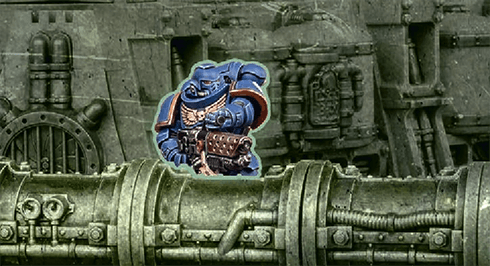
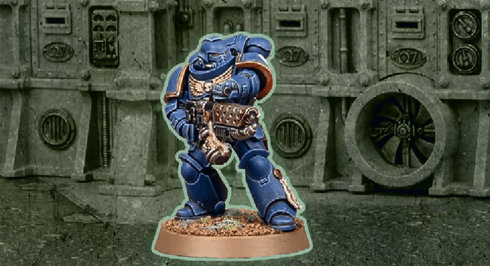
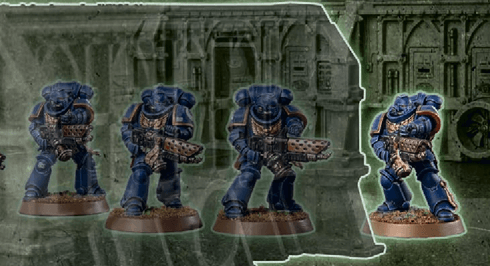
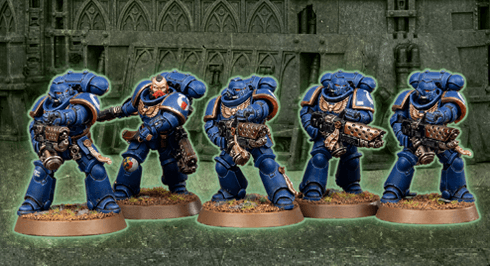
Other models and units can be either visible or fully visible to the observing model, as shown below. Note that terrain applies additional rules to visibility (13.07).
FAQ
| Q: | When checking line of sight from one model to another, is this drawn between the bases of those models, or between any part of them? |
| A: | Line of sight is drawn from any part of the observing model to any part of the model being observed. |
| Q: | When a model overhangs the edge of the battlefield, how does that affect its visibility? |
| A: | That model’s controlling player can draw line of sight from any part of that model that is not overhanging the edge of the battlefield. Their opponent can draw line of sight to any part of that model. |
- That model has the INFANTRY/BEASTS/SWARM keyword and is within a terrain area.
- That model is not fully visible to the attacking model due to one or more intervening terrain features and/or one or more intervening obscuring terrain areas (see below).
Each time a ranged attack targets a unit that has the benefit of cover against it, worsen the BS characteristic of that attack by 1.
FAQ
| Q: | When my unit shoots at another unit, how does it work if some models in the target unit are fully visible to some models in my unit, while others are within a terrain area/not fully visible? |
| A: | For each attacking model in your unit, determine whether the target unit has the benefit of cover, as described in Terrain and Visibility. In this scenario, the target unit will likely have the benefit of cover against some of the attacking models, but not all. This means that, in an example unit where all attacking models are using the same weapon, when you get to the Resolve Attacks step of the Attack Sequence, you will collect dice for attacks made by models against which the target unit has the benefit of cover separately from the dice for attacks made by models against which the target unit does not have the benefit of cover. |
Many deadly weapons can inflict fatal injuries on any foe, no matter their resilience.
Each time an attack made with a [LETHAL HITS] weapon results in a critical hit, you can choose for that attack to automatically wound the target.EFFECT: Your unit shoots as described in Making Attacks (04).
WHILE SHOOTING:
- You can only target one visible enemy unit within 24" of your unit (and only if it is an eligible target).
- Each attack only hits on an unmodified hit roll of 6 (irrespective of the attacking weapon’s BS characteristic or any modifiers). Those hits are not critical hits.
- You cannot re-roll hit rolls.
|
FAQ
| Q: | My attack has a rule that means it results in a critical hit on a hit roll of 4+. Does this work when snap shooting? |
| A: | Unless otherwise stated, no: when snap shooting, each attack only hits on a roll of 6. |
| Q: | My attack has a rule that means it results in a critical hit on a hit roll of 4+, and I would otherwise need a 5+ to hit. Does a 4+ hit? |
| A: | Yes, except when snap shooting: when snap shooting, each attack only hits on a roll of 6. |
The Death Guard are warriors of the Plague God Nurgle. Their bloated bodies are riddled with corruption, and their mere presence causes the foe to sicken and wither in the grip of supernatural diseases while the battlefield falls to rot and ruin around them.
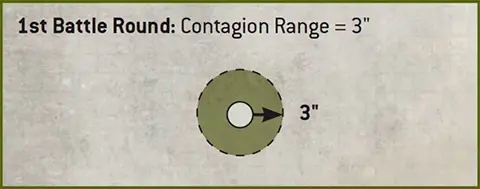
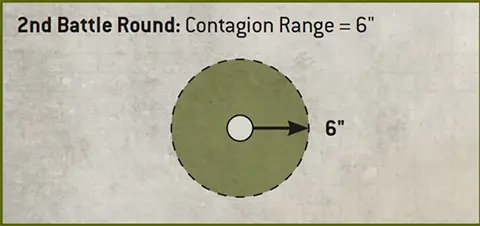
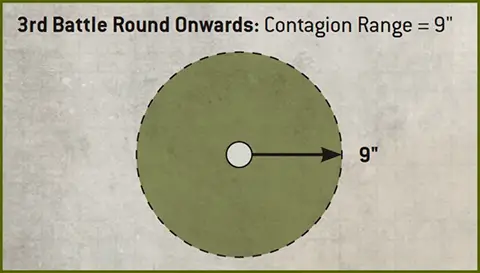
CONTAGION RANGE
Contagion Range changes over the course of the battle:
Contagion Range cannot be greater than 12" after modifiers.
During the Declare Battle Formations step, select one of the Plagues below. Until the end of the battle, while an enemy unit is Afflicted, subtract 1 from the Toughness characteristic of models in that unit, and that unit has the effect of your chosen Plague.
Skullsquirm Blight This horrifying affliction sees the minds and senses of the victim gnawed gradually away from within.
|
Rattlejoint Ague Limbs shuddering with fever palsy, bones turned brittle as glass, these warriors can barely act to defend themselves. Worsen the Save characteristic of models in this unit by 1. |
Scabrous Soulrot Victims of this insidious ailment become glassy eyed and morose as their very animus and essence decay. Worsen the Move, Leadership, and Objective Control characteristics of models in this unit by 1 (this rule can only worsen a model’s Objective Control characteristic to a minimum of 1). |
Errata
‘• Each time a model in this unit makes a ranged attack, enemy units have the benefit of cover against that attack.
• Each time a model in this unit makes a melee attack, subtract 1 from the Hit roll.’
The most potent weapons strike with such power that they make a mockery of armour and can cleave through several foes.
Each time an attack made with a [DEVASTATING WOUNDS] weapon results in a critical wound, the attack sequence for that attack ends and the target unit suffers a number of mortal wounds equal to the D characteristic of that weapon. These are inflicted after resolving any normal damage inflicted by those attacks.Mortal wounds inflicted by [DEVASTATING WOUNDS] weapons can damage a maximum of one model for each critical wound; any remaining mortal wounds inflicted by that attack are lost.
- If the target unit is an attached unit, use the highest T characteristic amongst bodyguard models in that unit that are on the battlefield.
- Use the highest T characteristic amongst models in that unit that are on the battlefield.
| ||||||||||||||||||||||||||||||
- Multiple Toughness Characteristics 05.02.01
When a model is destroyed, first resolve any rules that are triggered when it is destroyed, then it is removed from the battlefield. If any such rules apply, and if the model was destroyed as the result of an attack, unless otherwise stated, those rules are only resolved and that model is only removed after the attacking unit’s attacks have been resolved. Unless otherwise stated, destroyed models and units cannot use abilities or be selected or targeted by rules.
Some rules only trigger if an enemy model or unit was destroyed by you, or by a model or unit from your army. This means that the enemy model or unit was destroyed by an attack made by a model from your army, or by a player rule you have. Enemy models or units that are destroyed by any other means are not destroyed by you, or by a model or unit from your army.
Weapons powered by unstable and dangerous energy sources pose a substantial risk to the wielder and those that stand beside them.
Each time a unit is selected to shoot or selected to fight, after that unit has resolved all of its attacks, make a number of hazard rolls (06.03) for that unit equal to the number of [HAZARDOUS] weapons you selected in the Select Weapons step.FAQ
| Q: | I failed hazard rolls from [Hazardous] weapons, do those mortal wounds have to be allocated to the models with the [HAZARDOUS] weapons? |
| A: | No, you allocate the mortal wounds to the unit as per Mortal Wounds (06.02). (This represents Bob the guardsmen picking up his fallen squad mates plasma gun or that the twisting power of James the Chaos Sorcerer pulling his followers into the warp.) |
| Q: | If a rule says my unit must make a hazard roll does every model in the unit make a hazard roll? |
| A: | No, the unit would make 1 single hazard roll. |
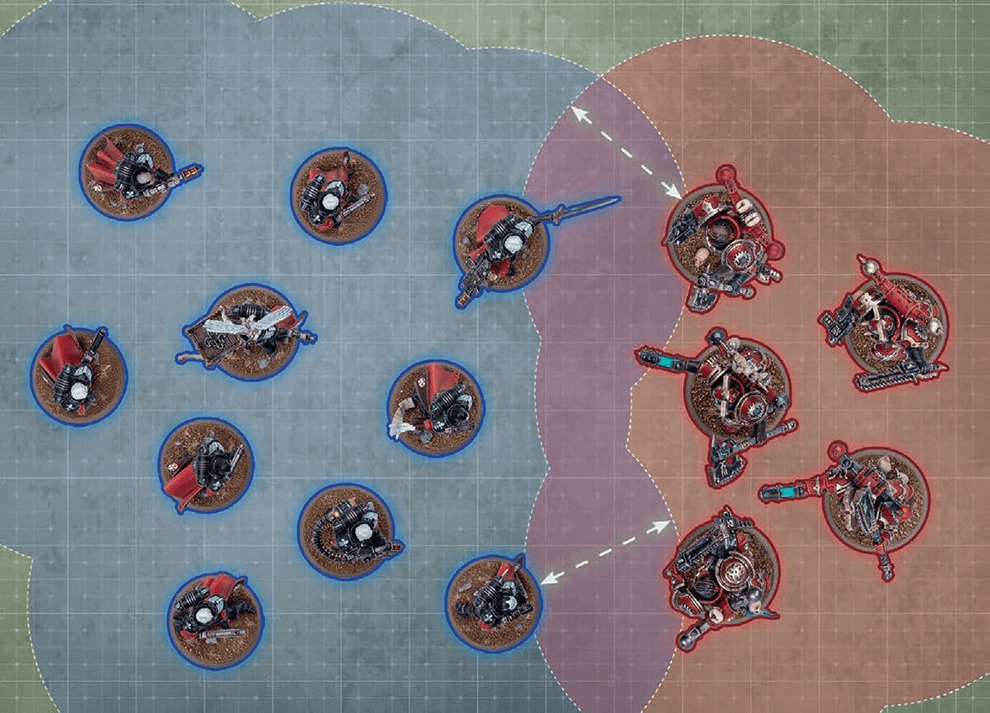
- While a friendly model is within engagement range of one or more enemy models, those models – and the units they belong to – are engaged with each other.
- While a unit contains no engaged models, that unit is unengaged.
FAQ
| Q: | Does my model or unit become engaged while moving through a enemy units engagement range during a move? |
| A: | No |
EFFECT: Your unit shoots as described in Making Attacks (04).
WHILE SHOOTING:
- You can only target one visible enemy unit within 24" of your unit (and only if it is an eligible target).
- Each attack only hits on an unmodified hit roll of 6 (irrespective of the attacking weapon’s BS characteristic or any modifiers). Those hits are not critical hits.
- You cannot re-roll hit rolls.
TARGET: One friendly unengaged unit (excluding TITANIC units).
EFFECT: Your unit shoots using snap shooting.
EFFECT: Your unit moves as described in Moving (03).
BEFORE MOVING: Make an advance roll by rolling one D6.
AFTER MOVING:
- Your unit must be unengaged.
- Until the end of the turn, unless otherwise stated, your unit is not eligible to declare a charge or start an action.
- Unengaged and made an advance move this turn.
- Has one or more [ASSAULT] weapons.
WHILE SHOOTING: You can only select [ASSAULT] weapons to make attacks with.
AFTER SHOOTING: Until the end of the phase, your unit is not eligible to start an action.
Folding stocks, shortened barrels or lightweight construction enable some weapons to be easily fired on the move.
Units containing one or more models with an [ASSAULT] weapon can shoot using assault shooting (10.05).- If that roll succeeds, that unit does not become battle-shocked.
- If that roll fails, that unit, and each model in it, is battle-shocked.
While a unit is battle-shocked:
- The Objective Control (OC) characteristic of all of its models is modified to ‘-’ (02.02).
- Its controlling player cannot target that unit with stratagems (15).
- It is not eligible to start an action (16), and any action it has started cannot be completed.
- Battlefield Morale 01.07.01
- Battle-shock Test 01.07.02
FAQ
| Q: | If a unit has a rule that allows it to start an action when it is battle-shocked can it also continue doing that action if it becomes battle-shocked after starting an action? |
| A: | Yes |
| Q: | If a unit becomes battle-shocked after starting an action does it stop performing that action? |
| A: | Yes |
Those possessed of lightning-fast reactions may strike before the opponent can react.
While every model in a unit has this ability, that unit is a Fights First unit.See the Resolve Fights First Combats step in the Fight phase (12.04).
Mighty heroes fight at the forefront of battle.
Before the battle, in the Muster Armies step, for each leader and support unit in your army, you can select one friendly bodyguard unit that unit can lead. That unit will then lead that bodyguard unit for the battle and form an attached unit with it.Unless otherwise stated, each bodyguard unit can only have one leader unit and one support unit attached to it.
EFFECT: Your unit is set up as described in Set Up (03.02).
BEFORE MOVING: Your unit is set up as described in Set Up (03.02).
WHILE MOVING: Set up your unit wholly within the set-up distance of one or more battlefield edges and more than 8" horizontally from all enemy units.
- Before the Third Battle Round: While doing so, no models can be set up within your opponent’s deployment zone.
There are many ways by which to deploy troops to the field of battle including tunnels, teleportation devices and other esoteric means of transportation.
Each time this unit makes an ingress move (20.04), if every model in this unit has this ability, it can be set up anywhere on the battlefield that is more than 8" horizontally from all enemy units, even if that is within your opponent’s deployment zone.- Create Groups: Divide all models in the target unit into the following groups, as many times as required:
- One group for each CHARACTER model.
- One group for all other models with the same W, Sv and InSv characteristics.
- Allocation Order: Declare the order in which those groups will have attacks allocated to them, applying all of the following:
- If a non-CHARACTER group contains a model that has lost one or more wounds, that group must be first in the allocation order.
- No CHARACTER group can be earlier in the allocation order than a non-CHARACTER group.
- CHARACTER groups containing a model that has lost one or more wounds must be earlier in the allocation order than CHARACTER groups containing no wounded models.
- Make Save Rolls: The opposing player makes one save roll for each attack that wounded the target by rolling one D6.
FAQ
| Q: | When declaring the allocation order of groups in my unit I have more than one non-CHARACTER groups that contain a model with a missing wound, how must I select the order? |
| A: | Those groups can be selected in an order of your choosing but must be in an order that makes them come before any non-CHARACTER groups that do not contain a model with a missing wound. |
| Q: | I have a unit being attacked with weapons that will modify some of their save rolls to be worse then 6 should I make those save rolls? |
| A: | Yes, because other models in your unit may have Sv’s that are better those models you’ve mentioned, this means that enough save rolls could be allocated to the those models that the rest of the results are not greater then the Sv’s of the other models in your unit. |
| Q: | Can I group or allocate a wound to a destroyed model? |
| A: | No. |
Heavy weapons are amongst the biggest guns on the battlefield, but require bracing to fire at full effect.
In your Shooting phase, each time an attack is made with a [HEAVY] weapon, add 1 to the hit roll if all of the following apply to the attacking unit:- That unit is unengaged.
- That unit was not set up on the battlefield this turn.
- No model in that unit has moved more than 3" this turn.
High-explosive rounds can fell several warriors in a single blast, but firing them too close to comrades is unwise.
Each time you gather attack dice for a [BLAST] weapon, add one additional attack dice for every five models that were in the target unit in the Select Targets step (rounding down).If this ability takes the form [BLAST X], each time you gather attack dice for such a weapon, add X additional attack dice for every five models that were in the target unit in the Select Targets step (rounding down) instead.
The INFANTRY and CHARACTER keywords are used in the following Death Guard datasheets:
Mighty heroes fight at the forefront of battle.
Before the battle, in the Muster Armies step, for each leader and support unit in your army, you can select one friendly bodyguard unit that unit can lead. That unit will then lead that bodyguard unit for the battle and form an attached unit with it.Unless otherwise stated, each bodyguard unit can only have one leader unit and one support unit attached to it.
Weapons powered by unstable and dangerous energy sources pose a substantial risk to the wielder and those that stand beside them.
Each time a unit is selected to shoot or selected to fight, after that unit has resolved all of its attacks, make a number of hazard rolls (06.03) for that unit equal to the number of [HAZARDOUS] weapons you selected in the Select Weapons step.Random Attacks: If a weapon has a random A characteristic, that characteristic is determined when generating attacks for that weapon at the Resolve Attacks step (04.03). If several weapons with random A characteristics are making identical attacks, generate the attacks for each of those weapons individually, and group them all together.
Random Damage: If a weapon has a random D characteristic, then each time an attack made with it inflicts damage, the controlling player determines that weapon’s characteristic when the opposing player has selected a model in the target unit to allocate that attack to.
When determining a random D characteristic, the dice roll made is called a damage roll.
Where a D characteristic includes an operator (e.g. a ‘+’, as in D6+1), the value after the operator is part of that D characteristic – it is not a modifier.
Other Random Characteristics: For all other characteristics, roll to determine the value on an individual, per-model or per-weapon basis each time that characteristic is required.
- Advance roll
- Charge roll
- Damage roll
- Hazard roll
- Hit roll
- Save roll
- Wound roll
- A roll to determine the number of attacks generated with a weapon.
TARGET: That unit or model.
EFFECT: You re-roll that roll. If you are rolling more than one dice together, select one of those dice to re-roll (excluding charge rolls, which you must re-roll in full).
TARGET: That unit.
EFFECT: That battle-shock roll is automatically successful.
RESTRICTIONS: You cannot use this stratagem more than once per battle.
TARGET: One friendly unit that is in strategic reserves (excluding AIRCRAFT).
EFFECT: Your unit makes an ingress move (20.04).
RESTRICTIONS: You cannot use this stratagem during the first battle round.
TARGET: One friendly unengaged unit within 12" of one or more enemy units. You can only select a VEHICLE unit if it is a CHARACTER/WALKER unit.
EFFECT: Resolve a charge with your unit (11.02). While doing so, before making the charge roll, you must select one of the following modes:
- Leap to Defend: When selecting charge targets, you can only select enemy units that made a charge move this phase and are within the maximum distance.
- Into the Fray:
- When making the charge roll, if the result is greater than 6 (after modifiers), change it to 6.
- When selecting charge targets, you can select any enemy units that are within 6" of your unit and within the maximum distance.
Precision attacks can pick high-value targets out in a crowd.
While resolving attacks made with one or more [PRECISION] weapons, at the start of the Allocation Order step (05.03), if the target unit contains one or more CHARACTER models visible to one or more of the attacking models, the active player can select one allocation group that contains one of those visible CHARACTER models. If they do, until those attacks are resolved, or until that CHARACTER group is destroyed (whichever happens first), that CHARACTER group is the current allocation group.TARGET: That CHARACTER unit.
EFFECT: Select one CHARACTER model in your unit. Until the end of the phase, that model’s melee weapons have the [PRECISION] ability.
TARGET: One friendly unit that is eligible to fight.
EFFECT: Until the end of the phase, your unit has the Fights First ability and it must be the next unit you select to fight (12.04).
TARGET: One Leader unit from your army and one friendly Bodyguard unit within 6" of it that it could normally be attached to.
EFFECT: Select one of your Leader unit’s Leader abilities. Until the start of your next Command phase, that Bodyguard unit is treated as being led by that Leader unit for the purposes of that Leader ability.
RESTRICTIONS: Once you target a unit with this Stratagem, that unit cannot be targeted with it again until your next Command phase.
TARGET: That unit or model from your army.
EFFECT: You re-roll that roll, test or saving throw.
TARGET: The unit from your army that Battle-shock test was just taken for (even though your Battle-shocked units cannot normally be affected by your Stratagems).
EFFECT: Your unit is treated as having passed that test instead, and is not Battle-shocked as a result.
TARGET: One unit from your army that has not been selected to shoot this phase.
EFFECT: Select one model in your unit that is equipped with a weapon with the [BLAST] ability. Until the end of the phase, when determining how many models are in the target unit for the purpose of that ability, include models that are not visible to the attacking model. In addition, attacks made with that weapon can be allocated to models that are not visible to the attacking model.
TARGET: One unit from your army that is within Engagement Range of one or more enemy units and that has not already been selected to fight this phase.
EFFECT: Your unit fights next.
One plague is never enough for this champion, and their repulsive form is a vessel for a mutated and semisentient disease capable of manifesting in varied contagious forms.
DEATH GUARD INFANTRY model only. (Once per battle, per army) In your Command phase, you can use this ability. If you do, select one of the Plague listed in Nurgle’s Gift. Enemy units within Contagion Range of this unit also have the effect of that Plague in addition to your army’s chosen Plague until the end of the battle.


Certain weapons are the bane of particular foes.
This ability always takes the form [ANTI-X Y+]. Each time an attack is made with an [ANTI] weapon, if the target unit has the keyword denoted by X, an unmodified wound roll of Y+ is a critical wound.TARGET: One TERMINATOR unit from your army.
EFFECT: Until the end of the phase, add 3" to the Contagion Range of models in your unit.
TARGET: One LORD OF VIRULENCE model from your army.
EFFECT: Select one objective marker within 30" of and visible to your model. Until the start of your next turn, while an enemy unit is within range of that objective marker, that unit is Afflicted.
TARGET: One TERMINATOR unit from your army that has not been selected to shoot this phase.
EFFECT: Until the end of the phase, ranged weapons equipped by models in your unit have the [ASSAULT] and [HEAVY] abilities.
TARGET: That TERMINATOR unit.
EFFECT: Select one enemy unit within Engagement Range of your unit, then roll one D6 for each model in your unit that is within Engagement Range of that enemy unit: for each 2+, that enemy unit suffers 1 mortal wound (to a maximum of 6 mortal wounds).
TARGET: One TERMINATOR unit from your army that has not been selected to fight this phase.
EFFECT: Until the end of the phase, each time a model in your unit makes an attack that targets an enemy unit (excluding MONSTERS and VEHICLES) you can re-roll the Hit roll.
TARGET: One TERMINATOR unit from your army that was selected as the target of one or more of the attacking unit’s attacks.
EFFECT: Until the end of the phase, each time a model in your unit is destroyed, if that model has not fought this phase, roll one D6. On a 4+, do not remove the destroyed model from play; it can fight after the attacking unit has finished making its attacks, and is then removed from play.
Rapid fire weapons are capable of long-ranged precision shots or controlled bursts at nearby targets.
This ability always takes the form [RAPID FIRE X]. Each time you gather attack dice for a [RAPID FIRE] weapon, add X additional attack dice if the target unit was within half range of that weapon in the Select Targets step.Example: If a [RAPID FIRE 1] weapon with an A characteristic of 1 targets a unit that is within half range, you would gather one additional attack dice for that weapon (for a total of two for that weapon).
Dual weapons are often grafted to the same targeting system for greater lethality.
Each time an attack is made with a [TWIN-LINKED] weapon, you can re-roll the wound roll.So grotesque and monstrous is this champion’s aspect that it fills the enemy with unreasoning dread simply to look upon him.
TERMINATOR model only. At the start of the Fight phase, each enemy unit within Engagement Range of the bearer’s unit must take a Battle-shock test.
A fanatical worshipper of Nurgle and a talented orator, this champion can infect their followers with the urgent need to forge into battle and spread the Plague God’s blessings to all.
TERMINATOR model only. While the bearer is leading a unit, add 1" to the Movement characteristic of models in that unit and you can re-roll Advance rolls made for that unit.
This armoured helm was crafted by the Daemon Prince Vermifulgus the Pestilent and carries his squirming enchantments. It manifests its wearer's will as roaring swarms of plump flies that whirl about their creator like an occluding shroud or descend on the foe to blind eyes, clog sensors and spread revolted panic.
TERMINATOR model only. While the bearer is leading a unit, models in that unit cannot be targeted by ranged attacks unless the attacking model is within 18".
By invoking the power of this ancient talisman, the bearer can rot a sagging rent in reality and step through the Warp to burst forth elsewhere amidst a gushing sluice of foul fluids.
TERMINATOR model only. Once per battle, at the end of your opponent’s turn, if the bearer’s unit is not within Engagement Range of one or more enemy units, you can remove it from the battlefield and place it into Strategic Reserves.